Rejoignez-nous pour un voyage dans le monde des livres!
Ajouter ce livre à l'électronique
Grey
Ecrivez un nouveau commentaire Default profile 50px
Grey
Abonnez-vous pour lire le livre complet ou lisez les premières pages gratuitement!
All characters reduced
Elizabethan Lover - Elizabethan Romance Adventure - cover

Elizabethan Lover - Elizabethan Romance Adventure

Barbara Cartland

Maison d'édition: Barbara Cartland

  • 0
  • 3
  • 0

Synopsis

Having sailed with Sir Francis Drake, swashbuckling privateer Rodney Hawkhurst yearns for a galleon of his own with which to plunder the Spanish Main in the name of Queen Elizabeth. Seeking investment from Sir Harry Gillingham, he has a fleeting encounter with an elfin, tomboyish golden-red-haired beauty ? Sir Harry?s youngest daughter Lizbeth ? and is bewitched by her limpid green eyes. Yet it is fair and golden-haired elder sister Phillida with whom he first falls in love... Granted his finances on the condition that Sir Harry?s weak, possibly even traitorous son sails with him in the hope that the mission will make him a man, Rodney embarks on a voyage of blood, honour and glory in which he gains great riches but loses his heart, not once, but twice. The risks are great but so are the rewards: wealth beyond compare and, as Rodney finally discovers, a greater, deeper, more passionate love than he ever imagined possible.
Disponible depuis: 14/10/2012.
Longueur d'impression: 198 pages.

D'autres livres qui pourraient vous intéresser

  • Dramatic Rise and Fall of the Portuguese Empire The: The History and Legacy of Portugal’s Mercantile Empire across the World - cover

    Dramatic Rise and Fall of the...

    Editors Charles River

    • 0
    • 0
    • 0
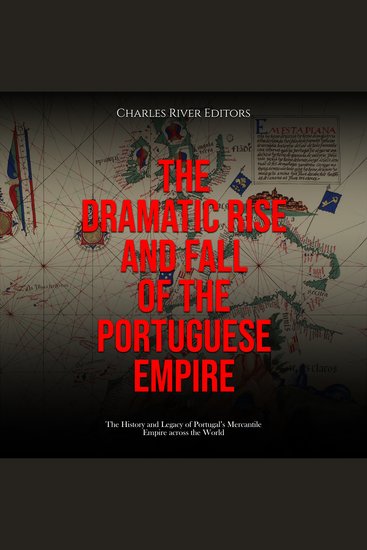
    Trade was able to increase in Europe around the world due to more effective ships being introduced, and some of the improvements that were made to the ships were first introduced by the Chinese. The introduction of multiple mast ships and the sternpost rudders allowed the ships to travel quicker and be more maneuverable. By the start of the 15th century, ships were now much larger and able to support long distance travel with a minimum number of crew aboard.  
    	With that, the Portuguese started exploring the west coast of Africa and the Atlantic under orders from Prince Henry the Navigator. At this point, Europeans had not yet been capable of navigating completely around Africa since the ships being built were not yet fully capable of being able to sail very far from the coast and navigation in open waters was difficult, but the Portuguese continued pushing down the western African coast looking for ways to bypass the Ottomans and Muslims of Africa who had been making overland trade routes difficult. In 1451, Prince Henry the Navigator helped fund and develop a new type of ship, the caravel, that featured triangular lateen sails and would be able to travel in the open ocean and sail against the wind. In 1488, Bartholomew Diaz rounded the southern tip of Africa, named the Cape of Good Hope by King John of Portugal, and entered the Indian Ocean from the Atlantic.  
    	The Portuguese found access to the trade regions that they had been searching for, but sailing from Portugal to India and beyond would require too many resources to travel with at once. To remedy this problem, Portugal began establishing a number of forts and trading posts along the route. The Portuguese were able to establish a fort on the west coast of India, Fort Manuel, in 1500, and in 1505 a fort was erected off the coast of Tanzania, thus beginning a trend of European colonization in Africa and Asia that would last for the next 400 years. 
    Voir livre
  • Fodder & Drincan - Anglo-Saxon Culinary History - cover

    Fodder & Drincan - Anglo-Saxon...

    Emma Kay

    • 0
    • 0
    • 0
    The book is an entertaining historical account of Anglo-Saxon cooking, covering the centuries from 400 to 1066 CE.The author gives us evidence based information from historical artefacts and plants, showing what our early ancestors had at their disposal.
    Voir livre
  • Free Speech - What Everyone Needs to Know® - cover

    Free Speech - What Everyone...

    Nadine Strossen

    • 0
    • 0
    • 0
    This concise but comprehensive book lays out specific answers to myriad topical questions about free speech law, and also general explanations of how and why the law distinguishes between protected and punishable speech. 


    The book focuses on modern First Amendment law, explaining the historic factors that propelled its evolution in a more speech-protective direction—in particular, the Civil Rights Movement. It highlights the many cases, involving multiple issues, in which robust speech-protective principles aided advocates of racial justice and other human rights causes. The book also shows how these holdings reflect universal, timeless values, which have been incorporated in many other legal systems, and have inspired countless thinkers and activists alike. 


    Without oversimplifying the complexities of free speech law, the book's lively question-and-answer format summarizes this law in an understandable, interesting, and memorable fashion. It addresses the issues in a logical sequence, presenting facts and eloquent language from landmark Supreme Court opinions. It will be illuminating to a wide range of listeners, from those who know nothing about free speech law, to those who have studied it but seek a well-organized summary of major doctrinal rules, as well as insights into their background, rationales, and interconnections.
    Voir livre
  • Outlines of Pyrrhonism - cover

    Outlines of Pyrrhonism

    Sextus Empiricus

    • 0
    • 0
    • 0
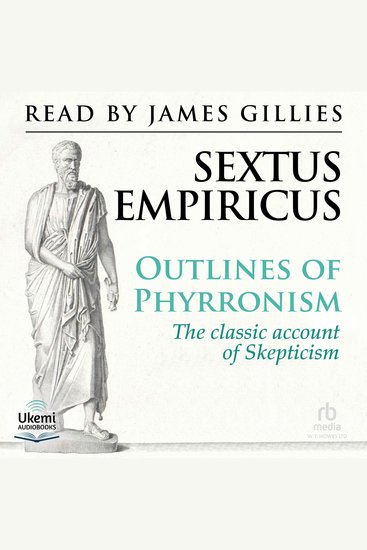
    Throughout history philosophers have sought to define, understand, and delineate concepts important to human well-being. One such concept is knowledge. Many philosophers believed that absolute, certain knowledge, is possible—that the physical world and ideas formulated about it could be given solid foundation unaffected by the varieties of mere opinion. 
     
    Sextus Empiricus stands as an example of the skeptic school of thought whose members believed that knowledge was either unattainable or, if a genuine possibility, the conditions necessary to achieve it were next to impossible to satisfy. In other words, in the absence of complete knowledge, one must make do with the information provided by an imperfect world and conveyed to the mind through sense impressions that can often deceive us. Throughout his life Sextus Empiricus entered into intellectual combat with those who confidently claimed to possess indubitable knowledge. For skeptics, the best one can hope to achieve is a reasonable suspension of judgment—remaining ever mindful that claims to knowledge require careful scrutiny, thoughtful analysis, and critical review if we are to prevent ourselves and others from plunging headlong into mistaken notions.
    Voir livre
  • Gavin at War - The World War II Diary of Lieutenant General James M Gavin - cover

    Gavin at War - The World War II...

    Lewis Sorley

    • 0
    • 0
    • 0
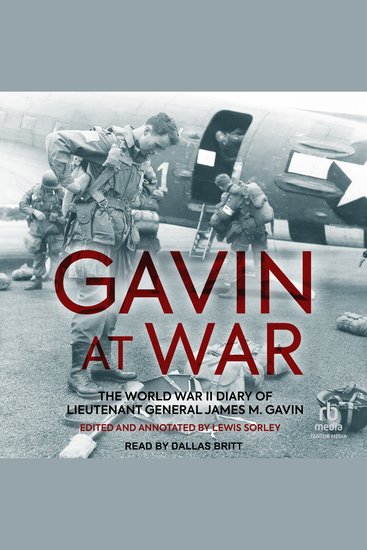
    Lieutenant General James Gavin, commander of the 82nd Airborne Division during WWII, is one of the best-known figures of the war. Beginning as the commander of the 505th Parachute Combat Team that spearheaded the American assault on Sicily in July 1943, Gavin advanced to division command and finally command of US forces in Berlin. He kept a wartime diary that starts in April 1943, as the unit was preparing to go to northern Africa and continues through to his final entry on September 1, 1945, during the occupation of Berlin. 


    During the war years, Gavin came into close contact with virtually all the leading airborne commanders and many others who would advance to the top levels of Army leadership. His diary includes observations on fellow military and political leaders, army operations, and the general's personal life. Gavin was an officer who led by example: on four combat jumps, he was the first man out the door. 


    For decades, Gavin kept the existence of the journal a secret; the general's family discovered it among his belongings after his death. Editor Lewis "Bob" Sorley has worked closely with the Gavin family and the Army Heritage Center to prepare the diary for publication. His edited and annotated version includes a prologue and epilogue to frame the entries within the wider scope of the general's life.
    Voir livre
  • Thinking Fast and Slow: Book Summary & Analysis - cover

    Thinking Fast and Slow: Book...

    Briefly Summaries

    • 0
    • 0
    • 0
    This is a concise summary and analysis of Thinking, Fast and Slow, by Daniel Kahneman. It is not the original book and is not affiliated with or endorsed by Daniel Kahneman. Ideal for those seeking a quick and insightful overview.
     
    This groundbreaking book explores the two systems that drive human thought: the fast, intuitive, and emotional system and the slow, deliberate, and logical system. Through engaging examples and real-world applications, it reveals the biases and cognitive errors that shape our decisions, from everyday choices to major life decisions. A must-read for anyone interested in understanding how the mind works and how to improve decision-making.
    Voir livre