Begleiten Sie uns auf eine literarische Weltreise!
Buch zum Bücherregal hinzufügen
Grey
Einen neuen Kommentar schreiben Default profile 50px
Grey
Jetzt das ganze Buch im Abo oder die ersten Seiten gratis lesen!
All characters reduced
Studies of Manners: Scenes from a Courtesan's Life - Enriched edition - cover

Studies of Manners: Scenes from a Courtesan's Life - Enriched edition

Balzac Honoré de

Übersetzer Ellen Marriage

Verlag: Musaicum Books

  • 0
  • 0
  • 0

Beschreibung

In 'Studies of Manners: Scenes from a Courtesan's Life' by Honoré de Balzac, readers are immersed in the intricate world of Parisian society during the early 19th century. Balzac's literary style is rich with detail, offering a vivid portrayal of the political, social, and cultural norms of the time. Through a series of interconnected vignettes, the book delves into the lives of courtesans, providing insight into their relationships, ambitions, and struggles for survival in a judgmental society. Balzac's prose is masterful, as he seamlessly weaves together multiple storylines to create a compelling narrative that sheds light on the complexities of human nature. This book is a prime example of Balzac's realism and his keen observation of society. The author's ability to capture the nuances of human behavior and societal hierarchies makes 'Studies of Manners' a timeless classic that continues to resonate with readers today. Recommended for those interested in exploring the intricacies of human relationships and the dynamics of society in a bygone era.

In this enriched edition, we have carefully created added value for your reading experience:
- A comprehensive Introduction outlines these selected works' unifying features, themes, or stylistic evolutions.
- The Author Biography highlights personal milestones and literary influences that shape the entire body of writing.
- A Historical Context section situates the works in their broader era—social currents, cultural trends, and key events that underpin their creation.
- A concise Synopsis (Selection) offers an accessible overview of the included texts, helping readers navigate plotlines and main ideas without revealing critical twists.
- A unified Analysis examines recurring motifs and stylistic hallmarks across the collection, tying the stories together while spotlighting the different work's strengths.
- Reflection questions inspire deeper contemplation of the author's overarching message, inviting readers to draw connections among different texts and relate them to modern contexts.
- Lastly, our hand‐picked Memorable Quotes distill pivotal lines and turning points, serving as touchstones for the collection's central themes.
Verfügbar seit: 18.12.2019.
Drucklänge: 425 Seiten.

Weitere Bücher, die Sie mögen werden

  • Identity and Violence - The Illusion of Destiny - cover

    Identity and Violence - The...

    Amartya Sen

    • 0
    • 0
    • 0
    "One of the few world intellectuals on whom we may rely to make sense out of our existential confusion." —Nadine Gordimer 


    In this sweeping philosophical work, Amartya Sen proposes that the murderous violence that has riven our society is driven as much by confusion as by inescapable hatred. Challenging the reductionist division of people by race, religion, and class, Sen presents an inspiring vision of a world that can be made to move toward peace as firmly as it has spiraled in recent years toward brutality and war.
    Zum Buch
  • Adoption - What You Should Know - cover

    Adoption - What You Should Know

    Janine Myung Ja

    • 0
    • 0
    • 0
    Before you spend up to $75,000 in hidden child-adoption fees, adult adoptees worldwide have investigated the history of domestic and international adoption and have started a movement to end the crisis of child trafficking. You can gain a bird's-eye view on adoption secrets before you transfer funds to the adoption agency. This information is available for a short time only. 
    This research book has been divided into four short, easy-to-read sections, revealing the making of the current child welfare system throughout time: starting in Europe (referred to as the European Child Migration Schemes); then spreading to America (known as the Orphan Train Movement); into Asia (called the Evangelical Baby "Swoop" Era), to what's trending today: Africa. 
    The pioneers who built and profited from the industry continue to deny adoptees access to documents that could lead them back to their families. This book protects you against adoption profiteers and traffickers who profess God is on their side. It summarizes the inception and expansion of the adoption industry, focusing on its roots and consequences kept from public awareness. Discover the history of adoption from another angle--a view adoption agencies will never tell you. The findings have been called mind-blowing! 
    How would you like to be given a new identity and removed from your siblings--never to be permitted to contact them again, even upon death? This is just one of many red tape adoptees are forced to contend with because of adoption. Inspired by a Haitian adoptee who died of heart failure after learning that he had been trafficked to France for overseas adoption but was never able to acquire justice. NOT recommended for adoption profiteers, anti-abortion fundamentalists, evangelicals, or individuals against equal rights for adult adoptees. Available in a textbook format as Adoption History: An Adoptee's Research into Child Trafficking (VANCE).
    Zum Buch
  • Good Mourning - Honest conversations about grief and loss - cover

    Good Mourning - Honest...

    Sally Douglas, Imogen Carn

    • 0
    • 0
    • 0
    From the creators of the popular podcast Good Mourning, this support-group-in-a-book helps readers navigate grief and loss with warmth, humour, raw honesty and the affirmation that they are not alone. 
     
    Sally Douglas and Imogen Carn met after the sudden deaths of their mothers only months apart. Their experiences led them to launch a podcast, and their no-holds-barred, relatable approach to talking about grief sparked a growing following of people eager to have honest conversations about what it really feels like to deal with loss. 
     
    Good Mourning is a compassionate survival guide for anyone dealing with grief - the kind of book Sal and Im wish they'd had to help them through the dark times. Here they shine a light on the many ways grief can impact our lives (hello ugly crying, exhaustion and 'grief brain'). Along with expert advice from clinical psychologist Tamara Cavenett and warm words and insights from hundreds of others who've experienced grief, the authors offer practical tips on coping with isolation and loneliness, navigating grief at work, managing milestones and so much more. 
     
    Whether you're one month in or ten years down the track, Good Mourning will help you make sense of life after loss - and know that you're not alone. 
     
    'A comforting support group in book form. A must-read for grievers.' ELLIDY PULLIN 
     
    ‘A wise guide for anyone who has loved and lost.’ INDIRA NAIDOO, author of The Space Between the Stars 
     
    'Good Mourning is a gift - the package you leave on the doorstep of anyone rocked by grief when you don't have the words.' JESSIE STEPHENS, author of Heartsick
    Zum Buch
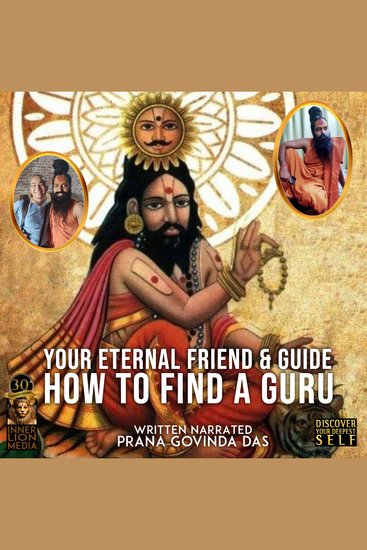
  • How To Find A Guru - cover

    How To Find A Guru

    Prana Govinda Das

    • 0
    • 0
    • 0
    Noted internationally known Self-help advocate and teacher of devotional yoga Prana Govinda Das was born in Liverpool, England in 1968 admittedly a pretty good year for all things bright and beautiful. He says, "From as early as I can remember I had an unquenchable thirst for knowledge, and a desire to understand the true nature of man and this world we live in. I was also always seeking out people who could answer all the questions I had about life, the universe, and everything." After studying film production in the early nineties Prana was able to fulfill his lifelong desire to travel to India. admittedly his first trip changed his life completely and forever. "At that point," He recalls, "my thirst for material knowledge turned to a desire to understand the spiritual side of life. For the next six years, I returned frequently, where I studied many different paths of Hinduism, Buddhism, and other forms of yoga and meditation. However, even after learning and experiencing so much I was still left incomplete." in 2001 during the young man's sixth trip to India, he traveled to Vrindavan, a holy town associated with Lord Krishna south of Delhi. It was there he met his spiritual guide, and mentor Srila Bhaktivedanta Narayana Goswami. Some twenty years on, Prana has been resident in his teacher's temples all over the world, particularly in India, Australia, America, and Europe. Welcome then to the inspirational, engrossing, all-inclusive teachings of Prana Govinda Das.
    Zum Buch
  • Joseph Stalin - cover

    Joseph Stalin

    Kelly Mass

    • 0
    • 0
    • 0
    From 1924 till his death in 1953, Joseph Vissarionovich Stalin was a Georgian revolutionary and Soviet politician who ruled the Soviet Union. He was General Secretary of the Communist Party of the Soviet Union from 1922 to 1952 and Chairman of the Soviet Union's Council of Ministers from 1941 to 1953. In spite of ruling the nation as part of a collective management, he ultimately combined power and ended up being the totalitarian of the Soviet Union by the 1930s. Stalin, a communist dedicated to Lenin's grasp of Marxism, formalized these concepts as Marxism-- Leninism, while his personal policies were called Stalinism.Stalin was born into an penniless family in Gori, Georgia, under the Russian Empire. He participated in the Tbilisi Spiritual Academy before signing up with the Marxist Russian Social Democratic Labour Party. He went on to modify the party's paper, Pravda, and used thefts, kidnappings, and security rackets to raise cash for Vladimir Lenin's Bolshevik faction. He was usually imprisoned and banished within the nation. Stalin ended up being a member of the freshly formed Communist Party's ruling Politburo when the Bolsheviks took power at the time of the October Revolution and developed a one-party state. Following Lenin's death in 1924, Stalin got control of the nation after serving in the Russian Civil War and managing the development of the Soviet Union in 1922. Socialism in one nation ended up being a major component of the party's concept under Stalin. The nation observed farming collectivization and quick industrialization because of the Five-Year Plans launched under his management, leading to a central command economy. That led to serious food production disturbances, which added to the starvation of 1932-- 33. Between 1934 and 1939, Stalin carried out the Great Purge to rid the nation of declared "working-class adversaries."
    Zum Buch
  • Answer to Job - cover

    Answer to Job

    C. G. Jung

    • 0
    • 0
    • 0
    Of all the books of the Bible, few have had more resonance for modern listeners than the Book of Job.  
     
    For a world that over the past century has witnessed horrors the like of which could not have been imagined by earlier generations, Job’s cries of despair and incomprehension are all too recognisable. The visionary psychotherapist Carl Gustav Jung understood this and responded with this remarkable book, in which he set himself face to face with 'the unvarnished spectacle of divine savagery and ruthlessness'.  
     
    Jung perceived in the hidden recesses of the human psyche the cause of a crisis that plagues modern humanity and leaves the individual, like Job, isolated and bewildered in the face of impenetrable fortune. By correlating the transcendental with the unconscious, Jung, writing not as a biblical scholar but 'as a layman and physician who has been privileged to see deeply into the psychic life of many people', offers a way for every listener to come to terms with the divine darkness which confronts each individual.  
     
    Carl Gustav Jung (1875-1961) founded the analytical school of psychology and developed a radical new theory of the unconscious. Translated by R. F. C. Hull.
    Zum Buch