Join us on a literary world trip!
Add this book to bookshelf
Grey
Write a new comment Default profile 50px
Grey
Subscribe to read the full book or read the first pages for free!
All characters reduced
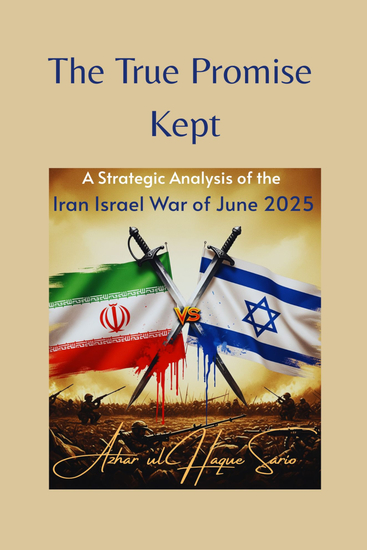
The True Promise Kept - A Strategic Analysis of the Iran Israel War of June 2025 - cover

The True Promise Kept - A Strategic Analysis of the Iran Israel War of June 2025

Azhar ul Haque Sario

Publisher: Azhar Sario Hungary

  • 0
  • 0
  • 0

Summary

Was it a calculated masterstroke or a reckless gamble that pushed the Middle East to the brink?


This book unpacks the explosive 12-day war between Iran and Israel in June 2025. It starts with the final, failed diplomatic efforts and the intelligence debates that set the stage for conflict. You'll read about Israel's massive opening attack, "Operation Rising Lion," which aimed to wipe out Iran's top military leaders and nuclear scientists in a single blow. The book details the audacious assassination campaign and the covert Mossad operations that paved the way for Israeli jets. Then, it shifts to Iran's stunning retaliation, "Operation True Promise III." Discover how Iran unleashed hundreds of advanced missiles, including new hypersonic weapons, overwhelming Israel's famed Iron Dome. The analysis covers the intense battle in the skies, the sophisticated drone warfare, and the parallel conflict waged in cyberspace by hackers and state actors. It examines the immense economic cost for both nations, a key factor driving the push for peace. The story climaxes with the dramatic American intervention, "Operation Midnight Hammer," and the high-stakes diplomatic maneuvers that led to a fragile, chaotic ceasefire.


What makes this book different is its balanced, multi-faceted perspective, moving beyond simplistic narratives of good versus evil. While other accounts might focus solely on military hardware, this analysis delves into the strategic thinking, the political calculations, and the human cost on both sides. It presents the official "victory" narratives from both Tehran and Tel Aviv, but then critically examines the deeper realities—the pyrrhic nature of Israel's success and the resilient deterrence demonstrated by Iran. By weaving together military strategy, economic pressures, cyber warfare, and international diplomacy, this book provides a uniquely comprehensive understanding of why the war happened, how it was fought, and how it has fundamentally reshaped the balance of power in the Middle East. It offers a clear-eyed look at the new, more volatile reality of direct state-on-state conflict that now defines the region.


Disclaimer: The author of this work is not affiliated with, sponsored by, or endorsed by any of the individuals, organizations, or entities mentioned. All trademarks, service marks, and company names are the property of their respective owners. This book is an independent work of strategic analysis and commentary, and any references to trademarked names or protected intellectual property are made under the principles of nominative fair use for the purpose of discussion, criticism, and analysis.
Available since: 06/26/2025.
Print length: 198 pages.

Other books that might interest you

  • The Status and Recognition of Post-1992 Transnistria - An Investigation of the Case for de jure Independence - cover

    The Status and Recognition of...

    Richard Colbey

    • 0
    • 0
    • 0
    The only book in English on the subject. Of topical relevance in the context of the current conflict in Ukraine.
    Show book
  • Political Choice in a Polarized America - How Elite Polarization Shapes Mass Behavior - cover

    Political Choice in a Polarized...

    Joshua N. Zingher

    • 0
    • 0
    • 0
    What motivates citizens to support one party over the other? Do they carefully weigh all of the relevant issues and assess which party or candidate best matches their own positions? Or do people look at politics as something more akin to a team sport—the specifics do not matter as long as you know what side your team is on? Answering these questions requires us to think about how much the average American knows about politics. Many scholars of public opinion believe that the majority of Americans only pay passing attention to politics. Thus the electorate's apparent lack of political competence presents a direct challenge to normative theories of democracy. How are citizens supposed to exert control over the government if they have no idea what is going on? 


    In Political Choice in a Polarized America, Joshua N. Zingher argues that these fears are overblown. Not only do individuals have core beliefs about what the government should or should not do, but individuals have become more likely to support the party that best matches their policy attitudes by both identifying as a member of that party and voting for that party in elections. However, as Zingher demonstrates, voters' ability to match their attitudes to a party or candidate varies according to signals sent by elites and increases as parties become more polarized.
    Show book
  • The Subversive Seventies - cover

    The Subversive Seventies

    Michael Hart

    • 0
    • 0
    • 0
    In The Subversive Seventies, Michael Hardt sets out to show that popular understandings of the political movements of the seventies—often seen as fractious, violent, and largely unsuccessful—are not just inaccurate, but foreclose valuable lessons for the political struggles of today. While many accounts of the 1970s have been written about the regimes of domination that emerged throughout the decade, Hardt approaches the subversive from the perspectives of those who sought to undermine the base of established authority and transform the fundamental structures of society. In so doing, he provides a novel account of the theoretical and practical projects of liberation that still speak to us today, too many of which have been all but forgotten. 


    The movements of the seventies responded directly to emerging neoliberal frameworks and other structures of power that continue to rule over us today. They identified and confronted political problems that remain central for us. The 1970s, in this sense, marks the beginning of our time. Looking at a wide range of movements around the globe, from the United States, to Guinea Bissau, South Korea, Chile, Turkey, and Italy, The Subversive Seventies provides a reassessment of the political action of the 1970s that sheds new light not only on our revolutionary past but also on what liberation can be and do today.
    Show book
  • Wage Labor And Capital - cover

    Wage Labor And Capital

    Karl Marx

    • 0
    • 0
    • 0
    Originally written as a series of newspaper articles in 1847, Wage-Labor and Capital were intended to give an overview of Marx’s central theories regarding the economic relationships between workers and capitalists. These theories outlined include the Marxian form of the Labour Theory of Value, which distinguishes “labor” from “labor-power”, and the Theory of Concentration of Capital, which states that capitalism tends towards the creation of monopolies and the disenfranchisement of the middle and working classes. These theories were later elaborated in Volume 1 of Capital, published in 1867. Karl Heinrich Marx FRSA was a German philosopher, a critic of political economy, economist, historian, sociologist, political theorist, journalist, and socialist revolutionary. His best-known titles are the 1848 pamphlet The Communist Manifesto and the four-volume Das Kapital.
    Show book
  • China's World View - Demystifying China to Prevent Global Conflict - cover

    China's World View -...

    David Daokui Li

    • 0
    • 0
    • 0
    Writing in response to the growing anti-Chinese sentiment and alarmed by the threat of war, Dr. David Daokui Li pulls from his wealth of firsthand experience to demystify contemporary Chinese society and advocate for understanding between China and the West. In this urgently needed and fascinating book, he explains the inner workings of a rising superpower to help the world understand how it works—and how to work with it. 


    In Li's hands, an economic and political system that often baffles Westerners becomes coherent, sophisticated, and logical. He begins by explaining how two thousand years of history—from Confucian philosophy and ancient imperial dynasties to Communist Party chairmen from Mao to Deng Xiaoping—profoundly influence China's leadership today. Li brings the listener into high-level meetings he attended with figures including Xi Jinping, showing China's approach to governance. 


    In demystifying contemporary Chinese society, Li helps listeners reconceptualize contemporary China and the implications of its growth. He asserts that China's rise will be beneficial for the global order, holding out the hope that with shared understanding and mutual learning the Chinese and Western systems will eventually find a way to peacefully coexist.
    Show book
  • Why the Nineties Matter - cover

    Why the Nineties Matter

    Terry H. Anderson

    • 0
    • 0
    • 0
    In Why the Nineties Matter, Terry Anderson provides a broad-ranging history of America in that decade. Not simply a chronological account, the book focuses on key trends that either began or gained steam then and which have had lasting effects until this day. Threading together politics, economic transformations, and sociocultural trends, he focuses on what mattered most in retrospect. Violent and extremist white nationalism intensified greatly in that decade, evidenced by the Oklahoma City bombing and the rise of the militia movement. The defection of the white working class from the Democratic Party began then as the Democrats expanded free trade and tried to cultivate professional-class Americans. Racial and gender politics transformed, birthing new movements that would grow in influence in the next century. Social media first emerged in the 1990s too, and its impact on all aspects of life cannot be underestimated. In foreign policy, America's long wars in the Middle East and Afghanistan have roots in US policies in the 1990s. And the current standoff between the US and Russia traces back to disagreements over NATO expansion a quarter century ago. 


    A pithy interpretive history of a decade that matters more than most think, this book will be an essential guide to anyone trying to understand that era.
    Show book