Junte-se a nós em uma viagem ao mundo dos livros!
Adicionar este livro à prateleira
Grey
Deixe um novo comentário Default profile 50px
Grey
Assine para ler o livro completo ou leia as primeiras páginas de graça!
All characters reduced
Beyond Thank You - The Transformative Power of Authentic Recognition - cover
LER

Beyond Thank You - The Transformative Power of Authentic Recognition

Azhar ul Haque Sario

Editora: Royal Co.

  • 0
  • 0
  • 0

Sinopse

Ever felt like a simple "thank you" just wasn't enough?  This book dives deep into the power of authentic recognition, going beyond surface-level gratitude to explore how it transforms individuals, teams, and entire organizations.


We'll unlock the secrets of the brain, exploring how appreciation activates reward centers and fuels motivation. Discover the fascinating world of mirror neurons and how praise can become contagious.  Uncover the psychology behind different rewards, from a heartfelt note to greater autonomy.  Learn how to craft recognition programs that truly resonate, align with your values, and celebrate every milestone.  We'll even tackle tricky topics like navigating generational differences and ethical social media recognition.


This isn't just another book on employee engagement. We're bridging the gap between neuroscience, psychology, and real-world workplace dynamics.  "Beyond Thank You"  gives you the tools to cultivate a culture of appreciation that boosts retention, skyrockets performance, and fosters genuine human connection in today's ever-changing workplace.  Get ready to unleash the transformative power of authentic recognition!
Disponível desde: 07/01/2025.
Comprimento de impressão: 229 páginas.

Outros livros que poderiam interessá-lo

  • Sumerians - Their History Religion and Inventions - cover

    Sumerians - Their History...

    Kelly Mass

    • 0
    • 0
    • 0
    The Sumerians were the people from Sumer, the first recognized society in the historic area of southern Mesopotamia (now southern Iraq), developed throughout the 6th and 5th centuries BC throughout the Chalcolithic and early Bronze Ages. In addition to age-old Egypt, the Caral-Supe culture, the Indus Valley civilization, the Minoan civilization, and age-old China, it is also one of the world's early civilizations. Sumerian farmers who lived along the Tigris and Euphrates valleys grew a great deal of grain and other items, which allowed them to establish metropolitan towns. Before 3000 BC, there was proto-writing. The earliest files date from between 3500 and 3000 BC and are from the cities of Uruk and Jemdet Nasr. 
    Most historical analysts believe that Sumer was first completely occupied between c. 5500 and 4000 BC by a West Asian population who spoke the Sumerian language, a non-Semitic and non-Indo-European agglutinative language isolate (as evidenced by the names of cities, rivers, standard professions, and so on). It wasn't an inflected language, in contrast to its Semitic cousins. 
    Go ahead and get stared, and get to know more about the Sumerians, what they did, who they were, and why so many people know so little about them.
    Ver livro
  • The Dress Diary - Secrets from a Victorian Woman's Wardrobe - cover

    The Dress Diary - Secrets from a...

    Kate Strasdin

    • 0
    • 0
    • 0
    In 1838, a young woman was given a diary on her wedding day. Collecting snippets of fabric from a range of garments—some her own, others donated by family and friends—she carefully annotated each one, creating a unique record of their lives. Her name was Mrs. Anne Sykes. 


    Nearly two hundred years later, the diary fell into the hands of Kate Strasdin, a fashion historian and museum curator. Using her expertise, Strasdin spent the next six years unraveling the secrets contained within the album's pages, and the lives of the people within. Her findings are remarkable. Piece by piece, she charts Anne's journey from the mills of Lancashire to the port of Singapore before tracing her return to England in later years. Fragments of cloth become windows into Victorian life: pirates in Borneo, the complicated etiquette of mourning, poisonous dyes, the British Empire in full swing, rioting over working conditions, and the terrible human cost of Britain's cotton industry. This is life writing that celebrates ordinary people: not the grandees of traditional written histories, but the hidden figures, the participants in everyday life. Through the evidence of waistcoats, ball gowns, and mourning outfits, Strasdin lays bare the whole of human experience in the most intimate of mediums: the clothes we choose to wear.
    Ver livro
  • Portraits of Childfree Wealth - 26 stories about how being Childfree impacts your life wealth and finances - cover

    Portraits of Childfree Wealth -...

    PhD Jay Zigmont

    • 0
    • 0
    • 0
    Have you ever wondered what people without children do with all their free time and money? Do you assume that they must have a lot of both? The truth is more complex than that! Childfree people come from as many different backgrounds and life circumstances as people with children do. Some are partnered, and some are not. Some are well-educated, some aren't. Some are independently wealthy, and some are just scraping by. Dr. Zigmont's "Portraits of Childfree Wealth" is a collection of 26 vignettes based on interviews with Childfree people. He adds his own significant insights, as both a fellow Childfree professional and a CERTIFIED FINANCIAL PLANNER™. This book is an eye-opening look at the lives of people in the United States who deliberately chose not to become parents, and if you're in the same boat, you'll find a lot to relate to here. If you have children, you'll learn how the other half lives. And if you're a finance professional, you'll see how money still plays a role for people who don't have to worry about leaving assets to their children.  
    In Portraits of Childfree Wealth, Dr. Jay Zigmont, CFP®, interviews 26 individuals and couples to understand their lives. Each portrait provides a different perspective on Childfree Wealth from a diverse population across the US. There are stories from people who are barely making ends meet and others who have achieved FIRE (Financial Independence, Retire Early) or FILE (Financial Independence, Live Early). Being Childfree does not automatically make people rich, as we still suffer from income disparities. The difference is that if a Childfree person is barely making ends meet now, they would have drowned if they had a child.
    Ver livro
  • Human Rights - A Universal Fight for Dignity Justice and Equality (5 in 1) - cover

    Human Rights - A Universal Fight...

    Marcus Klein

    • 0
    • 0
    • 0
    This is a bundle of 5 books, which are the following: 
    · Children's Rights: Children represent the future of our societies, yet they remain among the most vulnerable and marginalized populations worldwide. The protection of children's rights has become one of the most critical global issues in the 21st century, demanding urgent attention and action. 
    · Human Trafficking: Human trafficking is one of the gravest human rights abuses of our time, affecting millions of individuals across the globe. It is a hidden yet pervasive crime that exploits people for labor, sex, and other forms of servitude. 
    · Organ Harvesting: Organ harvesting represents one of the most pressing and disturbing ethical challenges of our time. This practice involves the removal of organs from individuals, often without consent, for transplantation or sale on the black market. While organ transplantation has revolutionized modern medicine, saving countless lives, the dark underbelly of the industry reveals a stark contrast—one where human rights are systematically violated, and vulnerable populations are exploited. 
    · Sexism: Sexism, a deeply entrenched social issue, has been pervasive throughout human history, shaping the experiences of individuals and communities across the globe. At its core, sexism refers to the belief that one gender is superior to another, typically manifesting in the unequal treatment and opportunities given to individuals based on their gender. 
    · Racism: Racism has been a persistent and destructive force throughout human history, shaping societies, cultures, and institutions in ways that continue to reverberate today. It manifests in myriad forms—through prejudice, discrimination, systemic inequities, and violence—targeting individuals and groups based on their race or ethnicity.
    Ver livro
  • A Sudden Clash of Thunder - Talks on Zen Stories - cover

    A Sudden Clash of Thunder -...

    Osho

    • 0
    • 0
    • 0
    According to Osho, laughter is "the very essence of Zen". And while the theme of these talks is that meditation - watching, remaining alert and aware - is the path to self-realization, Osho encourages us first to "be happy, and meditation will follow".
    Through Zen stories, jokes and answers to questions, Osho highlights our conditioning - our learned social and cultural behavior and beliefs - as the barrier to our natural state of happiness.
    Wielding his words like a humorous, compassionate Zen stick, Osho shows us how we can begin to recognize our conditioning and see that it is not the same as our authentic self.
    "This is the whole effort of all the masters: to create a sudden clash of thunder so those who are fast asleep can be awakened." (Osho)
    
    - Truth and Knowledge
    - Center and Periphery
    - From Accidental to Essential
    - Real Love
    - The Real Self
    - The Paradox of Love
    - Only the Gold
    - Compassion, Love, and Sex
    - The Laughing Buddha
    - Toward Nothingness
    © & ℗1976 OSHO International Foundation
    Ver livro
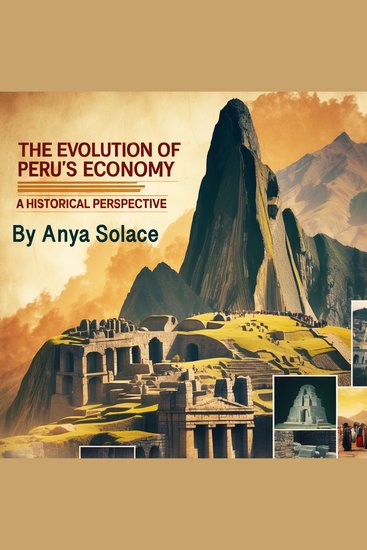
  • The Evolution of Peru's Economy - A Historical Perspective - cover

    The Evolution of Peru's Economy...

    Anya Solace

    • 0
    • 0
    • 0
    Peru’s economy has undergone a remarkable transformation over the centuries, shaped by geography, cultural heritage, and global economic forces. From the highly organized economic structures of pre-Colonial civilizations to the challenges of modern globalization, Peru’s development reflects a complex interplay of resource management, foreign influence, and domestic policies. Understanding the evolution of Peru’s economy requires a historical perspective that highlights the fundamental shifts in trade, industry, and governance that have defined the nation’s financial landscape.  
      
    The economic foundations of Peru were deeply influenced by its diverse geography and rich natural resources. The Andes, Amazon rainforest, and coastal plains provided a variety of ecosystems that supported agriculture, mining, and trade. Long before Spanish colonization, the Andean civilizations, particularly the Incas, developed sophisticated economic systems that relied on communal labor, redistribution networks, and agricultural innovations. These early economic structures created a foundation for productivity and social organization that persisted even after European intervention.  
      
    The arrival of the Spanish in the 16th century drastically altered Peru’s economic trajectory. The colonial period introduced extractive systems, such as the encomienda and mita, which forced indigenous populations into labor-intensive industries, particularly silver mining. This period established Peru as a key contributor to the Spanish Empire’s wealth but also entrenched an economic model centered on resource extraction and dependency on European markets. The restrictions imposed by Spain limited Peru’s economic autonomy, setting the stage for struggles following independence. 
    Ver livro