Rejoignez-nous pour un voyage dans le monde des livres!
Ajouter ce livre à l'électronique
Grey
Ecrivez un nouveau commentaire Default profile 50px
Grey
Abonnez-vous pour lire le livre complet ou lisez les premières pages gratuitement!
All characters reduced
Norway's Olympic Success - cover

Norway's Olympic Success

Ava Thompson

Traducteur A AI

Maison d'édition: Publifye

  • 0
  • 0
  • 0

Synopsis

Norway's Olympic Success explores the remarkable dominance of Norwegian athletes in winter sports, attributing their achievements to a unique blend of cultural values, strategic training, and equitable resource allocation. The book highlights that Norway, despite its small population, has consistently excelled in the Olympic Games due to deeply ingrained philosophies and methodologies. It examines how national training programs, some dating back to 1924, have evolved alongside technological advancements to produce elite athletes. A key aspect explored is "friluftsliv," the Norwegian concept emphasizing outdoor recreation and a lifelong commitment to physical activity. This cultural attitude fosters a competitive spirit from an early age, contributing significantly to athletic excellence. Furthermore, the book analyzes Norway's egalitarian approach to sports funding, contrasting it with more centralized models and demonstrating how this approach supports widespread participation and long-term athletic development. By examining the interlinked elements of structured training, cultural values, and resource distribution, the book offers a comprehensive explanation of Norway's sustained success in winter sports.

 
The book progresses by establishing a historical context, followed by a detailed analysis of training programs, the impact of "friluftsliv," and the effects of Norway's funding model. It uses Olympic statistics, comparative analyses, and case studies to support its claims, offering practical insights for other nations and sporting organizations seeking to enhance their own performance. This comprehensive approach provides a valuable understanding of the systemic and cultural factors behind Norway's Olympic triumphs.
Disponible depuis: 15/02/2025.
Longueur d'impression: 67 pages.

D'autres livres qui pourraient vous intéresser

  • The Expert Generalist - An Unpaved Road to Leadership - cover

    The Expert Generalist - An...

    Monique Lecomte

    • 0
    • 0
    • 0
    The Expert Generalist: An Unpaved Road to Leadership is a compelling exploration of how fortitude, adaptability, and resilience can transform a life shaped by adversity into one of purpose and leadership. From growing up in poverty in the American South to thriving in global boardrooms, Monique Lecomte shares lessons on overcoming obstacles, embracing feedback, and finding strength in creativity and connection. Through personal stories and actionable insights, this book inspires readers to craft their path, embrace versatility, and lead with authenticity and vision. 
    Through candid stories—from navigating Southern Baptist culture to selling peaches in a K-Mart parking lot—Monique unpacks what it means to be an "expert generalist," someone who adapts, connects across disciplines, and innovates. She shares actionable insights with each chapter, empowering readers to stand tall, make new plans, and advocate for themselves. 
    Monique’s message encourages individuals and organizations to foster mentorship, pursue innovation, and lead purposefully. Her book is more than a story of overcoming adversity; it’s a call to embrace your unique journey, navigate your unpaved road, and design a life and career that reflects your true potential.
    Voir livre
  • The Era of Faith - 632-1667CE - cover

    The Era of Faith - 632-1667CE

    Pope Urban II, Pico della...

    • 0
    • 0
    • 0
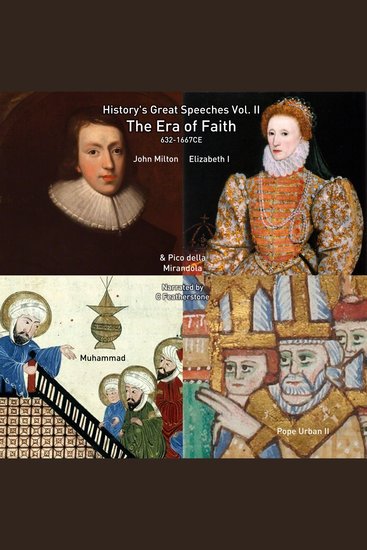
    Five speeches from a millennium shaped by faith and empire.632CE. In Muhammed’s farewell address, he lauds his people for their achievements and virtues, and gives them his final instructions for living within the faith.In 1095, Pope Urban II’s Against The Infidels speech launches the Crusades, which lasted for another two hundred years. In it the Pope exhorts his clergy to make true the promise of Christianity and rise against their weaker natures and the enemy in the east.Pico della Mirandola’s Oration On The Dignity Of Man has been described as “the manifesto of the Renaissance”, and is an introduction to his 900 Theses, which was the first printed book ever banned by the Church. Written in 1486, it weaves together philosophy and theology from across history and the world. While Christian, it is a review of the philosophies and religions of the ages.The first section details man’s supremacy over all other beings but God, due to his inherent mutability. The second section dives into the value of philosophy and theology, preparing a discussion of Christian magic and mystery. The final section explores a positive conception of Christian magic, placing it in ancient traditions of magic.In 1588, Elizabeth I’s speech rouses her forces against the Spanish Armada. The Armada came to conquer England and re-establish Catholicism as the state religion. The ensuing conflict is one of England’s great military victories. It includes the famous line “I know I have but the body of a weak and feeble woman; but I have the heart of a king, and of a king of England, too”.John Milton, Satan’s First Speech, Paradise Lost, 1667. We end the volume with a speech against faith and monarchy, which gives us the phrase “Better to reign in Hell, then serve in Heav'n.” Paradise Lost explores the limits of both divinity and monarchy, and marks the end of an age where the two combined to rule the world.
    Voir livre
  • The Second History of Man - cover

    The Second History of Man

    MD John Bershof

    • 0
    • 0
    • 0
    In the spirit of medieval writer Chaucer, all human activity lies within the artist’s scope, the History of Man Series uses medicine as a jumping off point to explore precisely that, all history, all science, all human activity since the beginning of time. The jumping off style of writing takes the reader, the listener into worlds unknown, always returning to base, only to jump off again. History of Man are stories and tales of nearly everything. 
    The Second History of Man focuses mostly on bacteria and bacterial infections as the foundation, jumping off into Darwin and evolution, gin & tonics and the discovery of the first antibiotic to treat infection (and it wasn’t penicillin), visiting with those clever chaps who cook up drugs in the lab. We’ll call upon poets & poetry, celebrities like Frank Sinatra, the Rat Pack, and Bobby Darin, the classical music of Haydn, Mozart and Beethoven, the tragic story of World War II, Anne Frank and the Holocaust, tuberculosis, and a few of the rich & famous who suffered from TB, travelling back in time to the Black Death which wiped out 25 percent of humans on Earth, exploring the origins of a salon and a saloon, Columbus and the Age of Discovery, the lost generations of childhood, ending with the invention of the Internet.
    Voir livre
  • Litigating the Pandemic - Disaster Cascades in Court - cover

    Litigating the Pandemic -...

    Susan M. Sterett

    • 0
    • 0
    • 0
    As officials scrambled in 2020 to manage the spread of COVID, the reverberations of the crisis reached well beyond immediate public health concerns. The governance problems that emerged in the pandemic would be problems in other climate-related disasters, too. 


    Many of these governance problems wound up in court. Businesses filed insurance claims for lost commerce; when the claims were denied, some companies sued. As state governments ordered closures and otherwise tried to adapt, interest organizations that had long sought to limit government authority challenged them in court. Political officials railed against litigation they argued would stop businesses from reopening. The United States, like other countries, governs partly through litigation, and litigation is one way of seeing the multiple governance failures during the pandemic. 


    Drawing on databases of cases filed, news reports, and other sources, Susan M. Sterett argues that governing during the pandemic must include the human institutions intertwined with the effects of the virus. Those institutions reveal problems well beyond the reach of technical expertise. Failures in private insurance as a way of governing risk, conflicts about the primacy of religion, government authority, and health, are problems that predated the pandemic and will persist in future disasters.
    Voir livre
  • What We Don't Do - Inaction in the Face of Suffering and the Drive to Do More - cover

    What We Don't Do - Inaction in...

    Nick Cooney

    • 0
    • 0
    • 0
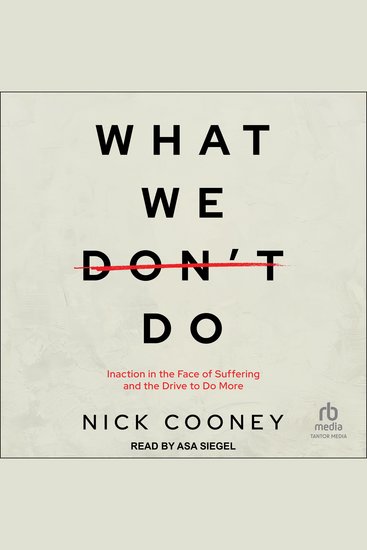
    When we think about whether we are good people leading a good life, we usually think about actions. Bad people do bad things that hurt others. Good people do good things that help others, and they avoid doing bad things. Simple. 


    But while our actions certainly have consequences, today our inactions have far greater and far graver consequences. Bad actions can result in the suffering of a few or several dozen others; inaction can result in the extreme misery of thousands. 


    For nearly our entire history as a species, we lived in small groups with minimal resources, leaving our ability to help others limited. Thanks to massive global populations, huge wealth disparities, and modern technologies, the average person now has more power to improve the lives of others than nearly anyone who has ever lived. But the flip side of that great power is the dizzyingly high cost of inaction, in which lives can hang in the balance with each dollar and hour of time we spend. 


    This is a book about what we don't do. It's about our failures to act and the suffering others endure as a result. It's also about the incredible good that can be achieved when we cultivate an internal drive to do more.
    Voir livre
  • Parmenides - cover

    Parmenides

    Plato

    • 0
    • 0
    • 0
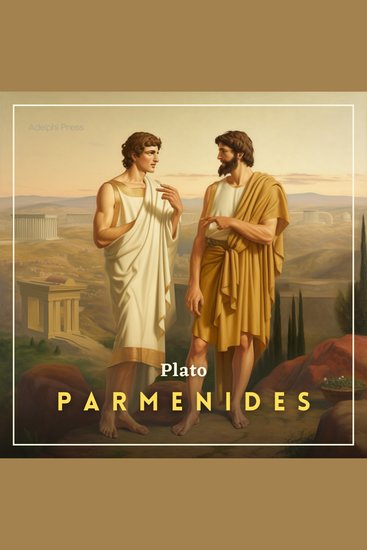
    "Parmenides" is one of Plato's dialogues in which the philosopher Parmenides visits Athens and engages in a philosophical conversation with a young Socrates. "Parmenides" is a complex and nuanced exploration of the nature of reality and the limits of human knowledge. Through the dialogue between Parmenides and Socrates, Plato explores the challenges of developing a coherent philosophical theory, as well as the importance of engaging in critical thinking and dialogue in order to refine and improve one's ideas. Read in English, unabridged.
    Voir livre