Rejoignez-nous pour un voyage dans le monde des livres!
Ajouter ce livre à l'électronique
Grey
Ecrivez un nouveau commentaire Default profile 50px
Grey
Abonnez-vous pour lire le livre complet ou lisez les premières pages gratuitement!
All characters reduced
The Man Who Saved The Earth - cover

The Man Who Saved The Earth

Austin Hall

Maison d'édition: E-Kitap Projesi & Cheapest Books

  • 0
  • 0
  • 0

Synopsis

The story opens on an oppressively hot day with a poor little newspaper boy, Charley, playing with a "burning glass" (a magnifying glass) which he uses to concentrate sunlight onto a small focal spot, thus intensifying the heat on some paper until it burns a hole, perhaps a portent of things to come. He is noticed by a recluse scientist, Dr. Robold, who takes interest in Charley's scientific curiosity and calls him a young Archimedes, referring to the ancient Greek who, as legend tells, used a "burning glass" from shore to set enemy ships ablaze as they were approaching. Charley has no parents to care for him. Dr. Robold takes Charley away from his pitiful life, to a mountain retreat in Colorado.

Years later, bizarre, terrifying events begin to occur. At a street intersection in Oakland, California, everything within a large circular area--streetcars, autos, people, pavement--suddenly vanishes without a sound, during a flash of bright, multi-colored light, leaving a vastly deep hole with perfectly smooth sides as though cut with a knife.
Disponible depuis: 30/01/2024.
Longueur d'impression: 150 pages.

D'autres livres qui pourraient vous intéresser

  • The Mysterious Ship - cover

    The Mysterious Ship

    H. P. Lovecraft

    • 0
    • 0
    • 0
    This story is unique because it doesn’t look like other short stories. It seems more like a draft of a book that is going to be made. There are two versions of this story: the short one and the long one. The short is originally published in Royal Press in 1902 and the long version was edited by anonymous.  "The Mysterious Ship" is a fascinating and sinister story about the ship. The ship is enigmatic because when it appeared – one person would disappear. The captain of the ship should be caught to solve that mystery. But who is he? Maybe, he is not even a human. Read the book to solve the mystery of the ship.A SmartTouch Media production.
    Voir livre
  • Murder in America - A Coast to Coast Collection of Murder and Mayhem - cover

    Murder in America - A Coast to...

    John L Breen

    • 0
    • 0
    • 0
    An entertaining collection by seven renowned American mystery writers— including Mary Higgins Clark and Whitley Strieber— this anthology offers a delightful mix of mystery, suspense, and murder. The stories include
    • " Starstruck" by Jon L. Breen, read by James Stacy: A group of aging actors is fatally haunted by the consequences of the McCarthy-era blacklist.
    
    • " Gee Whiz, My Lovely" by Betty Buchanan, read by Joan Rivers: A bouncy private investigator is invited by a " gorgeous nut" to find an elusive figure named Harvey.
    
    • " Lucky Day" by Mary Higgins Clark, read by Betsy Palmer: A young bride suspects her husband is somehow involved in a strange disappearance.
    
    • " It Was Bad Enough" by Ron Goulart, read by Arte Johnson: A comedian trying to make his comeback learns his ex-wife's tell-all book is about to be filmed.
    
    • " Pirate' s Moon" by William F. Nolan, read by Perry King: A psychic working for the LAPD fails to foresee that a stone-age cannibal cult may be terrorizing the city.
    
    • " Vaudeville" by Whitley Strieber, read by Roddy McDowall: An aging vaudeville comedienne dies— but not laughing.
    
    • " Snookered" by Gerald Tomlinson, read by David Birney: A story about a new breed of football coach and a team the sportswriters can't ignore.
    Voir livre
  • Twenty-Six Men and a Girl - From their pens to your ears genius in every story - cover

    Twenty-Six Men and a Girl - From...

    Maxim Gorky

    • 0
    • 0
    • 0
    Alexei Maximovich Peshkov was born on 28th March 1868, in Nizhny Novgorod, Russia. 
    Better known as Maxim Gorky he was orphaned at 11 and ran away from home at 12.  At 19 he had already attempted suicide and thereafter travelled, by foot, across the Russian Empire for 5 years. 
    His first book ‘Essays & Stories’ in 1898 was a sensation and so began a long career as an author of short stories, novels and plays.  Gorky saw writing as a moral and political act that would help to change the unjust world around him.  He was an ardent early advocate of the emerging Marxist movement and publicly opposed the Tsarist regime leading several times to his arrest.  
    In 1904 he began his own theatre but the censor banned every play and Gorky was forced to abandon the project. 
    But Gorky was a financially successful author, editor, and playwright and gave monies to political parties as well as for civil rights and social reform.  The brutal shooting of workers, which set in motion the Revolution of 1905, pushed Gorky more decisively toward radical solutions.  
    In 1906 he went to the United States to raise funds for the Bolsheviks. Those experiences including a scandal over travelling with his lover and not his wife deepened his contempt for the ‘bourgeois soul.’ 
    Gorky now moved to Capri in Italy, both for health reasons and to escape the increasingly repressive times in Russia.  
    An amnesty for the 300th anniversary of the Romanov dynasty saw him return to Russia in 1914. His politics remained close to the Bolshevik cause.  But soon, after the 1918 revolution, his essays referred to Lenin as a tyrant for his senseless arrests and repression.  He was soon appealing to the outside world for food aid after the catastrophic crop failure. 
    In October 1921 Gorky returned to Italy, now in Fascist hands, and settled in Sorrento until 1932.  His health worsened with the onset of tuberculosis. 
    He wrote several successful books there but now decided to find an understanding with the communist regime. Stalin invited him home and his return was hailed as a major propaganda victory.  He was decorated with the Order of Lenin, and a province, a park, and various streets re-named in his honour. 
    But he had his faults too.  In 1933, Gorky co-edited a book on the White Sea-Baltic Canal and denied even a single prisoner died during its construction, but thousands had. As well, knowing that some Nazis were homosexual, a phrase was attributed to him that said ‘exterminate all homosexuals and fascism will vanish’.  Although he was himself was quoting another he was decidedly homophobic. 
    With the increase of Stalinist repression in 1935 Gorky was placed under unannounced house arrest. 
    Maxim Gorky died on the 18th June 1936 from pneumonia.  He was 68. 
    Stalin and Molotov were among those who carried Gorky's urn of ashes at his funeral.
    Voir livre
  • The Festival - cover

    The Festival

    H. P. Lovecraft

    • 0
    • 0
    • 0
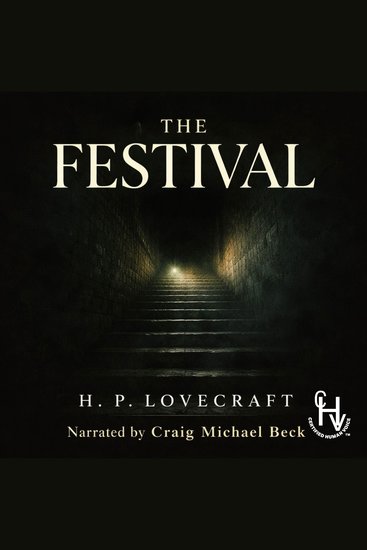
    An ancient tradition… and a descent into something far older than memory. 
     
    In The Festival, H. P. Lovecraft delivers a chilling tale of inherited ritual, hidden passageways, and the terrifying pull of the unknown. Returning to his ancestral town during the winter solstice, a lone traveler is drawn into a secretive celebration—one that reveals truths buried deep beneath history… and beneath the earth itself. 
     
    As the night unfolds, curiosity gives way to dread, and the familiar becomes profoundly alien. With Lovecraft’s signature blend of atmosphere and cosmic horror, this story lingers long after the final moment. 
     
    Expertly narrated by Craig Michael Beck, The Festival offers a haunting listening experience steeped in mystery, tension, and ancient fear.
    Voir livre
  • Essential Lovecraft Horror Stories - The Dreams in the Witch House The Haunter of the Dark The Rats in the Walls The Festival and The Curse of Yig - cover

    Essential Lovecraft Horror...

    H. P. Lovecraft

    • 0
    • 0
    • 0
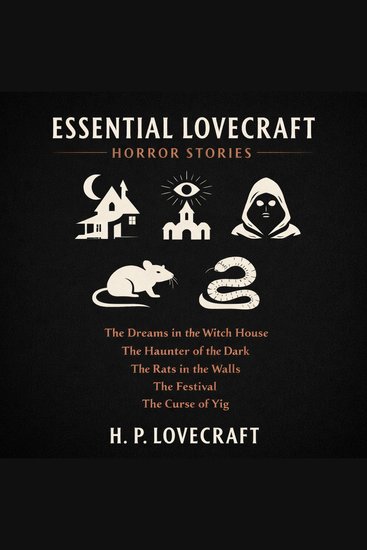
    Descend into the eerie imagination of H. P. Lovecraft with Essential Lovecraft Horror Stories, a chilling collection of five unforgettable tales of cosmic dread and forbidden knowledge. Featuring The Dreams in the Witch House, The Haunter of the Dark, The Rats in the Walls, The Festival, and The Curse of Yig, this volume explores haunted houses, ancient cults, unspeakable entities, and the fragile limits of human sanity. Perfect for fans of classic horror and cosmic terror, these timeless stories showcase Lovecraft’s haunting atmosphere and enduring influence on supernatural fiction.
    Voir livre
  • Stories About Orphans - Classic stories before the modern orphans in pop culture like Batman or Harry Potter - cover

    Stories About Orphans - Classic...

    Anton Chekhov, Hannah More,...

    • 0
    • 0
    • 0
    Life can be difficult.  We all experience hurdles, obstacles and problems that get in the way and may limit our opportunities.  But we can usually count on the steadfast and loving support of others.  We get that comfort from our parents and pass it on through the generations.  Sadly, some will not get that unconditional love and bond from their onset or their early years.  Growing up as an orphan is to know you are different and, on some levels at least, alone.  Surviving and thriving with this can damage a life or be used as fuel to achieve a whole, rich, and nurtured life. 
     
    In this volume our authors use this as their theme as they construct moving stories from bleak beginnings to lives with surprising outcomes.   
     
    1 - Stories About Orphans - An Introduction 
    2 - Vanka by Anton Chekhov 
    3 - Betty Brown, the St Giles Orange Girl by Hannah More 
    4 - Stephen Archer by George MacDonald 
    5 - The Indian Orphan. A Tale by Letitia Elizabeth Landon 
    6 - An Angel in Disguise by T S Arthur 
    7 - A Story of a Wedding Tour by Margaret Oliphant 
    8 - Some of the Shipwrecked by Mary E Mann 
    9 - The Living Telegraph by Boleslaw Prus 
    10 - The Sea Voyage by Charles Lamb
    Voir livre