Begleiten Sie uns auf eine literarische Weltreise!
Buch zum Bücherregal hinzufügen
Grey
Einen neuen Kommentar schreiben Default profile 50px
Grey
Jetzt das ganze Buch im Abo oder die ersten Seiten gratis lesen!
All characters reduced
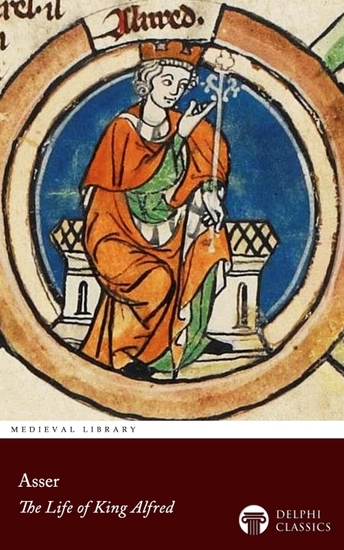
The Life of King Alfred by Asser Delphi Classics - cover

The Life of King Alfred by Asser Delphi Classics

Asserius Menevensis

Verlag: Delphi Publishing Ltd

  • 0
  • 0
  • 0

Beschreibung

Asser was a late ninth century Welsh monk, who is chiefly remembered as the friend, counsellor and biographer of Alfred the Great. Composed in Latin, ‘The Life of King Alfred’ follows his career from birth to accession in 871, describing in detail Alfred’s reign and his wars. It provides a revealing account of one of the greatest medieval kings, who sought to revive religion and learning in his kingdom. Among the earliest surviving royal biographies, it offers an admiring and endearing account of the monarch’s life, chronicling his battles against Viking invaders and his struggles to develop the power and knowledge of the Saxons, uniting his people at a time of grave peril. Delphi’s Medieval Library provides eReaders with rare and precious works of the Middle Ages, with noted English translations and the original texts.  This eBook presents multiple translations of Asser’s work, with illustrations, an informative introduction and the usual Delphi bonus material. (Version 1)

 
* Beautifully illustrated with images relating to Asser’s life and works* Features the complete extant text of Asser’s biography, in both English translation and the original Latin* Two English translations of ‘Vita Ælfredi regis Angul Saxonum’: John Allen Giles Translation, 1848; Albert S. Cook, 1905* Includes the translators’ original hyperlinked footnotes * Concise introduction to the text* Excellent formatting of the texts* Easily locate the sections you want to read with individual contents tables* Provides a special dual English and Latin text, allowing readers to compare the sections paragraph by paragraph — ideal for students* Features two bonus biographies, including Charles Plummer’s seminal study of Alfred the Great

 
CONTENTS:

 
The TranslationsBrief Introduction to ‘The Life of King Alfred’John Allen Giles Translation, 1848Albert S. Cook, Translation, 1905

 
The Original TextContents of the Latin Text

 
The Dual TextDual Latin and English Text

 
The BiographiesAsser (1900)The Life and Times of Alfred the Great (1902) by Charles Plummer
Verfügbar seit: 08.06.2024.
Drucklänge: 1625 Seiten.

Weitere Bücher, die Sie mögen werden

  • Empedocles - The Four Elements and Cosmic Cycles - cover

    Empedocles - The Four Elements...

    Hector Davidson

    • 0
    • 0
    • 0
    Empedocles, a philosopher and poet from the ancient Greek city of Acragas (modern-day Agrigento, Sicily), lived during the 5th century BCE and is often regarded as one of the most original thinkers of his time. His life and works remain an intriguing fusion of science, mysticism, and poetry. Though much of what we know about Empedocles comes from fragments of his writings, his ideas have had a profound and lasting influence on philosophy, science, and even religion. 
      
    Empedocles is best known for his theory of the four elements—earth, air, fire, and water—which he posited as the fundamental building blocks of the universe. Unlike his predecessors, who sought to explain the world through a singular substance (such as water for Thales or air for Anaximenes), Empedocles argued that these four elements combined and separated through two cosmic forces: Love (Philia) and Strife (Neikos). Love brings the elements together, fostering harmony and unity, while Strife pulls them apart, creating division and chaos. This cyclical process of combination and separation underlies the ongoing changes in the cosmos. 
      
    In addition to his materialistic philosophy, Empedocles incorporated spiritual and mystical elements into his worldview. He believed in the transmigration of souls, suggesting that human beings and other living creatures are bound to an endless cycle of reincarnation. According to Empedocles, the soul is trapped in a cycle of birth, death, and rebirth, and it can achieve liberation through purification and virtuous living. His philosophical system thus integrated both natural and ethical concerns, urging individuals to live in harmony with the forces of the cosmos and pursue a life of virtue.
    Zum Buch
  • The Nurse’s Naughty Tease - Lesbian First Time Sex - cover

    The Nurse’s Naughty Tease -...

    Laura Vixen

    • 0
    • 1
    • 0
    A visit to the new college nurse provides an unexpected delight for Julia when she sees a curvy figure in a tight, white uniform. It brings a fantasy to life and her interest doesn’t go unnoticed. An invite to Miss Lopez’s room that very evening is one she isn’t about to turn down and it gets her under the control of a teasing nurse who likes to play.  
    Zum Buch
  • The Rise and Fall of Brazil's Economic Giants - cover

    The Rise and Fall of Brazil's...

    Anya Solace

    • 0
    • 0
    • 0
    Brazil’s industrial foundations were shaped by its colonial past, rich natural resources, and evolving economic policies. The country’s transition from an agrarian economy to an industrial powerhouse was a long and complex process influenced by global trade dynamics, government intervention, and social changes. Understanding these foundations provides insight into the rise and fall of Brazil’s economic giants. 
    The origins of Brazil’s economy date back to the colonial period under Portuguese rule. Initially, the country’s economic activities were centered around agriculture, particularly the production of sugarcane, which became the backbone of Brazil’s early commerce. The Portuguese established large sugar plantations, or engenhos, along the northeastern coast, relying heavily on enslaved labor from Africa. This agricultural-based economy set the stage for Brazil’s role as a key exporter of raw materials, a trend that would persist for centuries. As global demand for sugar declined in the 17th and 18th centuries, Brazil’s economy diversified into gold mining, particularly in the state of Minas Gerais. The discovery of gold and diamonds attracted European settlers and boosted trade, but much of the wealth was extracted by the Portuguese crown, limiting local reinvestment. The reliance on commodity exports, without substantial industrial development, created a pattern that continued into modern times. 
    Brazil’s shift toward industrialization began in the late 19th and early 20th centuries, spurred by the decline of slavery, urbanization, and increasing foreign investment. The abolition of slavery in 1888 led to significant demographic changes, with many freed individuals moving to urban centers in search of work. Around the same time, European immigrants arrived in large numbers, bringing skills that contributed to Brazil’s growing workforce. The coffee boom of the late 19th century played a crucial role in financing Brazil’s early industries.
    Zum Buch
  • Parenting without Panic in an LGBT-Affirming World - Discipling Our Kids with Jesus' Truth and Love - cover

    Parenting without Panic in an...

    Rachel Gilson

    • 0
    • 0
    • 0
    Helps parents to teach young children what the Bible says about sexuality proactively and positively in a culture with contrasting ideas and values.   As Christian parents, we long to equip our kids as they venture out into a culture where LGBT is affirmed and celebrated. We want them to know what God says, and to love what God says. But, it’s hard to know where to start. That's where this book can help  Author Rachel Gilson helps you to teach your children proactively and positively about God’s beautiful design for human sexuality, gender, and relationships. This book will help you to provide your children with a Christian framework for sexual ethics, rather than letting the culture lay the foundations of their worldview in this area.   Rachel writes with understanding and clarity to help fellow parents engage with the wider LGBT narrative with faith rather than fear. Since she herself experiences same-sex attraction but has chosen to follow the Bible's teaching, she has put much thought into this topic. She reassures us that Jesus gives us everything we need to be faithful disciples in a fallen world, and that God works out his perfect purposes despite human sin. She also shares her wisdom on how to respond with grace and truth to people with different beliefs in this area.   This book is ideal for preschool and elementary-school children.
    Zum Buch
  • The Way of Nagomi - The Japanese Philosophy of Finding Balance and Peace in Everything You Do - cover

    The Way of Nagomi - The Japanese...

    Ken Mogi

    • 0
    • 0
    • 0
    Find balance and peace in every moment 


    Life is ephemeral and ever-changing; in Japan, it's called ukiyo—"floating world." How can we adapt to its fluctuations without being overcome? The answer is nagomi: a philosophy of balance—and the secret to a harmonious life. Neuroscientist Ken Mogi shares wisdom from Japanese history and culture to explain how nagomi can help you: 


    ● have happy relationships with loved ones who disagree 


    ● engage with the natural world without diminishing its beauty 


    ● strive for improvement while accepting imperfection 


    ● strike a balance to achieve calm. 


    If you've ever enjoyed a perfect bite of sushi—fresh fish, white rice, a hint of wasabi, maybe with a sip of sake—then you've already tasted what nagomi can achieve. Combining philosophy and advice, this book brings that balance into your health, work, relationships, and sense of self with nagomido—The Way of Nagomi!
    Zum Buch
  • The Cadence of a Song - The Life of Margaret Fay Shaw - cover

    The Cadence of a Song - The Life...

    Fiona J. Mackenzie

    • 0
    • 0
    • 0
    The first biography of one of the twentieth century's foremost champions of Hebridean culture.
    The American-born folklorist and musician Margaret Fay Shaw's passion for the Hebrides led her to the island of South Uist in 1929 and then to Canna in 1935 as the wife of the eminent folklorist John Lorne Campbell.
    Her extraordinary work in documenting and preserving traditional Gaelic songs and customs remains a vital resource for understanding Hebridean music, and the Campbells' house on Canna is a unique collection of priceless material celebrating the Hebridean world. This vast archive also includes Margarets collection of still and film photography, which capture the essence of island life at a time when old traditions were vanishing.
    This book celebrates the legacy and life of a remarkable woman, who herself wrote with such wit and flair of her travels and adventures and which took her from turn of-the-century Pennsylvania to 1920s New York, Paris, Nova Scotia and the Hebrides, where she lived until her death in 2004.
    Fiona J. Mackenzie has been named as one of The List's Hot 100 Arts and Culture Contributors in Scotland for 2025.
    Zum Buch