Rejoignez-nous pour un voyage dans le monde des livres!
Ajouter ce livre à l'électronique
Grey
Ecrivez un nouveau commentaire Default profile 50px
Grey
Abonnez-vous pour lire le livre complet ou lisez les premières pages gratuitement!
All characters reduced
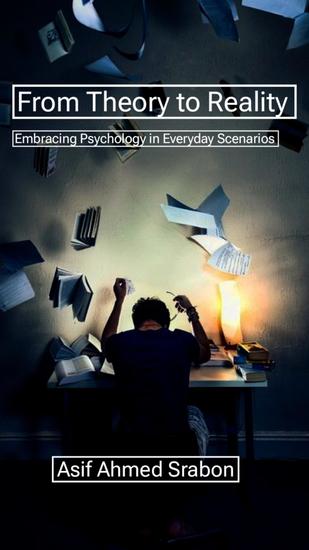
From Theory to Reality - Embracing Psychology in Everyday Scenarios - cover

From Theory to Reality - Embracing Psychology in Everyday Scenarios

Asif Ahmed Srabon

Maison d'édition: BookRix

  • 0
  • 0
  • 0

Synopsis

Dive into the intricate world of human behavior with Asif Ahmed Srabon's compelling exploration, "From Theory to Reality." This book takes readers on a thought-provoking journey, unraveling the threads of psychology and weaving them into the fabric of daily life. Through captivating stories and insightful analysis, Srabon guides readers to understand the profound impact of psychology on our choices, relationships, and overall well-being. "From Theory to Reality" is not just a book; it's a roadmap for navigating the complex landscape of human experience, offering valuable insights that bridge the gap between psychological theories and their real-world applications. Join Srabon on this enlightening adventure, and discover the hidden layers of meaning that psychology brings to our everyday existence.
Disponible depuis: 15/12/2023.
Longueur d'impression: 14 pages.

D'autres livres qui pourraient vous intéresser

  • Oracle of Dodona The: The History of Ancient Greece’s Oldest Oracle - cover

    Oracle of Dodona The: The...

    Editors Charles River

    • 0
    • 0
    • 0
    In ancient Greece, “no other practice was so universal than the consultation of oracles.” These holy sites were found in 260 locations around the Greek-speaking world, and they were considered the “most satisfactory means of ascertaining the future.” These sanctuaries were “set apart from the profane, ordinary world” and were in the beginning restricted to natural locations where the divine was thought to be “especially present.” They were set aside for special spiritual functions, and a state of purity was generally required of its participants. A historical tendency toward providing haven for criminals was based on the fear of shedding blood in a holy place, and the “fear that the evil magic would emanate from his curse.” 
    	Despite the interest in Greek oracles, modern knowledge remains limited in certain respects, because cult history has become so intertwined with mythology that the lines separating one from another have been nearly lost. Modern scholars studying the oracles have tried to pull the shroud of mythology away from historical facts to illuminate the realities of the Greek cults, but the job has often proved trickier than imagined. If anything, the work of scholars has deepened the mysticism of the oracles rather than dispel it, in large measure due to documenting fascinating and mysterious stories about them. For example, much has been written about natural vapors and fumes that may have caused psychoactive effects in petitioners at oracles. Modern civilizations at times employ this argument to excuse the supposed ignorance of the ancient Greeks, and in some cases, such vapors have been identified and may indeed explain the activities at certain oracles. However, archaeologist Jelle de Boer, intimately associated with some of the most iconic Greek oracles, cautioned that “something can be extra-natural without being outright supernatural.”
    Voir livre
  • Summary of Michael Shellenberger’s San Fransicko - cover

    Summary of Michael...

    Falcon Press

    • 0
    • 0
    • 0
    Buy now to get the main key ideas from Michael Shellenberger’s San Fransicko 
      
    In San Fransicko (2021), bestselling author Michael Shellenberger tackles the problem of increasing homelessness, especially in the city of San Francisco. He argues that the root cause isn’t the absence of accommodation, money, or social aid programs, but the principles embedded in the minds of some people who acquire them either by experience or by identity. As a result, the values that allow cities and civilizations to exist are diminishing. 
    Progressives always claim to have solutions for the issues of homelessness, crime, drug abuse, alcoholism, and inequality. However, a close examination of faltering cities shows that these social problems have become exceptionally worse under the control of progressives. In response, Shellenberger looks for a different way forward that will help both homeless people and the community around them. 
    Voir livre
  • How to Find Happiness - An Ancient Guide to the Good Life - cover

    How to Find Happiness - An...

    Marcus Tullius Cicero, Katharina...

    • 0
    • 0
    • 0
    Does happiness come from the pursuit of pleasure or moral virtue? A vivid new translation of Cicero’s exploration of a timeless question“Of course, we all want to be happy.” So wrote the Roman statesman, orator, and philosopher Marcus Tullius Cicero. He and his fellow Greek and Roman philosophers agreed that the secret to happiness—or what they called the “good life”—is pursuing the “greatest good.” The only problem is that they couldn’t agree on what the greatest good is. Cicero addressed this dilemma by composing a set of dialogues, On the Greatest Good and Evil (De finibus bonorum et malorum), in which he pitted advocates of different philosophical approaches to happiness against one another. Notably, these include the Epicureans (who believe that the greatest good is pleasure) and the Stoics (according to whom it is moral virtue). Rather than choosing sides, Cicero considers the pros and cons of the different philosophies, ultimately leaving it to his readers to make up their own minds. In How to Find Happiness, Katharina Volk offers a vivid new translation of selections from Cicero’s work, complete with an introduction and the original Latin text on facing pages. The result is a lively and engaging debate that invites each of us to discover our own path to happiness.
    Voir livre
  • Intellectual Training - cover

    Intellectual Training

    Harriet Martineau

    • 0
    • 0
    • 0
    "Intellectual Training" is a book by Harriet Martineau, a prominent 19th-century British social theorist, writer, and feminist. Originally published in 1838, it offers insights into the importance of education, particularly intellectual development, in shaping individuals and societies. Martineau's work emphasizes the cultivation of critical thinking, reasoning skills, and moral values as essential components of intellectual training.
    Voir livre
  • Lion City - Singapore and the Invention of Modern Asia - cover

    Lion City - Singapore and the...

    Jeevan Vasagar

    • 0
    • 0
    • 0
    In 1965, Singapore's GDP per capita was on a par with Jordan. Now it has outstripped Japan. After the Second World War and a sudden rupture with newly formed Malaysia, Singapore found itself independent–and facing a crisis. It took the bloody-minded determination and vision of Lee Kuan Yew, its founding premier, to take a small island of diverse ethnic groups with a fragile economy and hostile neighbors and meld it into Asia's first globalized city.Lion City examines the different faces of Singaporean life–from education and health to art, politics, and demographic challenges–and reveals how in just half a century, Lee forged a country with a buoyant economy and distinctive identity. It explores the darker side of how this was achieved too; through authoritarian control that led to it being dubbed "Disneyland with the death penalty."Jeevan Vasagar, former Singapore correspondent for the Financial Times, masterfully takes us through the intricate history, present, and future of this unique diamond-shaped island one degree north of the equator, where new and old have remained connected. Lion City is a personal, insightful, and definitive guide to the city, and how its extraordinary rise is shaping East Asia and the rest of the world.
    Voir livre
  • The Insider - How the Kiplinger Newsletter Bridged Washington and Wall Street - cover

    The Insider - How the Kiplinger...

    Rob Wells

    • 0
    • 0
    • 0
    When Willard M. Kiplinger launched the groundbreaking Kiplinger Washington Letter in 1923, he left the sidelines of traditional journalism to strike out on his own. With a specialized knowledge of finance and close connections to top Washington officials, Kiplinger was uniquely positioned to tell deeper truths about the intersections between government and business. With careful reporting and insider access, he delivered perceptive analysis and forecasts of business, economic, and political news to busy business executives, and the newsletter's readership grew exponentially over the coming decades. 


    More than just a pioneering business journalist, Kiplinger emerged as a quiet but powerful link between the worlds of Presidents Hoover and Roosevelt, and used his Letter to play a little-known but influential role in the New Deal. Part journalism history, part biography, and part democratic chronicle, The Insider offers a well-written and deeply researched portrayal of how Kiplinger not only developed a widely read newsletter that launched a business publishing empire but also how he forged a new role for the journalist as political actor.
    Voir livre