

Rejoignez-nous pour un voyage dans le monde des livres!
Ajouter ce livre à l'électronique
Grey
Ecrivez un nouveau commentaire Default profile 50px
Grey
Abonnez-vous pour lire le livre complet ou lisez les premières pages gratuitement!
All characters reduced
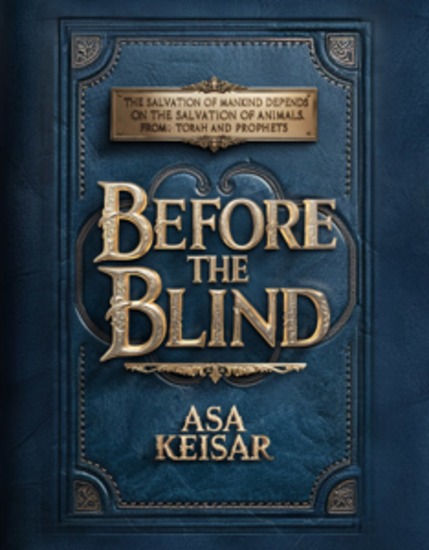
Before The Blind - cover

Before The Blind

Asa Keisar

Maison d'édition: Spines

  • 0
  • 0
  • 0

Synopsis

You are doing groundbreaking work, nothing less than a true revolution. I am hopeful more and more people will join your righteous journey so that Israel will become a light among the nations regarding its compassionate treatment of animals......I am happily obliged to thank you for your book, "BEFORE THE BLIND," which allowed me to become familiar with your work as a supporter and promoter of Veganism and animal rights in the Orthodox and Haredi Judaism spheres.It is clear that you are doing groundbreaking and courageous work, nothing less than a true revolution...I am a Vegetarian!Respectfully and appreciatively yours,Reuven (Ruby) RivlinJerus alem(President of Israel)
Disponible depuis: 30/07/2024.
Longueur d'impression: 256 pages.


D'autres livres qui pourraient vous intéresser

  • Voices for the Vanishing: Remembering Wildlife - cover

    Voices for the Vanishing:...

    MARGOT RAGGETT

    • 0
    • 0
    • 0
    Voices for the Vanishing: Remembering Wildlife 
    Narrated by Margot Raggett MBE 
    Over the past decade, Remembering Wildlife has become one of the most influential conservation publishing projects of its kind — raising over £1.2 million for frontline conservation and bringing together the world’s leading wildlife photographers, scientists, and conservationists. 
    Voices for the Vanishing brings together the written heart of the Remembering Wildlife series for the first time in audio form. 
    Across ten books — from elephants and rhinos to lions, cheetahs, bears, and pangolins — this audiobook weaves together powerful essays, firsthand field stories, and vital conservation insights from those working closest to some of the world’s most threatened species. 
    Narrated by Remembering Wildlife founder Margot Raggett MBE, with a special introduction by wildlife presenter Gordon Buchanan, these chapters explore not only the beauty of the natural world, but the complex realities of protecting it — from human-wildlife conflict and habitat loss to hope, resilience, and the people fighting for change. 
    Originally written to accompany iconic photographic collections, these essays stand alone as compelling listening for anyone who loves wildlife, Africa, wild places, and the future of our planet. 
    This is not a single story, but a tapestry — ten years of conservation voices brought together to be heard. 
    All profits from Remembering Wildlife support conservation projects working to protect endangered species around the world.
    Voir livre
  • Nightstalkers - The Wright Project and the 868th Bomb Squadron in World War II - cover

    Nightstalkers - The Wright...

    Richard Phillip Lawless

    • 0
    • 0
    • 0
    “Takes the reader into the Pacific war and offers a front-row seat to the exploits of the Wright Project and their highly innovative technology.” —War History Network 
     
    In August 1943, a highly classified US Army Air Force unit, code-named the “Wright Project,” departed Langley Field for Guadalcanal in the South Pacific to join the fight against the Empire of Japan. Operating independently, under sealed orders drafted at the highest levels of Army Air Force, the Wright Project was unique, both in terms of the war-fighting capabilities provided by classified systems the ten B-24 Liberators of this small group of airmen brought to the war, and in the success these “crash-built” technologies allowed. The Wright airmen would fly only at night, usually as lone hunters of enemy ships. In so doing they would pave the way for the United States to enter and dominate a new dimension of war in the air for generations to come.  
     
    This is their story, from humble beginnings at MIT’s Radiation Lab and hunting U-boats off America’s eastern shore, through to the campaigns of the war in the Pacific in their two-year march toward Tokyo. The Wright Project would prove itself to be a combat leader many times over and an outstanding technology innovator, evolving to become the 868th Bomb Squadron.  
     
    Comprehensive and highly personal, this story can now be revealed for the very first time, based on official sources, and interviews with the young men who flew into the night. 
     
    “A limber romp across the world of electronics and into the history of World War II.” —ARGunners.com
    Voir livre
  • Paleozoic Era The: The History of the Geologic and Evolutionary Changes that Began Over 500 Million Years Ago - cover

    Paleozoic Era The: The History...

    Editors Charles River

    • 0
    • 0
    • 0
    The current view of science is that Earth is around 4.6 billion years old, and the first 4 billion years of its development are known as the Precambrian period. For the first billion years or so, there was no life in Earth. Then the first single-celled life-forms, early bacteria and algae, began to emerge. It’s unclear where they came from or even if they originated on this planet at all, but this gradual development continued until around four billion years ago when suddenly (in geological terms) more complex forms of life began to emerge.  
    	Scientists call this time of an explosion of new forms of life the Paleozoic Era, and it stretched from around 541 to 250 million years ago. In the oceans and then on land, new creatures and plants began to appear in bewildering variety, and by the end of this period, life on Earth had diversified into a myriad of complex forms that filled virtually every habitat and niche available in the seas and on the planet’s only continent, Pangea. 
    	The Precambrian Period is divided into three eons: the Hadean, the Archaean, and the Proterozoic. One layer of carbon in rocks that date to the Archaean Eon, found on islands west of Greenland, seems to have fossilized tracks that may have been left by some form of organic life, but scientists simply are not certain. The oldest confirmed remains of life date from the same eon and were found in rocks in Western Australia, which were found to contain fossilized bacteria estimated to be 3.46 billion years old. It seems likely that there were thousands, perhaps even millions of forms of life in these early periods, and most seem to have been microscopic in size and very simple in developmental terms.
    Voir livre
  • Echolocation - cover

    Echolocation

    Sally Bliumis-Dunn

    • 0
    • 0
    • 0
    As a series, the poems in Echolocation swing back and forth from the natural world keenly observed--rain, birds, sunflowers, even a clam-- to the contortions of the human heart, mostly caused by hurt and loss. And isn't that where the best poetry resides, between the thing and the emotion, the swan and the grief? 
    --BILLY COLLINS 
    Echolocation is a collection driven by image and figurative language-- often the simile--and Bliumis-Dunn has both power of observation and imagination which she uses to great, lovely, terrifying and always compelling effect in these vivid, near- and far-looking poems. 
    --MARTHA RHODES 
    Sally Bluimis-Dunn's spare and stunning lyrics of grief and loss restore us to the clarity, and the clear finality, of our deepest emotions. They are grave and formal while being at the same time almost unbearably human and intimate. 
    --VIJAY SESHADRI 
    Sally Bliumis-Dunn leaves the reader of Echolocation in deceptively complex verbal landscapes in which both literal and figurative language play off each other with spare yet lapidary results in poems that focus on such everyday subjects as family, animals, loss, the seasons, menopause, and disaster with a compassionate, distilling eye. The voice that emanates from these poems is quiet but deeply resonant with generous stirrings beneath. She writes with what John Keats has called "disinterestedness"--a clear-headed objectivity that combines lucid narrative with lyrical charge. 
    --CHARD DENIORD 
    *Cover design by Wendy Letven
    Voir livre
  • Cougar Bay Nature Preserve - Saving Coeur d'Alene's Natural Gem - cover

    Cougar Bay Nature Preserve -...

    Theresa Shaffer

    • 0
    • 0
    • 0
    Fighting for Ecological HeritageIn 1992, a Hawaiian developer proposed a subdivision on Cougar Bay's northern shore, just two miles south of Coeur d'Alene. Dedicated, tenacious locals took on the seemingly impossible goal of stopping the "Cougar Beach" development. Unlikely allies--environmental activists and a cantankerous landowner--banded together. Private and public groups stepped up. In 1997, The Nature Conservancy purchased major shoreline areas and created a nature preserve. The sanctuary remained unaltered until more private land was gifted to the Bureau of Land Management and Kootenai County. After thirteen years of heroic perseverance, the Cougar Bay Nature Preserve became a reality. Idaho Wildlife Viewing Guide calls it one of the state's best wildlife viewing sites. Theresa Shaffer chronicles the battle to preserve this oasis for locals, visitors and wildlife alike.
    Voir livre
  • Planet X Hypothesis The: The History and Legacy of the Theory that the Solar System has a Hidden Planet - cover

    Planet X Hypothesis The: The...

    Editors Charles River

    • 0
    • 0
    • 0
    Naturally, as technological advances and the creation of flying aircraft became realities, the sighting of UFOs increased, as did the interest in potential contact with aliens. While incidents like the one at Roswell led to conspiracies and a craze among those who insisted the government was hiding proof of extraterrestrials’ existence, governments across the world were actually secretly studying UFO sightings by the mid-20th century. 
    Given all of that, it was hardly groundbreaking for scientists in the 19th century to have plenty of heated debates about their imperfect knowledge of astronomy. One particular argument was over whether there was a hidden planet beyond Neptune, dubbed by the theory’s original proponent, Percival Lowell, as Planet X. When Pluto was discovered in 1930, at the start of the Great Depression, scientists originally thought this new world, in the extreme cold at the outer edge of the Solar System, would solve a decades-old mystery regarding the orbit of Uranus, the seventh planet from the Sun. But soon, scientists realized that Pluto, at one point considered the 9th planet, was too small to explain the discrepancies found. Thus, some researchers began looking for the next planet, or Planet X. 
    Throughout our modern culture, “X” has remained the proverbial symbol of mystery. On the maps of buried pirate treasure, “X” is supposed to mark the spot where treasure seekers are to dig. In public schools, teenagers learn the utility of “X” as a variable in algebraic equations or as an axis in the Cartesian coordinate system. And “X” is also a Roman numeral symbolizing the quantity of 10, the highest value which can be counted on the fingers, and the next value beyond “9,” the largest single digit. The search for “Planet X,” then, is a quest rich with symbolism and mystery, rooted in history, astronomy, and astrology.
    Voir livre
