Begleiten Sie uns auf eine literarische Weltreise!
Buch zum Bücherregal hinzufügen
Grey
Einen neuen Kommentar schreiben Default profile 50px
Grey
Jetzt das ganze Buch im Abo oder die ersten Seiten gratis lesen!
All characters reduced
Prose remains of Arthur Hugh Clough with a selection from his letters and a memoir - Exploring faith doubt and human complexities through prose and letters - cover

Prose remains of Arthur Hugh Clough with a selection from his letters and a memoir - Exploring faith doubt and human complexities through prose and letters

Arthur Hugh Clough

Verlag: Good Press

  • 0
  • 0
  • 0

Beschreibung

In "Prose Remains of Arthur Hugh Clough, with a Selection from His Letters and a Memoir," Clough presents a rich tapestry of thought, reflecting on profound themes of faith, doubt, and the human condition. Written in a clear yet lyrical style, the collection combines essays, critiques, and personal correspondences, inviting readers into the introspective and often turbulent world of Victorian intellectualism. Clough's prose is imbued with a sense of urgency and introspection, resonating with the complexities of his era, particularly the interplay between established religious beliefs and emerging secular views, making it an essential piece within the Victorian literary canon. Arthur Hugh Clough (1819-1861) was an English poet and educational reformer who struggled with personal and societal dilemmas throughout his life. His academic tenure at Oxford and extensive travels across Europe provided him with a unique perspective on the academic and cultural shifts of his time. Clough'Äôs commitment to moral integrity and clarity in thought reflects his own inner grapple with faith and skepticism, elements made evident in this collection. This book is highly recommended for students of literature and philosophy alike, as it provides invaluable insight into the mind of a thinker caught in the throes of change. Clough's reflections remain remarkably relevant, offering timeless wisdom that challenges contemporary readers to ponder their own beliefs and societal norms.
Verfügbar seit: 10.07.2023.
Drucklänge: 308 Seiten.

Weitere Bücher, die Sie mögen werden

  • Immaculate - How the Steelers Saved Pittsburgh - cover

    Immaculate - How the Steelers...

    Tom O’Lenic, Ray Hartjen

    • 0
    • 0
    • 0
    Ahead of this year’s 50th anniversary of the National Football League’s most unforgettable play, Steelers Hall of Famer Franco Harris’ “Immaculate Reception,'' comes the book Immaculate: How the Steelers Saved Pittsburgh. Immaculate weaves together the historical stories of Pittsburgh and its beloved professional football team like the linear strands of DNA—antiparallel, twisting throughout, and irrevocably connected together. 
    Zum Buch
  • Adam Smith - The Father of Modern Economics - cover

    Adam Smith - The Father of...

    Hector Davidson

    • 0
    • 0
    • 0
    Adam Smith, often hailed as the father of modern economics, revolutionized the field with his pioneering ideas in the 18th century. His significance lies in his formulation of the foundational principles of classical economics, particularly through his seminal works, The Theory of Moral Sentiments and An Inquiry into the Nature and Causes of the Wealth of Nations. 
    In The Wealth of Nations, Smith introduced the concept of the "invisible hand," a metaphor for the self-regulating nature of free markets. He argued that individuals pursuing their self-interest unintentionally contribute to the economic well-being of society, as if guided by an invisible hand. This idea challenged the prevailing mercantilist views of the time, advocating instead for free trade and minimal government intervention in economic affairs. 
    Smith's exploration of the division of labor highlighted how productivity and efficiency could be vastly improved when tasks are specialized. This principle not only influenced economic theory but also had a profound impact on industrial practices and economic policy.
    Zum Buch
  • The American Dream - A History of the Nation's Ideals - cover

    The American Dream - A History...

    Harry Montgomery

    • 0
    • 0
    • 0
    The roots of the American Dream reach back to the earliest colonial settlements, when European settlers arrived with hopes of building a better life far from the constraints of their homelands. For many, the New World offered something previously unimaginable—land ownership, religious freedom, and the possibility of rising above the station into which they were born. These opportunities, though limited to a select group at the time, laid the foundation for the evolving idea that anyone could succeed through hard work and determination. In this fertile but dangerous land, ambition was a necessity, and the early colonists began to shape a cultural identity around individualism and perseverance. 
    As the colonies grew and developed, tensions with Britain intensified, giving rise to revolutionary ideas that would further fuel the American Dream. The rejection of monarchy and the assertion of natural rights became central to the vision of a new nation. The Revolution itself was not just a fight for independence but also a declaration that ordinary people had the right to govern themselves. The rhetoric of the time emphasized liberty, equality, and the pursuit of happiness—concepts that would become permanently embedded in the national consciousness. The struggle to gain freedom was brutal and uneven, but the ideals expressed during this time continued to inspire generations to believe in the possibility of social mobility and personal fulfillment. 
    One of the most significant documents in American history, the Declaration of Independence, formalized the promise of the American Dream. Its bold claim that "all men are created equal" introduced a national aspiration that transcended the immediate political conflict. Although in practice this equality was far from realized, the statement set a powerful ideal against which future Americans would measure their progress.
    Zum Buch
  • Galveston Ghost Tales - cover

    Galveston Ghost Tales

    Denise Sandoval

    • 0
    • 0
    • 0
    An entire city haunted by century-old ghosts. 
    In 1900, the city of Galveston was flourishing. With saloons, mansions, and even an opera house, the Texan island was known as "The Queen City of the Gulf...until heavy rains flooded the streets,putting the entire town under water and killing a third of the inhabitants. 
    When the tragedy was over, the island was eventually rebuilt...but many of the dead were not ready to leave the place they called 'home. Locals, as well as visitors, still speak about the uncarthly situations they've personally experienced, especially at the Walmart that replaced the St. Mary's Orphan Asylum. 
    "Galveston Ghost Tales" is a compendium of the eeriest stories from this haunted city. A photo of a little girl who wasn't there. The spirit of a nun that roams the aisles. The sound of a child crying. With firsthand accounts from those who have seen these things and more themselves, this book will fill your mind with shadowy figures. 
    Whether you already believe in ghosts or are still a skeptic, "Galveston Ghost Tales" will haunt your dreams all night long. 
    Grab a flashlight, snuggle under the sheets, and turn the pages! But take care. Chances are. you won't be sleeping tonight.
    Zum Buch
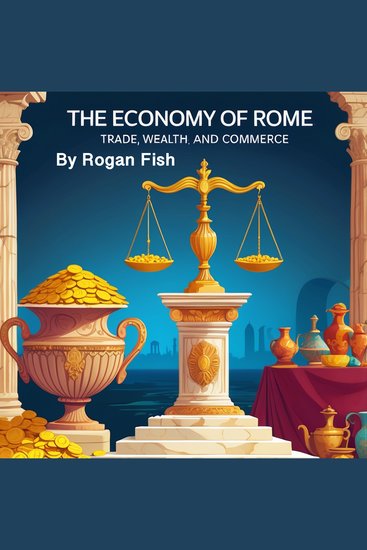
  • The Economy of Rome - Trade Wealth and Commerce - cover

    The Economy of Rome - Trade...

    Rogan Fish

    • 0
    • 0
    • 0
    The Roman economy was built upon a complex and interdependent system that evolved from its agrarian roots into a vast network of trade, production, and commerce. From the early Republic to the height of the Empire, Rome’s economic foundation was shaped by its reliance on agriculture, slave labor, and a structured monetary system. These key components allowed the Roman state to sustain its military conquests, support its urban populations, and facilitate long-distance trade across the Mediterranean and beyond. 
    Agriculture served as the backbone of the Roman economy, with the majority of the population engaged in farming. Small-scale subsistence farming dominated early Roman society, but as the Republic expanded, wealthy landowners acquired vast estates known as latifundia. These estates were worked by slaves and tenant farmers, producing surplus crops such as wheat, olives, and grapes, which were essential to both local consumption and trade. The shift from independent farming to large-scale agricultural estates increased economic disparities but also enabled Rome to support a growing urban population and supply its armies. 
    Slavery played a crucial role in sustaining the Roman economy. Enslaved people were not only laborers in agriculture but also worked in mines, workshops, and domestic households. The steady influx of slaves, primarily through military conquests, allowed Rome to maintain high levels of production and economic growth. The reliance on slave labor, however, also created structural weaknesses, as the economy was dependent on a continuous supply of enslaved workers, making it vulnerable during times of military decline.
    Zum Buch
  • The Fall of Saigon - End of the Vietnam War - cover

    The Fall of Saigon - End of the...

    Nova Ashford

    • 0
    • 0
    • 0
    In the final phase of the Vietnam War, North Vietnam’s military strategy shifted into high gear. Following the 1973 Paris Peace Accords, which led to the withdrawal of U.S. troops, the North Vietnamese leadership viewed the South as vulnerable and unprotected. They seized this opportunity to begin a calculated and aggressive push toward Saigon. With the People's Army of Vietnam (PAVN) leading the offensive, key cities and regions across South Vietnam began to fall in rapid succession. Unlike earlier phases of the war, which were marked by a slow grind of guerrilla warfare and jungle battles, this stage saw well-coordinated, large-scale military campaigns. The North's confidence was bolstered by the perception that American military support would not return in a meaningful way. 
    This advance was not just a military endeavor—it was psychological. Each victory in the North’s campaign chipped away at the morale of South Vietnamese forces. Soldiers deserted in droves, supplies were stretched thin, and leadership at the local and national levels began to falter under pressure. In places like Ban Me Thuot and Pleiku, the speed of the North's takeover stunned both local populations and the South Vietnamese military, who had grown reliant on U.S. support during prior conflicts. Fear and confusion spread among civilians, many of whom began fleeing their homes in anticipation of the advancing northern troops. 
    The North Vietnamese did not rely on brute force alone. They combined strategic military planning with psychological operations to deepen the sense of inevitable defeat among South Vietnamese soldiers and citizens. Leaflets and radio broadcasts promised fair treatment to those who surrendered and warned of dire consequences for those who resisted. The result was an erosion of will more powerful than any bombing campaign. Defenses crumbled not only because of lack of resources, but because of fear and fatigue.
    Zum Buch