Begleiten Sie uns auf eine literarische Weltreise!
Buch zum Bücherregal hinzufügen
Grey
Einen neuen Kommentar schreiben Default profile 50px
Grey
Jetzt das ganze Buch im Abo oder die ersten Seiten gratis lesen!
All characters reduced
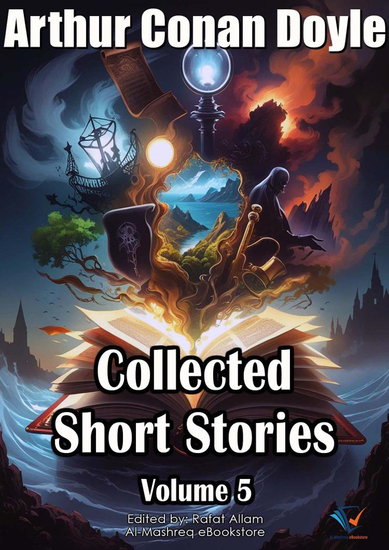
Collected Short Stories Volume 5 - Volume 5 - cover

Collected Short Stories Volume 5 - Volume 5

Arthur Conan Doyle

Verlag: Al-Mashreq eBookstore

  • 0
  • 0
  • 0

Beschreibung

Collected Short Stories, Volume 5 continues Arthur Conan Doyle's survey of his own wide-ranging short fiction. In this collection, the focus shifts to tales of intrigue and suspense. Doyle's knack for crime storytelling is on display in several tight plots involving clever deceptions and justice served. There are also humorous exploits – one story might recount the misadventures of bumbling burglars, while another portrays an absurd duel of wits in high society. Volume 4 doesn't shy away from the macabre, either: a few stories venture into darker territory, with twist endings that reveal criminal horrors or ironic fates. For example, a story like "The Silver Hatchet" mixes crime with a touch of the supernatural in a tale of a cursed object causing madness. Overall, this volume provides a thrilling reading experience, oscillating between light-hearted capers and grim mysteries, all unified by Doyle's clear, vigorous prose.
Verfügbar seit: 01.08.2025.
Drucklänge: 320 Seiten.

Weitere Bücher, die Sie mögen werden

  • Wild Seas Wilder Cities - A collection of environmental fiction poems and articles - cover

    Wild Seas Wilder Cities - A...

    Helen Salsbury, Richard...

    • 0
    • 0
    • 0
    Wild Seas, Wilder Cities is a ‘wild-seeded’ collection of short stories, poems, memoirs and environmental articles from 49 unique contributors, all concerned with showing the positive side of our relationship with the earth. 
     
    Thanks to funding from Portsmouth Creates, this audiobook features 50 different voices from across the Portsmouth community and beyond. Our readers range from teenagers to those in their nineties, including experienced actors, writers and volunteers from the public. 
     
    The many writers, poets and performers in this audiobook have given their work freely, so all profits are donated to the Hampshire & Isle of Wight Wildlife Trust for their Solent Seagrass Restoration Project. 
     
    Recorded at the award-winning Casemates Studios in Portsmouth. 
     
    Find out more at pensoftheearth.co.uk/audiobook 
     
    Reviews for the paperback: 
     
    ‘Calls to us in a rousing chorus of voices … a lyrical force for change.’ Nicola Chester, award winning author of On Gallows Down and Ghosts of the Farm. 
     
    ‘Bursting with inspiring and hopeful visions’ Carys Bray, author of A Song for Issy Bradley 
     
    ‘Mixing fact, fiction and poetry is such a good idea – we bear witness to the natural world in many ways, and the pieces come in all shapes and sizes, carrying messages of determination, love for nature, positive actions and the power of community.’ Sarah Jane Butler, author of Starling 
     
    ‘Full of love, enlightenment, practicality and poetry.’ Toby Litt, author of Patience 
     
    ‘A delightfully encouraging collection of writings on the ways we can help make the world wilder again, how we can change the narrative on climate change. Vibrant and alive, these are wonderful tales told of renaturing – of striving to support life in all its glorious forms on the earth, of restoring hope for the future.’ Dr James Canton, Director of Wild Writing, University of Essex
    Zum Buch
  • Forgetting is How We Survive - cover

    Forgetting is How We Survive

    David Frankel

    • 0
    • 0
    • 0
    A plane crashes. A boy drowns. A body is found on a dark lakeside. A woman tries to make sense of a strange memory from her childhood. A father searches for a missing dog – his only link to his lost son. A boy on the brink of adolescence embarks on a journey and gets more than he bargained for. Young lovers get their kicks trespassing in empty houses. A young man prepares to leave his hometown for the last time, and a giant sink hole threatens to swallow everything.
    In Forgetting Is How We Survive, people are haunted by ghosts of the past, tormented by doppelgangers and pining for the futures that have been lost to them. Each faces a turning point – an event that will move their life from one path to another, and every event casts a shadow.
    The stories in this collection come from another England where earthy realism hides another world where anything is possible.
    Zum Buch
  • 3 Stories - Irony - A trio of classic tales perfect for a commute walk or quiet night in - cover

    3 Stories - Irony - A trio of...

    O Henry, Guy de Maupassant, WW...

    • 0
    • 0
    • 0
    There is something about the number 3.    
     
    The Ancient Greeks believed 3 was the perfect number, and in China 3 has always been a lucky number, and they know a thing or two.   
     
    Most religions also have 3 this and 3 that and, of course, in these more modern times, three’s a crowd may be too many, except when it’s a ménage à trois.  It seems good things usually come in threes. 
     
    Whatever history and culture says WE think 3, a hat-trick of stories, is a great number to explore themes and literary avenues that classic authors were so adept at creating. 
     
    From their pens to your your ears. 
     
    01 - 3 Stories - Irony 
    02 - The Necklace by Guy de Maupassant 
    03 - The Gift of the Magi by O Henry 
    04 - The Monkey's Paw by W W Jacobs
    Zum Buch
  • Shades A Phantasy - Ukranian born Korolenko creates a fictional dialogue of Socrates to examine lifes biggest questions - cover

    Shades A Phantasy - Ukranian...

    Vladimir Korolenko

    • 0
    • 0
    • 0
    Vladimir Galaktionovich Korolenko was born in Zhytomyr, Ukraine, then part of the Russian Empire on 27th July 1853. 
     
    His father died when he was 13 and life was then often struck with bouts of poverty, which resulted in his education being somewhat erratic.   A spell in exile at 23 was followed by another as the politics of the times opposed his volatile but heart-felt passions. 
     
    Writing was also coming to the fore and in 1879 his debut short story telling of a young Narodnik searching for social and spiritual identity, was published. 
     
    In 1881, Korolenko refused to swear allegiance to the new Russian Tsar and was again exiled, this time much farther afield.  He spent the next three years doing manual work, but took time to study local customs and history.  These impressions in exile provided rich material for his writings. 
     
    In 1885 he was allowed to settle in Nizhny, where again he repeatedly questioned the authorities.  That same year ‘Makar's Dream’ established his literary reputation and was part of his first collection ‘Sketches and Stories’, the following year. 
     
    In the early 1890’s when famine struck Central Russia, he went to work on relief missions, collecting donations, supervising the delivery and distribution of food, opening 45 free canteens, all this while writing the graphic reports that would later be published as ‘In the Year of Famine’ in 1893. 
     
    By 1896 despite some psychological disorders, he was well regarded amongst Russian writers and was even a member of the Russian Academy of Sciences.  Throughout his writing career Korolenko was a staunch advocate of human rights, putting that sacred activity above what he called his 'part-time-writing'. 
     
    In the Revolutionary year of 1905, under his editorship, Russkoye Bogatstvo published the Manifest by the Petersburg Soviet of the Workers' deputies. Korolenko was now repeatedly harassed by the authorities, had his flat raided many times and materials confiscated. 
     
    As a lifetime opponent of Tsarism, he guardedly welcomed the Revolution of 1917.  Once the nature of Bolshevism was established, he soon started to criticize it. During the Russian Civil War that ensued, he condemned both the Red Terror and the White Terror.  
     
    Despite suffering from a progressive heart disorder, he collected food packages for children in famine-stricken Moscow and Petrograd as well as organised orphanages and shelters for the homeless.  
     
    Vladimir Korolenko died in Poltava, Ukraine, of the complications of pneumonia on 25th December 1921.  He was 68. 
     
    In this story Korolenko invokes the characters of Socrates and Elpidias who, after their deaths, involve themselves in a debate on God.  This is a tour-de-force of conception and execution.
    Zum Buch
  • The Queen of Spades - The founder of modern Russian literatures most famous piece of prose The Queen of Spades explores themes of greed and risk wrapped in the ebb and flow of an ongoing struggle between supernatural and reality - cover

    The Queen of Spades - The...

    Alexander Puskin

    • 0
    • 0
    • 0
    Alexander Sergeyevich Pushkin was born on 26th May 1799 in Moscow into a family of Russian nobility. 
     
    Raised by nursemaids and French tutors in French he learnt Russian only via the household staff. 
     
    He graduated from the prestigious Imperial Lyceum, near St Petersburg and plunged into the vibrant and raucous intellectual youth culture of what was then the capital of the Russian Empire.  
     
    In 1820, he published his first long poem, ‘Ruslan and Ludmila’, with much controversy about both subject and style.  Pushkin was heavily influenced by the French Enlightenment and gravitated, with other literary radicals, towards social reform angering the Government. 
     
    His early literary work and reputation was poetic and written as he travelled around the Empire or engaged himself in various rebellions against the Ottoman Empire.  A clash with his own government after his poem, ‘Ode to Liberty’, was found among the belongings of the Decembrist Uprising rebels meant two years of internal exile at his mother's rural estate.  His friends and family continually petitioned for his release, sending letters and meeting with Tsar Alexander I and then Tsar Nicholas I.   
     
    In 1825, whilst at his Mother’s estate, Pushkin wrote his most famous play, the drama ‘Boris Godunov’.  
     
    Upon meeting with Tsar Nicholas I, Pushkin obtained his release and began work as the Tsar's Titular Counsel of the National Archives.  However, because of the earlier problems the tsar retained control of everything Pushkin published, and he was banned from travelling at will. 
     
    Around 1828, Pushkin met the 16-year-old Natalia Goncharova, one of the most talked-about beauties of Moscow.  After much hesitation, Natalia accepted his marriage proposal after she received assurances that the government had no intentions to persecute the libertarian poet.  When the Tsar gave Pushkin the lowest court title, Gentleman of the Chamber, he became enraged, feeling that the Tsar intended to humiliate him. 
     
    In the year 1831, during Pushkin's growing literary influence, he met Nikolai Gogol.  Recognising his gifts Pushkin supported him and published his short stories in his own magazine ‘The Contemporary’. 
     
    By the autumn of 1836, Pushkin was falling into greater and greater debt and facing scandalous rumours that his wife was having an affair.  
     
    In January 1837, Pushkin sent a ‘highly insulting letter’ to his wife’s pursuer, Georges-Charles de Heeckeren d'Anthès.  The only answer could be a challenge to a duel. 
     
    It took place on 27th January.  D'Anthès fired first, critically wounding Pushkin; the bullet entered at his hip and penetrated his abdomen.  Two days later Alexander Pushkin died of peritonitis.  He was 37. 
     
    One of Pushkin’s most lauded stories ‘The Queen of Spades’ takes on gambling and the need for just a tiny piece of information that will turn the game in his favour and take life to a level that is sure to be both deserved and his by right.
    Zum Buch
  • The Generous Gambler - From their pens to your ears genius in every story - cover

    The Generous Gambler - From...

    Charles Pierre Baudelaire

    • 0
    • 0
    • 0
    Charles Pierre Baudelaire was born on April 9th 1821 in Paris to an amateur artist mother and professional father.  His father died when Charles was 6 but his mother remarried shortly after to Lieutenant Colonel Jacques Aupick who later became a prominent ambassador.  Consequently Charles received a good education and was encouraged to enter the legal profession by both parents but instead wanted to pursue the life of the writer and had already developed an appetite, whilst studying law, for prostitutes and alcohol that inevitably led to debt and his parents disapproval. 
    Baudelaire's literary published work began with well received art reviews and essays.  He was a pioneering translator which included the works of Edgar Allan Poe but his most remarkable, famous and memorable works was his poetry and in particular his volume entitled The Flowers of Evil ('Les Fleurs du Mal').  The principal subject of these innovative styled poems about the changing nature of beauty in the modern industrialised Paris were sex and death and included lost innocence, lesbianism, alcohol, depression and urban corruption. This work created a huge controversy that led to the successful prosecution of both Baudelaire and his publisher for creating an offense against public morals. However, the book did find an appreciative audience including Victor Hugo who wrote to Baudelaire: 'Your fleurs du mal shine and dazzle like stars... I applaud your vigorous spirit with all my might'.  The poems were hugely influential and in 1949 the judgement was officially reversed and Baudelaire recognised for his incredible talent. 
    He died within a year of suffering a severe stroke on 31st August, 1867 and was buried in the Montparnasse Cemetery.
    Zum Buch