Begleiten Sie uns auf eine literarische Weltreise!
Buch zum Bücherregal hinzufügen
Grey
Einen neuen Kommentar schreiben Default profile 50px
Grey
Jetzt das ganze Buch im Abo oder die ersten Seiten gratis lesen!
All characters reduced
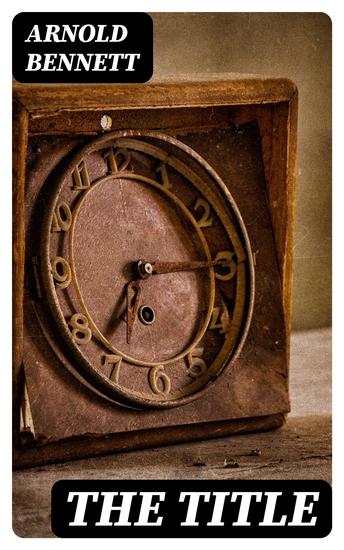
The Title - A Comedy in Three Acts - cover

The Title - A Comedy in Three Acts

Arnold Bennett

Verlag: DigiCat

  • 0
  • 0
  • 0

Beschreibung

In "The Title," Arnold Bennett intricately weaves a narrative that explores the complexities of artistic ambition and the struggle for success within the spheres of early 20th-century British society. The novel employs a keenly observational style, rich in dialogue and vivid characterizations, allowing readers to delve deeply into the psyche of its protagonist. As Bennett deftly captures the tension between personal desires and societal expectations, he offers a penetrating commentary on the nature of identity, the pursuit of authenticity, and the often harsh realities of artistic life in the burgeoning modern age. Arnold Bennett, a prominent figure in the early literary movement known as literary realism, was deeply influenced by his experiences in both the industrial North and the sophisticated culture of London. His background as a writer, critic, and playwright allowed him to navigate the intricacies of both communities, garnering a unique perspective that informs the deeply nuanced characters and settings in The Title. Often drawing on his own struggles with creative expression, Bennett's work exemplifies his commitment to portraying the human condition with honesty and empathy. This compelling exploration is highly recommended for readers interested in modernist literature, artistic representation, and the socio-cultural dynamics of the time. Bennett's nuanced portrayal of the quest for significance in an increasingly complex world resonates profoundly, making "The Title" a vital contribution to any literary canon.
Verfügbar seit: 16.09.2022.
Drucklänge: 53 Seiten.
Weitere Bücher, die Sie mögen werden

  • The Golden Honeymoon - cover

    The Golden Honeymoon

    Ring Lardner

    • 0
    • 0
    • 0
    The Golden Honeymoon is a story about the road, a long marriage, old memories, and the kind of conversation that's been going on for fifty years — and shows no sign of stopping.
    There's Florida sunshine, checkerboard pride, the quiet company of shared days, an unexpected brush with the past, and more oranges than anyone really asked for.
    Told in the voice of a man who always has something to say — and a wife who's heard every word — this Ring Lardner classic is funny, plainspoken, and sharper than it first lets on.
    A story about what's left unsaid when you've already said everything else.
    Zum Buch
  • The Black Cat - cover

    The Black Cat

    Sampi Books, Edgar Allan Poe

    • 0
    • 0
    • 0
    Edgar Allan Poe's "The Black Cat" is a short story that explores themes of guilt and perversity. The narrator, haunted by cruelty to his black cat and acts of domestic violence, is consumed by paranoia and madness. His attempt to conceal a crime leads to his own disgrace.
    Zum Buch
  • No Thoroughfare - cover

    No Thoroughfare

    Wilkie Collins, Charles Dickens

    • 0
    • 0
    • 0
    Walter Wilding has lived his life secure in the knowledge that he was the son of his mother. But a chance encounter shocks him to his deathbed, leaving his friend and Executor George Vendale charged with the finding of the real Walter Wilding. Meanwhile, George pitches woo to Margerite Obenreizer, but has to deal with her dastardly guardian and uncle. The story twists and turns from the wine cellars of England, to Soho and then to the Alps of Switzerland, where George discovers that Mr Obenreizer is right about one thing to the last... "So little is the world, that one cannot keep away from persons." Originally written as a stage play by Wilkie Collins and Charles Dickens, it was later turned into a collaborative novel by the two.  
    Narrated by Michael Ward.
    Zum Buch
  • Gooseberries - From their pens to your ears genius in every story - cover

    Gooseberries - From their pens...

    Anton Chekhov

    • 0
    • 0
    • 0
    Anton Pavlovich Chekhov was born on 29th January 1860 in Taganrog, on the south coast of Russia.  
    His family life was difficult; his father was strict and over-bearing but his mother was a passionate story-teller, a subject Chekhov warmed to. As he later said; ‘our talents we got from our father, but our soul from our mother’.  
    At school Chekhov was distinctly average. At 16 his father mis-managed his finances and was declared bankrupt. His family fled to Moscow. Chekhov remained and eked out a living by various means, including writing and selling short sketches to newspapers, to finish his schooling. That completed and with a scholarship to Moscow University obtained he rejoined his family. 
    He was able to help support them by selling satirical sketches and vignettes of Russian lifestyles and gradually obtained further commissions. In 1884, he qualified as a physician and, although it earned him little, he often treated the poor for free, he was fond of saying ‘Medicine is my lawful wife, and literature is my mistress.’ 
    His own health was now an issue as he began to cough up blood, a symptom of tuberculosis.  Despite this his writing success enabled him to move the family into more comfortable accommodation.  
    Chekhov wrote over 500 short stories which included many, many classics including ‘The Kiss’ and ‘The Lady with a Dog’.  His collection ‘At Dusk’ won him the coveted Pushkin Prize when was only 26.  
    He was also a major playwright beginning with the huge success of ‘Ivanov’ in 1887.   
    In 1892 Chekhov bought a country estate north of Moscow. Here his medical skills and money helped the peasants tackle outbreaks of cholera and bouts of famine. He also built three schools, a fire station and a clinic.  It left him with less time for writing but the interactions with real people gained him detailed knowledge about the peasantry and their living conditions for his stories.  
    His most famous work, ‘The Seagull’ was received disastrously at its premiere in St Petersburg. It was later restaged in Moscow to highlight its psychological aspects and was a huge success. It led to ‘Uncle Vanya’, ‘The Three Sisters’ and ‘The Cherry Orchard’.  
    Chekhov suffered a major lung hemorrhage in 1897 while visiting Moscow. A formal diagnosis confirmed tuberculosis and the doctors ordered changes to his lifestyle.  
    Despite a dread of weddings the elusive literary bachelor quietly married the actress Olga Knipper, whom he had met at rehearsals for ‘The Seagull’, on 25th May 1901. 
    By May 1904 with his tuberculosis worsening and death imminent he set off for the German town of Badenweiler writing cheerful, witty letters to his family and assuring them his health was improving.  
    On 15th July 1904 Anton Chekhov died at Badenweiler.  He was 44.
    Zum Buch
  • The Man of the Crowd - cover

    The Man of the Crowd

    Sampi Books, Edgar Allan Poe

    • 0
    • 0
    • 0
    In "The Man of the Crowd" by Edgar Allan Poe, the narrator becomes obsessed with following a mysterious old man through the bustling streets of London, intrigued by his enigmatic presence. This pursuit reveals the complexity of human nature and the impenetrability of urban anonymity.
    Zum Buch
  • The Voice of God - From their pens to your ears genius in every story - cover

    The Voice of God - From their...

    Winifred Holtby

    • 0
    • 0
    • 0
    Winifred Holtby was born on 23rd June 1898 to a prosperous farming family in the village of Rudston in Yorkshire.  
    A governess provided her early education before she went to Queen Margaret's School in Scarborough.  After passing the entrance exam for Somerville College, Oxford in 1917, she decided to join the Women's Army Auxiliary Corps in early 1918.  However, soon after her arrival in France, the War ended. 
    She returned to study at Oxford and met fellow student Vera Brittain.  After graduating from Oxford, in 1921, Winifred and Vera moved to London, hoping to establish themselves as authors. 
    Her early novels met with only moderate success but as a journalist she was both prolific and increasingly well-known.  Her articles graced more than 20 newspapers and magazines, including the Manchester Guardian newspaper.   
    Winifred was a committed feminist, socialist and pacifist.  She gave many lectures for the League of Nations Union.  She was also active in the Independent Labour Party and was a campaigner for the unionisation of black workers in South Africa. 
    In 1931 the symptoms of high blood pressure, recurrent headaches and bouts of lassitude brought forth a diagnosis of Bright's disease.  She was given two years to live and now put all her efforts into what was to become her crowning achievement: South Riding.  Released posthumously it received lavish praise and enormous sales.  Her canon of works tackle difficult subjects head on, many in unusual ways, brimming with verve and usually strong female protagonists. 
    Winifred Holtby died on 29th September 1935 in London.  She was 37.
    Zum Buch