Join us on a literary world trip!
Add this book to bookshelf
Grey
Write a new comment Default profile 50px
Grey
Subscribe to read the full book or read the first pages for free!
All characters reduced
The Ghost - cover

The Ghost

Arnold Bennett

Publisher: The Ebook Emporium

  • 0
  • 0
  • 0

Summary

"To love her was to invite a death warrant."

Rosetta Rosa is the most beautiful opera singer in Europe, possessing a voice that enchants the masses and a face that haunts every man who sees her. But a terrifying curse follows her: every man who falls in love with her meets a sudden, violent end. When young doctor Carlo Trent finds himself under her spell, he must confront a silent, spectral rival—the jealous ghost of the late Lord Sutherland—who guards Rosa from the grave.

A Supernatural Battle of Wills: Moving from the glittering social circles of London to the foggy streets of Paris, The Ghost is a gripping exploration of obsession. Unlike traditional ghost stories, Bennett's phantom is a chillingly silent presence, a manifestation of pure, possessive malice. Carlo Trent must use his scientific mind to battle an enemy that defies the laws of nature.

The Darker Side of Arnold Bennett: Best known for his realistic "Five Towns" novels, Bennett proves his mastery of the uncanny in this atmospheric thriller. The Ghost blends the high-society drama of the Edwardian era with a psychological horror that explores the thin line between love and madness. It is a story where the most dangerous thing isn't the unknown, but the lingering grip of the past.

Love is eternal. But so is revenge. Purchase "The Ghost" today and experience a classic tale of spectral suspense.
Available since: 01/06/2026.
Print length: 122 pages.

Other books that might interest you

  • For Brodie's Benefit - cover

    For Brodie's Benefit

    Charles E. Van Loan

    • 0
    • 0
    • 0
    For Brodie's Benefit by Charles E. Van Loan is offered here in a clean English digital edition prepared for fluent ebook reading. The work stands within classics and gives modern readers direct access to a public-domain classic with navigable structure and a restrained typographic presentation. The opening pages establish the book's atmosphere with this first movement: BIG TOM O'CONNOR strolled into Shaughnessy's place about ten minutes after the proprietor finished decorating the west wall of the establishment with his most recently acquired work of art, the same being a full-length, life-size portrait of Robert Emmet Brodie, heavy-weight, done in oils and also t This edition is suited to readers who want a reliable, uncluttered version of the text for study, rediscovery, and sustained reading.
    Show book
  • Pelham - A Dandy's Progress Through Society - cover

    Pelham - A Dandy's Progress...

    Edward Bulwer-Lytton

    • 0
    • 0
    • 0
    A young dandy of no particular convictions makes his way through London society, the diplomatic service and a murder investigation, dressed better than anybody. Bulwer-Lytton published it at twenty-five and it is said to be the reason English gentlemen wore black in the evening for the next century.
    Show book
  • The Seven Dials Mystery - cover

    The Seven Dials Mystery

    Agatha Christie

    • 0
    • 0
    • 0
    From the Queen of Crime, a Golden Age detective mystery featuring friends sharing a country house and the practical joke that becomes a heinous crime. During a weekend party at The Chimneys, a historic English country house, a group of friends decide to play a prank on a friend infamous for oversleeping. Only the eight alarm clocks they set up in his room don't wake him up and, in the morning, they discover Gerald isn't just dead asleep. He's dead. Was it an overdose of the sleeping draught beside his bed? Or is there a murderer afoot? Led by Lady Eileen Brent, the houseguests investigate. But their efforts have them stumbling on a spy plot. What sort of killer are they after? And will they find him before he strikes again?
    Show book
  • St Martin's Summer - A King's Envoy at the Château de Condillac - cover

    St Martin's Summer - A King's...

    Rafael Sabatini

    • 0
    • 0
    • 0
    Monsieur de Garnache, the Queen-Regent's hot-tempered envoy, rides into Dauphiny to free Valerie de La Vauvraye from the Château de Condillac, where the dowager is holding her until she agrees to marry the dowager's son Marius, and finds he must draw a sword to get her out. Sabatini spoke five languages and wrote in English because, he said, all the best stories are told in it; the fencing here is technically correct, the comedy is dry, and the whole thing is set in Dauphiné under the regency of Marie de' Medici.
    Show book
  • The Nine Billion Names of God - cover

    The Nine Billion Names of God

    Arthur C. Clarke

    • 0
    • 0
    • 0
    "The Nine Billion Names of God" is a 1953 science fiction short story by British writer Arthur C. Clarke. The story was among the stories selected in 1970 by the Science Fiction Writers of America as one of the best science fiction short stories published before the creation of the Nebula Awards. It was reprinted in The Science Fiction Hall of Fame, Volume One, 1929–1964.In a Tibetan lamasery, the monks seek to list all of the names of God. They believe the Universe was created for this purpose, and that once this naming is completed, God will bring the Universe to an end. Three centuries ago, the monks created an alphabet in which they calculated they could encode all the possible names of God, numbering about 9,000,000,000 ("nine billion") and each having no more than nine characters. Writing the names out by hand, as they had been doing, even after eliminating various nonsense combinations, would take another 15,000 years; the monks wish to use modern technology to finish this task in 100 days.They rent a computer capable of printing all the possible permutations, and hire two Westerners to install and program the machine. The computer operators are skeptical but play along. After three months, as the job nears completion, they fear that the monks will blame the computer (and, by extension, its operators) when nothing happens. The Westerners leave slightly earlier than their scheduled departure without warning the monks, so that it will complete its final print run shortly after they leave. On their way to the airfield they pause on the mountain path. Under a clear night sky they estimate that it must be just about the time that the monks are pasting the final printed names into their holy books. Then they notice that "overhead, without any fuss, the stars were going out."
    Show book
  • Speed - From their pens to your ears genius in every story - cover

    Speed - From their pens to your...

    Sinclair Lewis

    • 0
    • 0
    • 0
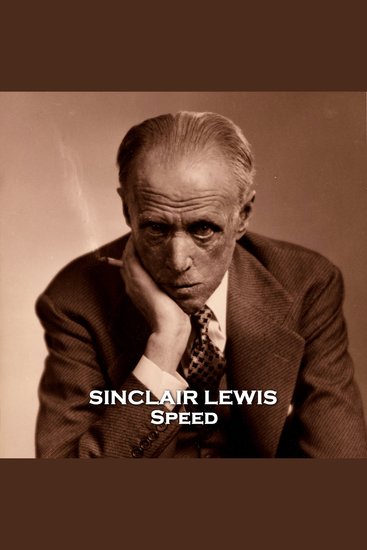
    Harry Sinclair Lewis was born on 7th February 1885 in the village of Sauk Centre, Minnesota. 
    Childhood was lonely. He was ungainly looking—red-headed, tall, overly thin, stricken with acne and somewhat pop-eyed—making friends and meeting girls were difficult for him. At 13 he unsuccessfully absconded from home in an attempt to become a drummer boy in the Spanish-American War. 
    In late 1902 Lewis left home for the Oberlin Academy in preparation for Yale University. At Oberlin, he developed a religious enthusiasm that ebbed and flowed for his remaining teenage years. The following year he was at Yale but did not receive his degree until 1908, having taken time off to work at Upton Sinclair's cooperative-living colony in Englewood, New Jersey, and to travel to Panama.  
    Lewis's earliest published creative work—romantic poetry and short sketches—appeared in some Yale magazines, one of which he later became editor of. After graduation Lewis moved location and jobs several times trying to make ends meet whilst writing fiction for publication.  
    In working for newspapers and publishing houses he developed a knack for churning out short stories for magazines. He also earned money by selling plots to Jack London. 
    Lewis first published  ‘Hike and the Aeroplane’ in 1912 under a pseudonym. A couple of years later his books were rather more serious in tone and by 1930 he was the first American author to receive the Nobel Prize in Literature, which was awarded "for his vigorous and graphic art of description and his ability to create, with wit and humor, new types of characters."  
    Amongst his classics which changed the shape of American fiction were ‘Main Street’, ‘Babbitt’, ‘Arrowsmith’ (for which he received but declined the 1926 Pulitzer Prize), ‘Elmer Gantry’, ‘Dodsworth’ and his prediction of a US fascist dictator in ‘It Can’t Happen Here.’ 
    As well as novels, he wrote numerous short stories, plays and other articles. 
    Sinclair Lewis died in Rome on 10th January 1951, aged 65, from advanced alcoholism.
    Show book