Begleiten Sie uns auf eine literarische Weltreise!
Buch zum Bücherregal hinzufügen
Grey
Einen neuen Kommentar schreiben Default profile 50px
Grey
Jetzt das ganze Buch im Abo oder die ersten Seiten gratis lesen!
All characters reduced
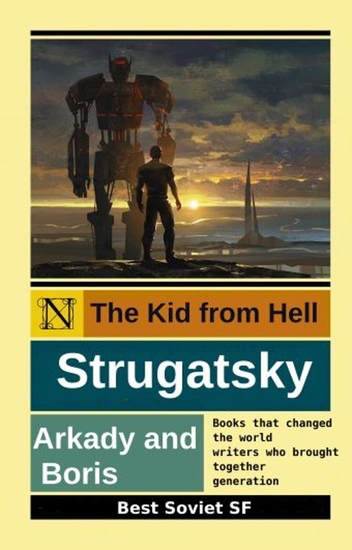
The Kid from Hell - Best Soviet SF - cover

The Kid from Hell - Best Soviet SF

Arkady Strugatsky, Boris Strugatsky

Verlag: Readers Union / The Science Fiction Book Club

  • 0
  • 0
  • 0

Beschreibung

The novel tells the story of Gack, a teenage boy from Giganda. Gack is a cadet commando in Fighting Cats: an elite army unit of the Alai Duchy. In the first chapter of the novel, Gack is mortally wounded in a dogfight with an attacking tank unit of the army of the Empire. Kornei Yashmaa, a progressor, finds him and takes him to Earth, where the doctors practically resurrect Gack. Yashmaa tries to help Gack adjust to life on Earth.
 
However, Gack does not want to cooperate, nor does he believe that Earth is real. At first, he thinks that everything Yashmaa and other Earthlings tell him is a part of his psychological training as an officer of the Alai Army. Even after Yashmaa proves to him that he is indeed on a different planet, Gack still thinks that he was sent to Earth with an unknown secret mission by the Alai military.
 
His next idea is that the Earth wants to conquer Giganda and wants to use him as a test subject or a future propaganda agent. As he learns more about the technology and lifestyle on Earth (he is even given an android servant), he becomes more and more confused. Accidentally, Gack discovers that other Gigandians have been taken to Earth as well, but they have integrated into the society and do not want to deal with him.
 
After a month since Gack's arrival on Earth, Yashmaa tells him that the war on Giganda was stopped by progressors and that the Alai Duchy as well as the Empire is no more. Gack is shocked by the news so much that he demands to go back to Giganda immediately. When Yashmaa refuses, Gack tries to escape by force. With the help of his android servant, he manages to construct an assault rifle and ammunition to it. Gack threatens to shoot Yashmaa if he does not send him back. Yashmaa can easily disarm Gack, but, persuaded by Gack's actions, decides to let him go.
 
In the last chapter, Gack is back on Giganda and helps local doctors cure a plague ravaging a nearby city. He is home.
Verfügbar seit: 28.05.2023.
Drucklänge: 180 Seiten.

Weitere Bücher, die Sie mögen werden

  • The Yarkand Manner - cover

    The Yarkand Manner

    Saki Saki

    • 0
    • 0
    • 0
    The Yarkand Manner by Saki is a satirical short story that explores the peculiarities of human behavior through the lens of a fictional newspaper's editorial staff. The narrative begins with Sir Lulworth Quayne and his nephew discussing the phenomenon of migration among both animals and humans. 
    They reflect on a recent trend where the entire staff of the Daily Intelligencer, a prominent London newspaper, embarks on an ambitious journey to Eastern Turkestan, seeking adventure and new perspectives.Upon their return, however, the staff adopts a mysterious and aloof demeanor known as the "Yarkand manner." This change leads to a decline in communication and accessibility, causing confusion and concern among their colleagues and the public.
    Zum Buch
  • A Man with Two Lives - From their pens to your ears genius in every story - cover

    A Man with Two Lives - From...

    Ambrose Bierce

    • 0
    • 0
    • 0
    Ambrose Gwinnett Bierce was born on 24th June 1842 at Horse Cave Creek in Meigs County, Ohio. His parents were poor but they introduced him to literature at an early age, instilling in him a deep appreciation of books, the written word and the elegance of language.  
    Growing up in Koscuisko County, Indiana poverty and religion were defining features of his childhood, and he would later describe his parents as “unwashed savages” and fanatically religious, showing him little affection but always quick to punish. He came to resent religion, and his introduction to literature appears to be their only positive effect. 
    At age 15 Bierce left home to become a printer’s devil, mixing ink and fetching type at The Northern Indian, a small Ohio paper. Falsely accused of theft he returned to his farm and spent time sending out work in the hopes of being published. 
    His Uncle Lucius advised he be sent to the Kentucky Military Institute. A year later he was commissioned as an Officer.  As the Civil War started Bierce enlisted in the 9th Indiana Infantry Regiment.  
    In April 1862 Bierce fought at the Battle of Shiloh, an experience which, though terrifying, became the source of several short stories. Two years later he sustained a serious head wound and was off duty for several months. He was discharged in early 1865.  
    A later expedition to inspect military outposts across the Great Plains took him all the way to San Francisco. He remained there to become involved with publishing and editing and to marry, Mary Ellen on Christmas Day 1871.  They had a child, Day, the following year.  
    In 1872 the family moved to England for 3 years where he wrote for Fun magazine. His son, Leigh, was born, and first book, ‘The Fiend’s Delight’, was published.  
    They returned to San Francisco and to work for a number of papers where he gained admiration for his crime reporting. In 1887 he began a column at the William Randolph Hearst’s San Francisco Examiner.  
    Bierce’s marriage fell apart when he discovered compromising letters to his wife from a secret admirer. The following year, 1889 his son Day committed suicide, depressed by romantic rejection. 
    In 1891 Bierce wrote and published the collection of 26 short stories which included ‘An Occurrence at Owl Creek Bridge’.  Success and further works including poetry followed.  
    Bierce with Hearst’s resources helped uncover a financial plot by a railroad to turn 130 million dollars of loans into a handout. Confronted by the railroad and asked to name his price Bierce answered “my price is $130 million dollars. If, when you are ready to pay, I happen to be out of town, you may hand it over to my friend, the Treasurer of the United States”.  
    He now began his first foray as a fabulist, publishing ‘Fantastic Fables’ in 1899.  But tragedy again struck two years later when his second son Leigh died of pneumonia relating to his alcoholism.  
    He continued to write short stories and poetry and also published ‘The Devil’s Dictionary’.  
    At the age of 71, in 1913 Bierce departed from Washington, D.C., for a tour of the battlefields where he had fought during the civil war. At the city of Chihuahua he wrote his last known communication, a letter to a friend. It’s closing words were “as to me, I leave here tomorrow for an unknown destination,” Ambrose Bierce then vanished without trace.
    Zum Buch
  • A New Script - A System Apocalypse short story - cover

    A New Script - A System...

    Tao Wong

    • 0
    • 0
    • 0
    Every moment, filmed. Every struggle, recorded.  
       
    Day to day life is hard for film students. Whether you're an editor, a scriptwriter or a videographer, it's never easy. More so when an apocalypse has arrived, taking with it the industry you've dedicated your life to and leaving you with Skills ill-suited to a post-apocalyptic fantasy hellscape.  
       
    But humans are adaptable and Skills, with just a touch of imagination, can be wielded with precision.  
       
    And if there's one thing this party has, it's imagination galore.  
       
    A New Script is set in the second year of the apocalypse (between books 4 and 5) and features new characters.
    Zum Buch
  • The Decameron Volume I - cover

    The Decameron Volume I

    Giovanni Boccaccio

    • 0
    • 0
    • 0
    "The Decameron" is a collection of novellas by Italian author Giovanni Boccaccio, written between 1348 and 1353. It is a masterpiece of Italian literature and a significant work of early Renaissance literature. The frame narrative of "The Decameron" revolves around ten individuals who flee plague-ridden Florence and take refuge in a villa in the countryside. To pass the time, they tell one another stories—100 in total—over the course of ten days. These stories encompass a wide range of themes, from love and morality to wit and humor, and they offer a vivid portrayal of Italian society in the 14th century.
    Zum Buch
  • After the Funeral - From their pens to your ears genius in every story - cover

    After the Funeral - From their...

    Mary Butts

    • 0
    • 0
    • 0
    Mary Frances Butts was born on 13th December 1890 in Poole, Dorset. 
    Her early years were spent at Salterns, an 18th-century house overlooking Poole Harbour.  Sadly in 1905 her father died, and she was sent for boarding at St Leonard's school for girls in St Andrews. 
    Her mother remarried and, from 1909, Mary studied at Westfield College in London, and here, first became aware of her bisexual feelings.  She was sent down for organising a trip to Epsom races and only completed her degree in 1914 when she graduated from the London School of Economics.  By then Mary had become an admirer of the occultist Aleister Crowley and she was given a co-authorship credit on his ‘Magick (Book 4)’. 
    In 1916, she began the diary which would now detail her future life and be a constant reference point for her observations and her absorbing experiences. 
    During World War I, she was doing social work for the London County Council in Hackney Wick, and involved in a lesbian relationship.  Life changed after meeting the modernist poet, John Rodker and they married in 1918. 
    In 1921 she spent 3 months at Aleister Crowley's Abbey of Thelema in Sicily; she found the practices dreadful and also acquired a drug habit.  Mary now spent time writing in Dorset, including her celebrated book of short stories ‘Speed the Plough’ which saw fully develop her unique Modernist prose style. 
    Europe now beckoned and several years were spent in Paris befriending many artists and writing further extraordinary stories.   
    She was continually sought after by literary magazines and also published several short story collections as books. Although a Modernist writer she worked in other genres but is essentially only known for her short stories.  Mary was deeply committed to nature conservation and wrote several pamphlets attacking the growing pollution of the countryside. 
    In 1927, she divorced and the following year her novel ‘Armed with Madness’ was published.  A further marriage followed in 1930 and time was spent attempting to settle in London and Newcastle before setting up home on the western tip of Cornwall.  By 1934 the marriage had failed. 
    Mary Butts died on 5th March 1937, at the West Cornwall Hospital, Penzance, after an operation for a perforated gastric ulcer. She was 46.
    Zum Buch
  • Seasons of Purgatory - cover

    Seasons of Purgatory

    Shahriar Mandanipour

    • 0
    • 0
    • 0
    The first English-language story collection from "one of Iran's most important living fiction writers" (Guardian) 


    In Seasons of Purgatory, the fantastical and the visceral merge in tales of tender desire and collective violence, the boredom and brutality of war, and the clash of modern urban life and rural traditions. Mandanipour, banned from publication in his native Iran, vividly renders the individual consciousness in extremis from a variety of perspectives: young and old, man and woman, conscript and prisoner. While delivering a ferocious social critique, these stories are steeped in the poetry and stark beauty of an ancient land and culture.
    Zum Buch