Junte-se a nós em uma viagem ao mundo dos livros!
Adicionar este livro à prateleira
Grey
Deixe um novo comentário Default profile 50px
Grey
Assine para ler o livro completo ou leia as primeiras páginas de graça!
All characters reduced
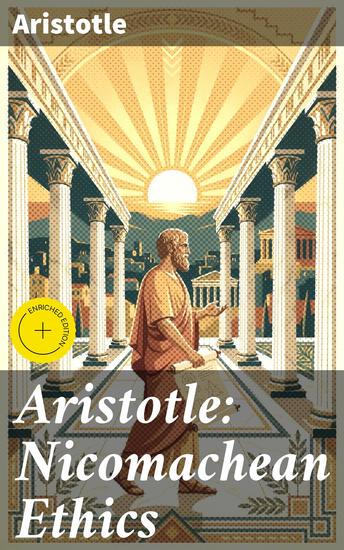
Aristotle: Nicomachean Ethics - Enriched edition Complete Edition - cover
LER

Aristotle: Nicomachean Ethics - Enriched edition Complete Edition

Aristotle

Tradutor D. P. Chase

Editora: Good Press

  • 0
  • 0
  • 0

Sinopse

In "Nicomachean Ethics," Aristotle presents a foundational text in the study of moral philosophy, meticulously exploring the nature of the good life and the cultivation of virtue. Through a methodical and pragmatic approach, Aristotle delves into key concepts such as happiness (eudaimonia), moral virtue, and the role of reason in ethical decision-making. The work stands out for its blend of rigorous analytic thought and relatable examples, situating the discussion in the context of the classical Greek polis. Its influence extends beyond philosophy into multiple disciplines, inviting rich dialogues on ethics and personal responsibility. Aristotle, a student of Plato and tutor to Alexander the Great, draws upon his extensive experience in both philosophical inquiry and empirical observation to shape this pivotal ethical treatise. His familiarity with the political structures and moral dilemmas of ancient Greece informs his exploration of human behavior and the pursuit of a meaningful life. This work reflects his endeavor to synthesize the theoretical with the practical, grounded in his belief that ethics must permeate all aspects of human existence. Highly recommended for students of philosophy and anyone seeking to enhance their understanding of ethical principles, "Nicomachean Ethics" is an essential read. Aristotle'Äôs insights remain profoundly relevant, encouraging reflection on personal values and the pursuit of a virtuous life in contemporary society.

In this enriched edition, we have carefully created added value for your reading experience:
- A succinct Introduction situates the work's timeless appeal and themes.
- The Synopsis outlines the central plot, highlighting key developments without spoiling critical twists.
- A detailed Historical Context immerses you in the era's events and influences that shaped the writing.
- An Author Biography reveals milestones in the author's life, illuminating the personal insights behind the text.
- A thorough Analysis dissects symbols, motifs, and character arcs to unearth underlying meanings.
- Reflection questions prompt you to engage personally with the work's messages, connecting them to modern life.
- Hand‐picked Memorable Quotes shine a spotlight on moments of literary brilliance.
- Interactive footnotes clarify unusual references, historical allusions, and archaic phrases for an effortless, more informed read.
Disponível desde: 01/12/2023.
Comprimento de impressão: 180 páginas.

Outros livros que poderiam interessá-lo

  • The Third Battle of Ypres - The History of the Largest Battle in Flanders during World War I - cover

    The Third Battle of Ypres - The...

    Charles River Editors

    • 0
    • 0
    • 0
    With the exception of a few hours on Christmas Day 1914, the shelling, sniping, raids, and bloodshed at Ypres in Belgium never ceased from the moment of first contact between the British Expeditionary Force (BEF) and the Imperial German army. The Ypres salient had formed the previous year during the “race to the sea,” when the opposing armies tried and failed to outflank each other in a series of maneuvers and counter-maneuvers.  
    	The Ypres salient bulged a few miles forward into Belgium, representing the only part of that nation the Germans had not occupied. Held by a mix of British, French, Canadian, Belgian, and colonial troops, this thorn in the Germans’ side had held off massive but clumsily handled attacks by barely-trained German volunteers and conscripts in late 1914 at the First Battle of Ypres. Each side had attempted to launch a major offensive through Ypres at the same time, leading to a blood-soaked encounter battle that, after weeks of futile butchery amid the small farms, hedgerows, canals, and tracts of woodland, devolved into a grim stalemate. Lines of trenches faced each other and sniping, artillery bombardment, and small actions led to an ongoing stream of casualties to the rear and corpses into the new soldiers’ graveyards established conveniently close to the front lines.  
    	The heaviest fighting in the vicinity took place in 1917 during the Third Battle of Ypres, a linked series of battles on the Western Front that took place from July-November of that year. It is still remembered as one of the most notorious battles in British history. British troops, who called this series of battles Passchendaele after the small Belgian village that formed the final objective, continued to use the same tactics that had been employed since early 1915 as they were ordered into frontal attacks on prepared German trenches protected by artillery, barbed wire, bunkers, and machine gun positions.
    Ver livro
  • Creating the Modern Army - Citizen-Soldiers and the American Way of War 1919-1939 - cover

    Creating the Modern Army -...

    William J. Woolley

    • 0
    • 0
    • 0
    The modern US Army was largely created in the years between the two world wars. Prior to World War I, officers in leadership positions were increasingly convinced that building a new army could not take place as a series of random developments but had to be guided by military policy. In 1920, Congress accepted that idea and embodied it in the National Defense Act. In doing so it also accepted army leadership's idea of entrusting America's security to the Citizen Army, and tasked the nation’s Regular Army with developing and training that force. Creating the Modern Army details the efforts of the Regular Army to do so in the face of austerity budgets and public apathy while simultaneously responding to the challenges posed by the new and revolutionary mechanization of warfare. 


    In this book Woolley focuses on the development of what he sees as the four major features of the modernized army that emerged due to these efforts. 


    The US Army that fought World War II was clearly a citizen army whose leadership was largely trained within the framework of the institutions of the army created by the National Defense Act. The way that army fought the war may have been less decisive and more costly in terms of lives and money than it should have been. But that army won the war and therefore validated the citizen army as the US way of war.
    Ver livro
  • A Most Awkward Ridiculous Appearance - cover

    A Most Awkward Ridiculous...

    Benjamin Franklin

    • 0
    • 0
    • 0
    Benjamin Franklin left behind quite a legacy as an inventor, politician, and philosopher. Yet when he first arrived in Philadelphia, his future wife thought he had “a most awkward, ridiculous appearance.” Franklin recalls that this was because at the time he was carrying a large dinner roll under each arm and eating a third as he walked down the street. This delightful excerpt from his memoir shows how Franklin got his start in the printing business and demonstrates his skill as a humorist.  
    Ver livro
  • The Fragile Planet - Zero Waste Strategies in The Fight Against Climate Change And Pollution - cover

    The Fragile Planet - Zero Waste...

    Davis Truman

    • 0
    • 0
    • 0
    This audiobook is narrated by an AI Voice.  
    "The Fragile Planet" will take you on an inspirational journey towards a sustainable future. In an era where our planet faces unprecedented challenges, this book is a beacon of hope, illuminating the path to a cleaner, greener, and more resilient world. 
    With meticulous research and compelling storytelling, "The Fragile Planet" explores the intricate web of interconnected issues that threaten our world, from carbon emissions to plastic pollution, deforestation to biodiversity loss. 
    This book serves as a blueprint for a brighter future, outlining zero-waste strategies that individuals, communities, and nations can adopt to combat climate change and pollution effectively. It offers well-researched evidence and inspiring success stories, empowering readers to take meaningful action in their own lives. 
    Embrace this enlightening journey, and join the global movement to protect our only home - the fragile planet.
    Ver livro
  • Inner Citadel The: A guided meditation for inner strength calm and resilience - cover

    Inner Citadel The: A guided...

    Serene Ember

    • 0
    • 0
    • 0
    The Inner Citadel is a contemplative audiobook devoted to inner stillness, clarity, and quiet strength. Through poetic reflection and calm narration, it gently guides the listener inward—away from noise, excess, and external pressure—toward a grounded and peaceful center that remains steady through change. 
    Rather than offering rules or instruction, this audiobook invites reflection on simplicity, responsibility, compassion, impermanence, and the unshakable presence within. Each passage encourages awareness, integrity, and a deeper understanding that lasting peace is not found in controlling the outer world, but in returning to balance within oneself. 
    Designed for slow listening and thoughtful presence, The Inner Citadel serves as a meditative companion for those seeking calm in uncertain times and a deeper connection with their own inner life.
    Ver livro
  • Ancient Greek Astronomy and Astrology: The History of Celestial Observations in Greece - cover

    Ancient Greek Astronomy and...

    Charles River Editors

    • 0
    • 0
    • 0
    For the ancient Greeks, the gods were capricious beings subject to the same passions, emotions, and vicissitudes as humans were, and no more enlightened as to the nature of existence and the path to a good and happy life. Given the fallibility of the gods in Greek mythology, some philosophers and scientists stepped in where religion refused to go. As early as the 6th century BCE Greek thinkers began to thoroughly explore the world and the actions of humans through natural science, reason, mathematics, metaphysics, and ontology. After Thales, a stream of philosophers, mathematicians, and engineers emerged, including names that are well known today, including Plato, Aristotle, Socrates, Pythagoras, Archimedes, Heraclitus, Epicurus, and Diogenes. 
    For the ancient Babylonians and Egyptians, sky watching served religious or practical purposes, but for the Greeks, it was also theoretical. They wanted to know why heavenly bodies moved as they did, and for that reason, the Greeks added mathematics, geometry, and philosophical reasoning to the crucial foundational data of the Sumerians, Babylonians, and Egyptians. Over hundreds of years, various Greek innovators explored the underlying mechanics of the universe, leading to the first physical models of the cosmos. By the 5th century BCE, Pythagoras proposed that the world was not flat, but a sphere, Anaxagoras explained why eclipses happened and described meteorites, and Leucippus and Democritus wrote that tiny, invisible atoms were the building blocks of the entire universe. By the 3rd century BCE, Aristarchus of Samos taught that Earth rotated on its axis each day and revolved around the Sun each year. Eratosthenes used geometry to calculate the distance around Earth from pole to pole, and he came unbelievably close to precisely accurate measurements. Thanks to these scientific pioneers and their works, the Greeks laid the cornerstone of modern astronomy. 
    Ver livro