¡Acompáñanos a viajar por el mundo de los libros!
Añadir este libro a la estantería
Grey
Escribe un nuevo comentario Default profile 50px
Grey
Suscríbete para leer el libro completo o lee las primeras páginas gratis.
All characters reduced
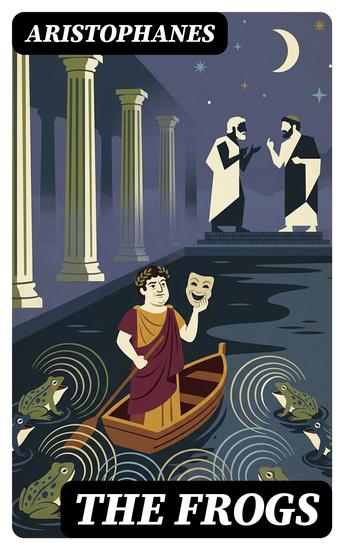
The Frogs - Enriched edition - cover

The Frogs - Enriched edition

Aristophanes

Editorial: DigiCat

  • 0
  • 0
  • 0

Sinopsis

In "The Frogs," Aristophanes skillfully combines comedy and social critique to explore themes of art, politics, and the afterlife within the context of Athenian drama. This satirical play, structured as a journey to the underworld, showcases Aristophanes' hallmark use of clever wordplay, vivid characters, and biting humor. As the protagonist, Dionysus, embarks on a quest to retrieve the playwright Euripides, the narrative serves as both a reflection on the decline of Athenian drama and a critique of contemporaneous political landscapes. The interactions between the dead poets serve as a vehicle for Aristophanes to express his perspective on the state of tragedy and the cultural shifts in Athens, illustrating the fragility and vitality of artistic expression amidst societal change. Aristophanes, often referred to as the 'father of comedy,' lived during the tumultuous periods of the Peloponnesian War and reflected the zeitgeist of his times through his work. His sharp wit and keen observations of Athenian life illuminate the socio-political issues faced by citizens. Aristophanes had a profound interest in the theatre's role as a social commentator, which is central to "The Frogs," as it invites audiences to consider the value of both art and the artist within their society. "The Frogs" is an essential read for enthusiasts of classic literature and those interested in the interplay between comedy and tragedy. With its rich layers of meaning and cultural critique, this play not only entertains but also provokes thoughtful reflection on the role of the arts in society. Aristophanes' masterful blend of humor and philosophy offers valuable insights that resonate even in contemporary contexts, making this work a timeless exploration of the human condition.

In this enriched edition, we have carefully created added value for your reading experience:
- A succinct Introduction situates the work's timeless appeal and themes.
- The Synopsis outlines the central plot, highlighting key developments without spoiling critical twists.
- A detailed Historical Context immerses you in the era's events and influences that shaped the writing.
- An Author Biography reveals milestones in the author's life, illuminating the personal insights behind the text.
- A thorough Analysis dissects symbols, motifs, and character arcs to unearth underlying meanings.
- Reflection questions prompt you to engage personally with the work's messages, connecting them to modern life.
- Hand‐picked Memorable Quotes shine a spotlight on moments of literary brilliance.
- Interactive footnotes clarify unusual references, historical allusions, and archaic phrases for an effortless, more informed read.
Disponible desde: 16/09/2022.
Longitud de impresión: 36 páginas.

Otros libros que te pueden interesar

  • Momentous Words - cover

    Momentous Words

    Edward Rowland Sill

    • 0
    • 0
    • 0
    LibriVox volunteers bring you 10 recordings of Momentous Words by Edward Rowland Sill. This was the weekly poetry project for the week of November 23rd, 2008.
    Ver libro
  • Henry IV Part One - cover

    Henry IV Part One

    Pierre Arthur Laure, Tom...

    • 0
    • 0
    • 0
    This play introduces Shakespeare’s greatest comedic character, the dissolute knight Sir John Falstaff. 
    While King Henry’s England is threatened by rebellion, the king’s scapegrace son Hal haunts the taverns of London, his companions a crew of rogues and thieves let by Falstaff. The earl of Northumberland and his fiery son Hotspur scheme to overthrow the crown. Can Hal be brought to a sense of duty as Prince of Wales? Or will the influence of Falstaff prove too strong? The issue is decided when Hal, Hotspur, and Falstaff come together at the climactic battle of Shrewsbury. 
    Hal is played by Jamie Glover and King Henry by Julian Glover. Richard Griffiths is Falstaff. 
    ACT IScene 1. King Henry’s plans to lead a crusade to the Holy Land are frustrated when he hears that an English army under Edmund Mortimer has been defeated by the Welsh chieftan Owen Glendower. Henry reveals that Harry Percy, known as Hotspur, has defeated the Scottish Earl of Douglas in battle. Thinking of his son, unruly Hal, the King envies the valiant Hotspur’s father, the Lord Northumberland. The King’s council is to convene on the following Wednesday when Hotspur will be made to account for his giving the king only one of his hostages.Scene 2. Ned Poins tries to persuade Prince Hal and his friend, the debauched knight Sir John Falstaff, to take part in a robbery at Gadshill. The Prince reuses but is finally persuaded by Poins, who has a secret scheme to expose Falstaff for the coward he is. Once alone, Hal muses on his unprincely behavior, comparing himself to the sun, who allows himself to be covered by the clouds, only to appear more brilliant when he emerges from the “ugly mists.”Scene 3. King Henry angrily dismisses Worcester when the Earl reminds him that it was his family that first put Henry on the throne. Hotspur claims that his irritation at the arrival of a foppish courtier on the battlefield has been misinterpreted as a refusal to give up prisoners to the king. However, he will only agree to surrender them if the King ransoms Mortimer, Hotspur’s brother-in-law. Henry is incensed: Mortimer, he says, is a traitor, having married his captor Owen Glendower’s daughter. Unmoved by Hotspur’s impassioned defense of Mortimer, he warns, “Send us your prisoners, or you will hear of it.” Northumberland restrains the enraged Hotspur. Worcester reminds them that the King’s hostility to Mortimer stems from the fact that he, not Henry, is Richard II’s rightful heir. When Hotspur finally calms down, his uncles suggests that they raise a rebellion against the King, relying on the support of Glendower, Douglas, Mortimer, and the Archbishop of York. 
    ACT IIScene 1. Gadshill hears that there are wealthy travelers on the road: an ideal prey for their planned robbery.Scene 2. Falstaff and his cronies rob the travelers, and are, in turn, assaulted by Hal and Poins, who are in disguise.Scene 3. Hotspur’s wife Kate begs him to tell her why he is so abstracted, but he warns her not to question him further.Scene 4. Prince Hal is relaxing in an Eastcheap tavern when Falstaff arrives and recounts how he fought off eleven men. When Hal reveals that the two assailants were, in fact, Poins and himself, Falstaff is unabashed, claiming that he recognized Hal all along, and would not have killed the heir apparent. A messenger arrives from the King, summoning the Prince to court in the morning: the rebels are rising. Hal is concerned at the prospect of being horribly “chid” by his father the king but Falstaff persuades him to practice an answer. A Sheriff arrives to arrest Falstaff for his part in the robbery, but Hal lies to protect his friend. The stolen money, he says, will be paid back with interest. 
    ACT IIIScene 1. The rebels gather at Glendower’s castle in Wales. Hotspur and Glendower quarrel over the division of the Kingdom, though Hotspur is finally pacified. The wives of Hotspur and Mortimer enter and the rebels seem at amity.Scene 2. The king
    Ver libro
  • Much Ado About Nothing - cover

    Much Ado About Nothing

    William Shakespeare

    • 0
    • 0
    • 0
    Much Ado About Nothing appears to have been written around 1599, shortly before As You Like It and Twelfth Night. The action combines two narrative threads: the spirited comedy of the courtship of Benedick and Beatrice, and the sombre tale of confused love between Hero and Claudio. The first is a creation by Shakespeare and the second appears to have been drawn from an Italian source, either by Bandello or Ariosto. 
    The action takes place in Messina. Eponymous lovers Hero and Claudio seem to be ideally matched and nearly everyone is looking forward to their impending marriage. The odd man out is the sinister Don John, brother and former enemy of Don Pedro, Prince of Aragon, but recently restored to the Prince’s favour. Being of a morose and jealous temperament, Don John plots to disrupt the wedding and cause division between the lovers, with the aid of his fellow conspirators, Borachio and Conrade. However, this evil plan is thwarted by an unexpected incursion by the bumbling constables Dogberry and Verges. The young couple are finally reunited, but only after Claudio has first been led to believe that his rejected spouse, Hero, has died of shame and grief.  
    The matching of Beatrice and Benedick, encouraged by some artful chicanery by Hero and Claudio, and marked by many witty and sardonic exchanges of repartee, serves to lighten the texture of the darker elements of the action. 
    Featuring Emma Faye as Hero, Kendra Murray as Beatrice, Dara Brown as Claudio, Lillian Rachel as Benedick, Cate Barratt as Dogberry, and Gary Macfadden as Don John. Also featuring the voices of Catherine Bilson, Ron Altman, Alan Weyman, P J Morgan, Claudio Anglade, John Burlinson and Linda Barrans. 
    Songs arranged by Alan Weyman 
    Audio edited by Denis Daly 
    Text kindly provided by playshakespeare.com
    Ver libro
  • Paradise Lost - Key Insights - cover

    Paradise Lost - Key Insights

    John Milton

    • 0
    • 0
    • 0
    Step into an epic tale of ambition, rebellion, and redemption. Paradise Lost is one of the greatest masterpieces ever written, a timeless journey through the depths of human choice and divine purpose. 
    This powerful narrative unveils the dramatic fall of angels, the rise of darkness, and the eternal struggle between good and evil. With vivid imagery and profound reflections, it explores the courage to resist temptation, the pain of loss, and the resilience of the human spirit. 
    More than a story, this is an exploration of destiny, freedom, and the inner battles that define us. Perfect for listeners who seek inspiration, wisdom, and the reminder that even in the midst of chaos, hope and light endure. 
    Let this audiobook awaken your imagination and challenge your perspective on life, faith, and the choices that shape your future.
    Ver libro
  • Paradise Lost (version 2) - cover

    Paradise Lost (version 2)

    John Milton

    • 0
    • 0
    • 0
    As Vergil had surpassed Homer by adapting the epic form to celebrate the origin of the author’s nation, Milton developed it yet further to recount the origin of the human race itself and, in particular, the origin of and the remedy for evil; this is what he refers to as “things unattempted yet in prose or rhyme.”After a statement of its purpose, the poem plunges, like its epic predecessors, into the midst of the action, shockingly bringing to the front the traditional visit to the underworld, for Satan’s malice is the mainspring of the negative action.  But at the center of the poem lies the triumph by the Son of God over the angelic rebels, which counteracts Satan’s evil design.  To preview this pattern, the fallen angels’ council in hell is counterbalanced by a council in heaven, in which the Son offers himself as a scapegoat for mankind long before the original sin has been committed.With this background, the narrator introduces us to Eden and our “Grand Parents.”  Satan is detected spying on them and is expelled from the garden, after which God sends an angel to tutor Adam and Eve in the history of the heavenly war that has led to the present situation.  At Adam's request, the heavenly guest then recounts the creation of the visible world, explaining also the proper nature of development, whereby all things proceed from lower to higher by refining that which nourishes them.Satan, however, returning in the form of a snake, offers Eve an evolutionary shortcut in the form of a magical food capable of endowing her with super powers.  He claims it has conferred on him both reason and speech.  Since Eve is suffering at the moment from a fancied slight to her moral strength, she allows herself to forget her recent lesson and yields to this temptation.  Adam, unable to imagine life without Eve (and failing to explore alternatives to sin), accepts the fruit from her and eats as well. Satan’s triumph is short-lived, for although hell and the world of mankind are now linked by a broad highway, he and his followers are humiliated in hell by being turned involuntarily into snakes every year.Whatever their reasons, both Adam and Eve have disobeyed their Maker’s sole command, and both are condemned to mortality and expulsion from the garden, but before they leave they are vouchsafed another history lesson, this time of the world to come: the progress of sin, the Savior’s coming, and the growth of the church.
    Ver libro
  • Gitanjali - cover

    Gitanjali

    Rabindranath Tagore

    • 0
    • 0
    • 0
    Gitanjali is a collection of 103 poems in English, largely translations by the Bengali poet Rabindranath Tagore. This volume became very famous in the West, and was widely translated into other languages. In England a slender volume was published in 1913, with an exhilarating preface by W. B. Yeats. In the same year, Rabindranath became the first non-European to win the Nobel prize. (summary by Hilara)"On many an idle day have I grieved over lost time. But it is never lost, my lord. Thou hast taken every moment of my life in thine own hands.Hidden in the heart of things thou art nourishing seeds into sprouts, buds into blossoms, and ripening flowers into fruitfulness.I was tired and sleeping on my idle bed and imagined all work had ceased. In the morning I woke up and found my garden full with wonders of flowers." 81, Gitanjali
    Ver libro