Join us on a literary world trip!
Add this book to bookshelf
Grey
Write a new comment Default profile 50px
Grey
Subscribe to read the full book or read the first pages for free!
All characters reduced
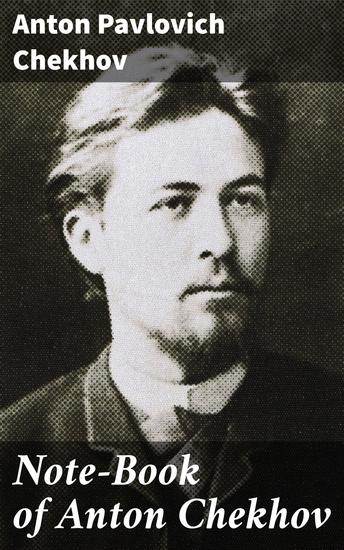
Note-Book of Anton Chekhov - Insights into a Literary Genius: Musings and Reflections of a Russian Master Storyteller - cover

Note-Book of Anton Chekhov - Insights into a Literary Genius: Musings and Reflections of a Russian Master Storyteller

Anton Pavlovich Chekhov

Translator S.S. Koteliansky, Leonard Woolf

Publisher: Good Press

  • 0
  • 0
  • 0

Summary

In "Note-Book of Anton Chekhov," the esteemed playwright and short story master offers an insightful glimpse into his writing process and philosophical musings. This collection of notes, reflections, and observations showcases Chekhov's distinctive literary style'Äîcharacterized by its brevity, wit, and depth'Äîilluminating the nuanced interplay between the mundane and the profound. The entries, varying from sharp social commentary to poignant introspection, are emblematic of the author's innovative approach to literature during the late 19th century, positioning him as a precursor to modernist thought. Anton Pavlovich Chekhov, often regarded as one of the greatest playwrights and short story writers in history, used his experiences as a physician and his profound observations of Russian society to cultivate a unique critical lens. His deep understanding of the human condition'Äîtempered by both compassion and irony'Äîshapes the reflections found in this notebook. Chekhov'Äôs dedication to capturing life with authenticity and his pursuit of artistic truth are palpable, offering readers an intimate look at the mind of a literary genius. Readers are encouraged to delve into "Note-Book of Anton Chekhov" not only for its literary merit but also for the enriching experience it provides into the convolutions of creativity. This book serves as a testament to Chekhov's introspective nature and enduring relevance, making it an indispensable read for anyone interested in the processes behind great literature.
Available since: 08/12/2023.
Print length: 66 pages.

Other books that might interest you

  • Edward Vernon-Harcourt - The Last Aristocratic Archbishop of York - cover

    Edward Vernon-Harcourt - The...

    Tony Vernon-Harcourt

    • 0
    • 0
    • 0
    Edward Vernon-Harcourt (1757–1847) was Archbishop of York from 1807 until his death at the age of 90.
    
     
    As a younger son of a wealthy land-owning family, Archbishop Harcourt depended on good family and political connections to make progress in the Church. He had to combine his responsibility for one of the largest dioceses in the Church of England with his duties in parliament and at court and with providing for his family of 16 children. More supportive of reform of both parliament and the church than most of his fellow bishops, Harcourt took steps to improve the training of ordinands in his diocese, encouraged the building of over 100 new churches to cope with population growth in the industrial towns of the West Riding and made some progress in tackling pluralism and non-residence. He was not afraid to stand up for a cause he believed to be right.
    
     
    In this biography, Tony Vernon-Harcourt examines the professional and family life of one of the last aristocratic bishops in the Church of England.
    Show book
  • Bucket to Greece - Volume 4 - cover

    Bucket to Greece - Volume 4

    V.D. Bucket

    • 0
    • 0
    • 0
    The delightfully comic account of a British couple and their imported cats starting over in a new country continues in Bucket to Greece Volume 4. The atmosphere is tense in the Bucket household, with Barry and Cynthia, or specifically Cynthia and her vile mutant cat, having outstayed their welcome. The race is on for them to find somewhere to live before their imminent wedding. Harold's house has potential, but Barry needs Victor's help to take advantage of the obnoxious Brit. 


    With chickens to tend and local politics to break into, Victor discovers retirement offers little time for lazing about. He takes to the sea, repping on the lazy day cruise in the company of the ouzo loving Kapetanios Vasos and his mute sidekick Sami, and crams up on Greek aphrodisiacs to prepare for a gastronomic excursion. Victor schemes to rid the house of superfluous kittens, hatches a plot to ensure the local taverna isn't turned into a tourist attraction, and lends a hand with the search when Spiros' uncle Leo goes on the missing list. Spiros, courting the fragrant Sampaguita, introduces her to the exciting ex-pat scene of inedible foreign dinners; Milton is targeted by vanity publishing scammers, and a stubborn sheep stalks the streets of Meli.
    Show book
  • A Welcome Respite - How I Regained My Strength Patience and Well-Being While Caregiving - cover

    A Welcome Respite - How I...

    Kathyrn Leigh Scott

    • 0
    • 0
    • 0
    For any caregiver who ever needed to feel renewed, Kathryn Leigh Scott offers a compassionate acknowledgment of the love, patience, and determination it takes to do the right thing for yourself and for those you love.
     
     
    When Kathryn Leigh Scott's husband, Geoff, was diagnosed with a terminal illness, she had to become his caregiver. As powerless as she was to stop the effects of the disease, she needed to be there for him. She wanted to be. And as much as she hated to admit it, the situation was taking its toll.
     
     
    Stressed out, isolated from friends, and emotionally and physically exhausted, Kathryn joined a caregiver support group. This circle of empathetic new friends encouraged her to recapture her own sense of being. With their help, she learned that the best way to care for Geoff was to take care of herself as well. It became a welcome respite…and a necessary one.
     
    Show book
  • This Will Be My Undoing - Living at the Intersection of Black Female and Feminist in (White) America - cover

    This Will Be My Undoing - Living...

    Anonymous

    • 0
    • 0
    • 0
    From one of the fiercest critics writing today, Morgan Jerkins’ highly-anticipated collection of linked essays interweaves her incisive commentary on pop culture, feminism, black history, misogyny, and racism with her own experiences to confront the very real challenges of being a black woman today—perfect for fans of Roxane Gay’s Bad Feminist, Rebecca Solnit’s Men Explain Things to Me, and Chimamanda Ngozie Adichie’s We Should All Be Feminists. 
    Morgan Jerkins is only in her twenties, but she has already established herself as an insightful, brutally honest writer who isn’t afraid of tackling tough, controversial subjects. In This Will Be My Undoing, she takes on perhaps one of the most provocative contemporary topics: What does it mean to “be”—to live as, to exist as—a black woman today? This is a book about black women, but it’s necessary reading for all Americans. 
     
    Doubly disenfranchised by race and gender, often deprived of a place within the mostly white mainstream feminist movement, black women are objectified, silenced, and marginalized with devastating consequences, in ways both obvious and subtle, that are rarely acknowledged in our country’s larger discussion about inequality. In This Will Be My Undoing, Jerkins becomes both narrator and subject to expose the social, cultural, and historical story of black female oppression that influences the black community as well as the white, male-dominated world at large.  
     
    Whether she’s writing about Sailor Moon; Rachel Dolezal; the stigma of therapy; her complex relationship with her own physical body; the pain of dating when men say they don’t “see color”; being a black visitor in Russia; the specter of “the fast-tailed girl” and the paradox of black female sexuality; or disabled black women in the context of the “Black Girl Magic” movement, Jerkins is compelling and revelatory.
    Show book
  • Interview with Serial Killer Ted Kaczynski the Unabomber An - cover

    Interview with Serial Killer Ted...

    Ted Kaczynski

    • 0
    • 0
    • 0
    Theodore John Kaczynski (May 22, 1942 - June 10, 2023), also known as the Unabomber, was an American mathematician, serial killer, and domestic terrorist. A mathematics prodigy, he abandoned his academic career in 1969 to pursue a reclusive primitive lifestyle and lone wolf terrorism campaign. Kaczynski murdered three people and injured 23 others between 1978 and 1995 in a nationwide mail bombing campaign against people he believed to be advancing modern technology and the destruction of the natural environment. He authored a roughly 35,000-word manifesto and social critique called “Industrial Society and Its Future” which opposes all forms of technology, rejects leftism and fascism, advocates cultural primitivism, and ultimately suggests violent revolution. The following recording is from a 1999 prison interview.
    Show book
  • A Year in Paris - Season by Season in the City of Light - cover

    A Year in Paris - Season by...

    Anonymous

    • 0
    • 0
    • 0
    From the incomparable John Baxter, the bestselling author of The Most Beautiful Walk in the World, a sumptuous and definitive portrait of Paris through the seasons, highlighting the unique tastes, sights, and changing personality of the city in spring, summer, fall, and winter. 
    “A man with a great appreciation of what makes Paris tick.”— Newsday 
    When the common people of France revolted in 1789, one of the first ways they chose to correct the excesses of the monarchy and the church was to rename the months of the year. Selected by poet and playwright Philippe-Francois-Nazaire Fabre, these new names reflected what took place at that season in the natural world; Fructidor was the month of fruit, Floréal that of flowers, while the winter wind (vent) dominated Ventôse.  
    Though the names didn’t stick, these seasonal rhythms of the year continue to define Parisians, as well as travelers to the city. As acclaimed author and long-time Paris resident John Baxter himself recollects, “My own arrival in France took place in Nivôse, the month of snow, and continued in Pluviôse, the season of rain. To someone coming from Los Angeles, where seasons barely existed, the shock was visceral. Struggling to adjust, I found reassurance in the literature, music, even the cuisine of my adoptive country, all of which marched to the inaudible drummer of the seasons.” 
    Devoting a section of the book to each of Fabre’s months, Baxter draws upon Paris’s literary, cultural and artistic past to paint an affecting, unforgettable portrait of the city. Touching upon the various ghosts of Paris past, from Hemingway and Zelda Fitzgerald, to Claude Debussy to MFK Fisher to Francois Mitterrand, Baxter evokes the rhythms of the seasons in the City of Light, and the sense of wonder they can arouse for all who visit and live there. 
    A melange of history, travel reportage, and myth, of high culture and low, A Year in Paris is vintage John Baxter: a vicarious thrill ride for anyone who loves Paris.
    Show book