Join us on a literary world trip!
Add this book to bookshelf
Grey
Write a new comment Default profile 50px
Grey
Subscribe to read the full book or read the first pages for free!
All characters reduced
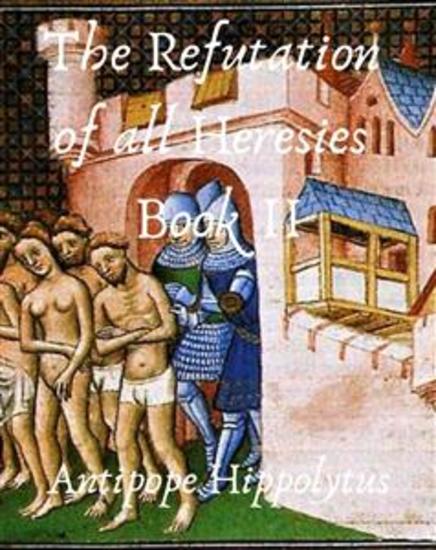
The refutation of all heresies Book II - cover

The refutation of all heresies Book II

Antipope Hippolytus

Publisher: Skyline

  • 0
  • 0
  • 0

Summary

1. These are the contents of the 6th (book) of the Refutation of all Heresies . 2. What Simon has dared, and that his doctrine is confirmed (by quotations) from magicians and poets. 3. What Valentinus has laid down, and that his doctrine is not framed from the Scriptures, but from those of the Platonists and Pythagorists. 4. And what is thought by Secundus, Ptolemy and Heracleon, and how they have used as their own, but with different words, the thoughts of those whom the Greeks (think) wise. 5. What has been held by Marcus and Colarbasus [and their disciples] and that some of them gave heed to magic arts and Pythagorean numbers.
Available since: 01/19/2022.

Other books that might interest you

  • White Lies Matter - The Gospel of MAWA - cover

    White Lies Matter - The Gospel...

    Rev. Micaiah Wright

    • 0
    • 0
    • 0
    This audiobook is narrated by an AI Voice.   
    White Lies Matter: The Gospel of MAWA isn’t just a book—it’s a sermon, a roast, and a history lesson rolled into one blistering satire of American politics. Beneath the bright red MAGA cap, the author exposes what the slogan really meant: Make America White Again. 
    With wit as sharp as Twain, the bite of Carlin, and the unflinching honesty of Chappelle, this audiobook takes listeners on a journey through America’s not-so-secret gospel of racial nostalgia. From the election of Barack Obama that shook the foundations of white exceptionalism, to Steve Bannon and Donald Trump baptizing a movement in fear, grievance, and privilege, WLM uncovers how the “American Dream” was fenced off and sold as exclusive property. 
    Each chapter functions like a scripture reading from the Church of MAWA, complete with commandments, proverbs, and revelations that peel back patriotic veneers to reveal the machinery of exclusion underneath. It’s biting, it’s funny, and it’s devastatingly honest—because America’s greatest myths are also its greatest lies. 
    This is not a quiet audiobook. It’s meant to provoke laughter, outrage, and reflection in equal measure. Whether you’re a believer in the gospel of MAWA or a skeptic watching from the pews, White Lies Matter insists you confront the uncomfortable truth: racism was never a glitch in the system—it was the system. 
    At once irreverent and illuminating, this is satire that cuts to the bone and asks the question no campaign slogan dares to touch: Whose America are we really trying to make “great” again?
    Show book
  • When Harry Met Pablo - Truman Picasso and the Cold War Politics of Modern Art - cover

    When Harry Met Pablo - Truman...

    Matthew Algeo

    • 0
    • 0
    • 0
    Harry Truman and Pablo Picasso were contemporaries and were both shaped by and shapers of the great events of the twentieth century—the man who painted Guernica and the man who authorized the use of atomic bombs against civilians. But in most ways, they couldn’t have been more different. Picasso was a communist, and probably the only thing Truman hated more than communists was modern art. Picasso was an indifferent father, a womanizer, and a millionaire. Truman was utterly devoted to his family and, despite his fame, far from a rich man. How did they come to be shaking hands in front of Picasso’s studio in the south of France? Truman’s meeting with Picasso was quietly arranged by Alfred H. Barr Jr., the founding director of New York’s Museum of Modern Art and an early champion of Picasso. Barr knew that if he could convince these two ideological antipodes, the straight-talking politician from Missouri and the Cubist painter from Málaga, to simply shake hands, it would send a powerful message, not just to reactionary Republicans pushing McCarthyism at home but to the whole world: modern art was not evil. A rigorous history with a heartwarming center, When Harry Met Pablo intertwines the biographies of Truman and Picasso, the history of modern art, and twentieth-century American politics, but at its core, it is the touching story of two old men who meet for the first time and realize they have more in common—and are more alike—than they ever imagined.
    Show book
  • Sapiens Journey The: Exploring the Extraordinary Story of Homo Sapiens - A Deep Exploration of Human Evolution Civilization and the Future of Homo Sapiens - cover

    Sapiens Journey The: Exploring...

    Bryan M. Deleon

    • 0
    • 0
    • 0
    The Sapiens Journey is a deep dive into the story of Homo sapiens, exploring how this species rose from early origins to shaping civilizations. This Homo sapiens audiobook traces the journey through key milestones in human history, from the Cognitive Revolution to the development of society, technology, and culture. 
    For those interested in audiobooks on Homo sapiens, this narration provides a compelling perspective based on anthropology, archaeology, and evolutionary science. Whether searching for sapiens audiobooks, sapiens audiobook, or insights into the human story, this journey offers a broad understanding of our past, present, and future. 
    Covering migration, survival, and the Sapiens Journey, this audiobook is ideal for those fascinated by history, science, and the legacy of humanity. Audiobooks sapiens, sapien audiobook, and sapiends audiobook all explore what makes humans unique—this audiobook provides an accessible and engaging experience. 
    If you’re looking for the definitive exploration of Homo sapiens audiobooks, sapiens history, and the incredible human story, this audiobook offers everything from evolutionary biology to ancient civilizations in one engaging journey.
    Show book
  • The World's Worst Conspiracies - cover

    The World's Worst Conspiracies

    Mike Rothschild

    • 0
    • 0
    • 0
    The World's Worst Conspiracies is a compilation of the most fascinating, bizarre and compelling conspiracy theories in the world today. 
     
    Delving into speculation about the assassination of JFK, chemtrails, the emergence of the 'New World Order', the sinister experiments at CERN, possible cover-ups regarding Area 51 and the so-called Clinton Body Count, this collection provides an essential reference for everyone interested in learning more about the secret forces that may be controlling our world. 
     
    Taking a balanced and measured approach, it explores why these theories have taken hold, and how much truth lies at their foundations. 
     
    Do you believe them?
    Show book
  • Mind Games - Psychological Manipulation Used to Confuse or Control - cover

    Mind Games - Psychological...

    Cito Harder

    • 0
    • 0
    • 0
    Mind games refer to psychological manipulation used to confuse, control, or manipulate others. They are a set of tactics designed to distort reality and influence someone's perception of situations, often without them realizing it. At the core, mind games prey on emotions, thoughts, and behavior, using subtle cues or calculated moves to lead the targeted individual into a state of confusion, self-doubt, or dependency. These psychological games often occur in situations where one person or group seeks to dominate or maintain power over another, exploiting the vulnerabilities of the victim for personal gain. 
    The essence of mind games lies in their subtlety. Unlike direct manipulation or coercion, mind games are indirect, creating an illusion of free will while slowly influencing decisions and actions. A skilled manipulator may present ideas, situations, or beliefs in a way that seems harmless or logical on the surface, yet their true purpose is to influence and control how others think and act. In many cases, these tactics are so skillfully executed that the person being manipulated may never even recognize that they are being played. 
    One of the key aspects of mind games is the element of confusion. Manipulators often engage in tactics that cause the victim to question their own beliefs, memories, and experiences. This psychological tactic, known as gaslighting, is a prime example of mind games at work. By distorting reality, manipulators create uncertainty in their target’s mind, making them doubt their own sense of reality. Over time, this confusion erodes the victim’s confidence and independence, rendering them more susceptible to further manipulation.
    Show book
  • Jin Dynasty - Northern Warriors and the Conquest of China - cover

    Jin Dynasty - Northern Warriors...

    Rolf Hedger

    • 0
    • 0
    • 0
    The Jurchens, the ancestors of the Manchu people, emerged as a formidable force in northeastern Asia long before they established the Jin Dynasty. Originating from the forests and plains of Manchuria, they were a collection of semi-nomadic and agricultural tribes with a distinct culture, language, and way of life. Their society was organized into clans led by chieftains, and they engaged in hunting, fishing, and farming while maintaining a warrior tradition that would later define their military prowess. Although they lived independently, they often found themselves under the influence of stronger neighboring powers, including the Korean kingdoms and the Khitan-led Liao Dynasty. 
    The Liao Dynasty, which dominated much of northern China and Manchuria, exerted control over the Jurchens for centuries. The Khitan rulers forced them into a tributary system, requiring them to provide labor, furs, and horses in exchange for nominal autonomy. While this arrangement allowed the Jurchens to retain aspects of their culture, it also placed them in a subordinate position. However, resentment grew among the Jurchen clans, who viewed the Khitan overlords as oppressive rulers. This growing dissatisfaction set the stage for their eventual rebellion. 
    Despite their subjugation, the Jurchens developed a strong warrior tradition and mastered cavalry warfare, which would later give them an advantage over their adversaries. They organized themselves into tribal confederations and honed their skills in archery and horseback combat, making them formidable in battle. Their ability to adapt to different terrains, combined with their knowledge of the harsh northern climate, allowed them to maintain resilience and independence, even under Liao control. Over time, they also adopted elements of Chinese and Khitan governance, learning valuable administrative techniques that would later aid them in state-building.
    Show book