Join us on a literary world trip!
Add this book to bookshelf
Grey
Write a new comment Default profile 50px
Grey
Subscribe to read the full book or read the first pages for free!
All characters reduced
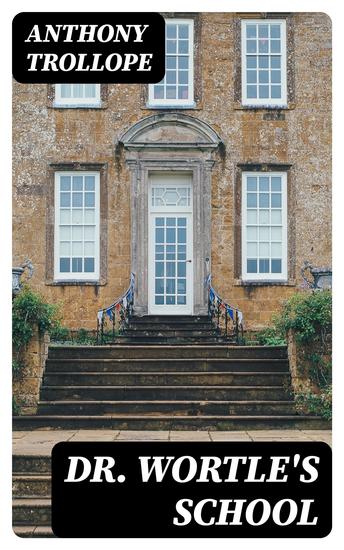
Dr Wortle's School - cover

Dr Wortle's School

Anthony Trollope

Publisher: DigiCat

  • 0
  • 0
  • 0

Summary

In "Dr. Wortle's School," Anthony Trollope presents a vivid exploration of the English educational system and the societal changes of his time. Set in a fictional preparatory school, the novel intricately weaves themes of morality, ambition, and human fallibility, showcasing Trollope's characteristic sharp wit and keen social observation. The narrative is marked by Trollope's distinctive descriptive style, revealing the complexities of character interactions against the backdrop of a rapidly modernizing society, which echoes the evolving educational philosophies of Victorian England. Anthony Trollope, a prominent Victorian novelist, drew upon his own experiences as a postmaster and his keen awareness of social structure to craft compelling narratives. His deep engagement with the societal issues of his time, particularly concerning education and class, informed the rich tapestry of characters in "Dr. Wortle's School." Trollope's prolific writing career reflects a fascination with the moral dilemmas faced by individuals within institutional frameworks, offering an astute critique of the era. This novel is highly recommended for readers interested in the interplay of education and societal norms, as well as those who appreciate nuanced character development and historical context. Trollope's insights into the human condition resonate through his narrative, providing a thought-provoking exploration that remains relevant today.
Available since: 09/16/2022.
Print length: 180 pages.

Other books that might interest you

  • In the Gulf Stream (Unabridged) - cover

    In the Gulf Stream (Unabridged)

    Charles Kingsley

    • 0
    • 0
    • 0
    Charles Kingsley (12 June 1819 - 23 January 1875) was a broad church priest of the Church of England, a university professor, social reformer, historian, novelist and poet. He is particularly associated with Christian socialism, the working men's college, and forming labour cooperatives, which failed, but encouraged later working reforms. He was a friend and correspondent of Charles Darwin.
    IN THE GULF STREAM: The appearance of the first fragments of gulf-weed caused quite a
    little excitement, and set an enthusiastic pair of naturalists, a midland hunting squire, and a travelled scientific doctor who had been twelve years in the Eastern Archipelago, fishing eagerly over the bows, with an extemporized grapple of wire, for gulf-weed, a specimen
    of which they did not catch.
    Show book
  • The Man in the Iron Mask - cover

    The Man in the Iron Mask

    Alexandre Dumas

    • 0
    • 0
    • 0
    A hidden twin, a stolen throne, and a secret so dangerous it could shatter a kingdom.
    In this dramatic finale to the Musketeers saga, a mysterious prisoner—his face locked behind an iron mask—holds the key to a truth that could overthrow Louis XIV. As Athos, Porthos, Aramis, and D'Artagnan find themselves torn between loyalty and justice, friendships are tested, alliances shift, and the fate of France hangs in the balance.
    
    Praised as "one of Dumas's most powerful and emotionally charged works," this novel delivers political intrigue, daring escapes, heartbreaking choices, and unforgettable heroism. Readers love its rich drama, iconic twist, and triumphant yet tragic depth.
    
    If you crave epic adventure, royal secrets, and the final, thrilling chapter of the Musketeers, this story will grip you until its stunning conclusion.
    
    Unmask the truth—start reading now and experience the legend brought to life.
    Show book
  • May Day - cover

    May Day

    F. Scott Fitzgerald

    • 0
    • 0
    • 0
    May Day - one of the stories, which entered in a collection of eleven short stories by F. Scott Fitzgerald "Tales of the Jazz Age" (1922). 
    Published as a novelette in The Smart Set in July, 1920, "May Day" relates a series of events which took place in the spring of the previous year, during the "general hysteria" which inaugurated the Jazz Age.
    The story uses the May Day Riots of 1919 as historical backdrop. During these events, as the lower-class is fighting for certain causes, a group of privileged Yale alumni meet for a dance.
    During the story a Jewish man is beat up by a crowd as he expounds socialist rhetoric. Fitzgerald, however, was not an anti-semite, and his characterizing of the Jewish man can be seen as a commentary of the brutality of the crowd contrasted with the man's wit and fervor.
    Show book
  • Mr Brisher's Treasure (Unabridged) - cover

    Mr Brisher's Treasure (Unabridged)

    H. G. Wells

    • 0
    • 0
    • 0
    Mr. Brisher's Treasure is a short story by H. G. Wells. Herbert George "H. G." Wells (21 September 1866 - 13 August 1946) was an English writer, now best known for his work in the science fiction genre. He was also a prolific writer in many other genres, including contemporary novels, history, politics and social commentary, even writing textbooks and rules for war games. Wells is sometimes called "The Father of Science Fiction," as are Jules Verne and Hugo Gernsback. His most notable science fiction works include The War of the Worlds, The Time Machine, The Invisible Man and The Island of Doctor Moreau. Wells's earliest specialised training was in biology, and his thinking on ethical matters took place in a specifically and fundamentally Darwinian context. He was also from an early date an outspoken socialist, often (but not always, as at the beginning of the First World War) sympathising with pacifist views. His later works became increasingly political and didactic, and he sometimes indicated on official documents that his profession was that of "Journalist." Most of his later novels were not science fiction. Some described lower-middle class life (Kipps; The History of Mr Polly), leading him to be touted as a worthy successor to Charles Dickens, but Wells described a range of social strata and even attempted, in Tono-Bungay (1909), a diagnosis of English society as a whole. Wells's first non-fiction bestseller was Anticipations of the Reaction of Mechanical and Scientific Progress Upon Human Life and Thought (1901). When originally serialised in a magazine it was subtitled, "An Experiment in Prophecy,"
    Show book
  • Companions of Jehu The (Unabridged) - cover

    Companions of Jehu The (Unabridged)

    Alexandre Dumas

    • 0
    • 0
    • 0
    Les Compagnons de Jehu (The Companions of Jehu) is set in the 1800s, during Napoleon's rise to power. The title refers to a secret organisation of young aristocrats-turned-highwaymen that continuously steals the money of the Directoire in order to finance the restoration of monarchy. It has all the typical Dumas ingredients, that is to say duels, political intrigues, noble heroes and a tragic love store that would make Shakespeare green with envy. Not to mention a hero with a murky past who you will love-to-hate. Be prepared to shed quantities of tears. You've been warned!
    Show book
  • Negore the Coward (Unabridged) - cover

    Negore the Coward (Unabridged)

    Jack London

    • 0
    • 0
    • 0
    Jack London (born John Griffith Chaney, January 12, 1876 - November 22, 1916) was an American author, journalist, and social activist. He was a pioneer in the then-burgeoning world of commercial magazine fiction and was one of the first fiction writers to obtain worldwide celebrity and a large fortune from his fiction alone.
    NEGORE, THE COWARD: He had followed the trail of his fleeing people for eleven days, and his pursuit had been in itself a flight; for behind him he knew full well were the dreaded Russians, toiling through the swampy lowlands and over the steep divides, bent on no less than the extermination of all his people.
    Show book