

Begleiten Sie uns auf eine literarische Weltreise!
Buch zum Bücherregal hinzufügen
Grey
Einen neuen Kommentar schreiben Default profile 50px
Grey
Jetzt das ganze Buch im Abo oder die ersten Seiten gratis lesen!
All characters reduced
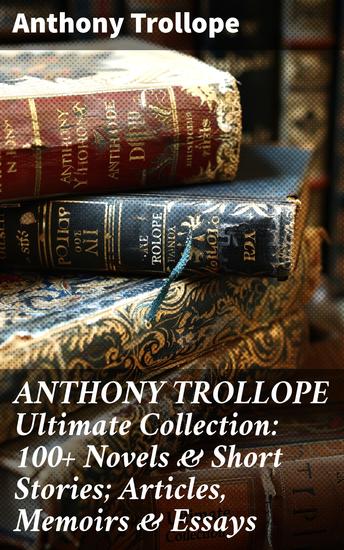
ANTHONY TROLLOPE Ultimate Collection: 100+ Novels & Short Stories; Articles Memoirs & Essays - Exploring Victorian Society: A Collection of Masterful Works - cover

ANTHONY TROLLOPE Ultimate Collection: 100+ Novels & Short Stories; Articles Memoirs & Essays - Exploring Victorian Society: A Collection of Masterful Works

Anthony Trollope

Verlag: Good Press

  • 0
  • 0
  • 0

Beschreibung

In the expansive compilation, "ANTHONY TROLLOPE Ultimate Collection: 100+ Novels & Short Stories; Articles, Memoirs & Essays," readers are invited to delve into the rich tapestry of Victorian life as depicted through Trollope's prolific writing. This ultimate collection not only highlights his masterful storytelling and nuanced character development but also showcases his keen sociopolitical observations. With an engaging prose style that intertwines wit and profound insights, Trollope's work reflects the intricacies of class, politics, and gender, providing a comprehensive view of 19th-century British society. Anthony Trollope, an astute chronicler of his times, was influenced by his personal experiences and extensive travels through the English countryside. Coming from a background of fluctuating fortunes, he draws upon both his public service in the Post Office and his literary pursuits, yielding a distinctive perspective that resonates throughout his narratives. Trollope'Äôs dedication to capturing the human condition, along with his unyielding work ethic, prompted him to produce an oeuvre that is both extensive and enduring. This ultimate collection is a must-read for anyone seeking a holistic understanding of Victorian literature or a comprehensive introduction to Trollope'Äôs works. Whether a seasoned Trollope enthusiast or a newcomer, readers will find themselves captivated by the depth of his narratives and the timeless themes that echo across his writings.
Verfügbar seit: 12.12.2023.
Drucklänge: 24851 Seiten.

Weitere Bücher, die Sie mögen werden

  • A Wireless Message - From their pens to your ears genius in every story - cover

    A Wireless Message - From their...

    Ambrose Bierce

    • 0
    • 0
    • 0
    Ambrose Gwinnett Bierce was born on 24th June 1842 at Horse Cave Creek in Meigs County, Ohio. His parents were poor but they introduced him to literature at an early age, instilling in him a deep appreciation of books, the written word and the elegance of language.  
    Growing up in Koscuisko County, Indiana poverty and religion were defining features of his childhood, and he would later describe his parents as “unwashed savages” and fanatically religious, showing him little affection but always quick to punish. He came to resent religion, and his introduction to literature appears to be their only positive effect. 
    At age 15 Bierce left home to become a printer’s devil, mixing ink and fetching type at The Northern Indian, a small Ohio paper. Falsely accused of theft he returned to his farm and spent time sending out work in the hopes of being published. 
    His Uncle Lucius advised he be sent to the Kentucky Military Institute. A year later he was commissioned as an Officer.  As the Civil War started Bierce enlisted in the 9th Indiana Infantry Regiment.  
    In April 1862 Bierce fought at the Battle of Shiloh, an experience which, though terrifying, became the source of several short stories. Two years later he sustained a serious head wound and was off duty for several months. He was discharged in early 1865.  
    A later expedition to inspect military outposts across the Great Plains took him all the way to San Francisco. He remained there to become involved with publishing and editing and to marry, Mary Ellen on Christmas Day 1871.  They had a child, Day, the following year.  
    In 1872 the family moved to England for 3 years where he wrote for Fun magazine. His son, Leigh, was born, and first book, ‘The Fiend’s Delight’, was published.  
    They returned to San Francisco and to work for a number of papers where he gained admiration for his crime reporting. In 1887 he began a column at the William Randolph Hearst’s San Francisco Examiner.  
    Bierce’s marriage fell apart when he discovered compromising letters to his wife from a secret admirer. The following year, 1889 his son Day committed suicide, depressed by romantic rejection. 
    In 1891 Bierce wrote and published the collection of 26 short stories which included ‘An Occurrence at Owl Creek Bridge’.  Success and further works including poetry followed.  
    Bierce with Hearst’s resources helped uncover a financial plot by a railroad to turn 130 million dollars of loans into a handout. Confronted by the railroad and asked to name his price Bierce answered “my price is $130 million dollars. If, when you are ready to pay, I happen to be out of town, you may hand it over to my friend, the Treasurer of the United States”.  
    He now began his first foray as a fabulist, publishing ‘Fantastic Fables’ in 1899.  But tragedy again struck two years later when his second son Leigh died of pneumonia relating to his alcoholism.  
    He continued to write short stories and poetry and also published ‘The Devil’s Dictionary’.  
    At the age of 71, in 1913 Bierce departed from Washington, D.C., for a tour of the battlefields where he had fought during the civil war. At the city of Chihuahua he wrote his last known communication, a letter to a friend. It’s closing words were “as to me, I leave here tomorrow for an unknown destination,” Ambrose Bierce then vanished without trace.
    Zum Buch
  • Hamlet | Simple Shakespeare Series - The classic play adapted to modern language - cover

    Hamlet | Simple Shakespeare...

    Jeanette Vigon

    • 0
    • 0
    • 0
    This modern adaptation of "Hamlet" breathes new life into Shakespeare's legendary tale, presenting it in contemporary English to draw readers into the vortex of betrayal, revenge, and existential angst at the heart of the play. With Prince Hamlet's story unfurling in the modern vernacular, the timeless tragedy of the Danish prince wrestling with grief, moral uncertainty, and the specter of vengeance becomes more accessible and immediate. Whether you're meeting Hamlet for the first time or returning to the shadowed corridors of Elsinore Castle, this version is crafted to convey the raw emotion and profound insights of Shakespeare's work in a language that speaks directly to the modern reader. 
    Key features of this modern version of "Hamlet":Showcases Shakespeare's intricate narrative and deep philosophical queries in clear, modern English, broadening its appeal.Maintains the original's narrative depth and existential themes, ensuring the essence of Shakespeare's vision remains intact without the need for external commentary.Perfect for educational settings and readers seeking an intuitive understanding of the play’s themes, characters, and complex storyline.Draws in readers of today with an age-old exploration of revenge, sanity, loyalty, and existential musings, proving the play's enduring relevance.Preserves the emotional intensity and character complexity that Shakespeare is renowned for, allowing a direct connection to the dilemmas and passions of his characters.Stimulates critical thought and discussion around perennial human concerns such as justice, the effects of grief, and the essence of existence, inviting readers to ponder deeply.Opens up Shakespeare's oeuvre to new audiences, encouraging exploration and appreciation of literary artistry with ease and enthusiasm.
    Zum Buch
  • Ineligible - A Simon Iff Occult Detective Story - cover

    Ineligible - A Simon Iff Occult...

    Aleister Crowley

    • 0
    • 0
    • 0
    Edward Alexander Crowley was born on 12th October 1875 to wealthy parents in Royal Leamington Spa in Warwickshire. 
     
    He was educated at Malvern College, Tonbridge School, Eastbourne College and finally Trinity College, Cambridge where he focused on his passions of mountaineering and poetry and published several volumes. 
     
    Life for Crowley was to abandon his parents’ Christian faith and instead to inject himself into Western esotericism.  In 1898, he joined the esoteric Hermetic Order of the Golden Dawn and was trained in ceremonial magic before studying both Hindu and Buddhist practices in India. 
     
    On his Egyptian honeymoon in 1904 he claimed contact with an entity―Aiwass―who gave him the sacred Book of the Law which served as the basis for the Thelema religion where he identified as its prophet.  During the Great War, which he spent in the United States, he claimed to be working for British Intelligence but by the 1920s he had decamped to pursue a libertine lifestyle in Sicily, and in the ensuing scandals was evicted by the Italian Government. 
     
    He divided the following two decades between France, Germany, and England, and the continuing promotion of Thelema. 
     
    During his life he gained widespread notoriety for his drug use, his bisexuality, and his alarming views on society.  In short, polite society frowned on his ways, his thoughts and his influence but to many others his stance had much of value.  Even after death he was a darling for the 60’s counterculture but his influence has since waned.   
     
    His literary works were both prolific and covered many topics.  In the early part of his career he published many poetry books, even plays, before his darker and more forceful works came to dominate his output. 
     
    Aleister Crowley died on 1st December 1947 at Hastings in England. He was 72.
    Zum Buch
  • The Wonderful Tune - A weird tale where music meets torment - cover

    The Wonderful Tune - A weird...

    Jessie Douglas Kerruish

    • 0
    • 0
    • 0
    Jessie Douglas Kerruish was born in Seaton Carew, Hartlepool, County Durham in 1884. 
     
    Little is known about the author’s life and to a large extent her work remains either neglected or out of favour. 
     
    Her literary career got off to a very bright start in 1917 when she won the Hodder & Stoughton First Novel Prize for ‘Miss Haroun Al-Raschid’.  Five years later came her seminal work ‘The Undying Monster’, which today is still regarded as a macabre werewolf classic. 
     
    Throughout her career she contributed short stories to such popular periodicals as Novel, Lady's and Weekly Tale-Teller.  One of the best was ‘The Wonderful Tune’ and whilst the title sounds light and airy her dark imagination riddles the narrative.  Many of her works were set in exotic locations from North Africa to the Middle East. 
     
    Her output was small, limited to two collections of short stories and several novels. 
     
    During the 1930’s severe and debilitating migraines prevented her from working for any length of time and all she could muster was contributions to anthologies. 
     
    Jessie Douglas Kerruish died in Hove, Sussex in 1949, in obscurity.
    Zum Buch
  • The Sherlock Holmes Collection - The Classic Tales - cover

    The Sherlock Holmes Collection -...

    Arthur Conan Doyle

    • 0
    • 0
    • 0
    Sherlock Holmes was created by British author Sir Arthur Conan Doyle. Referring to himself as a "consulting detective" in the stories, Holmes is known for his proficiency with observation, deduction, forensic science, and logical reasoning that borders on the fantastic, which he employs when investigating cases for a wide variety of clients, including Scotland Yard. 
     
    Holmes first appeared in print in 1887's A Study in Scarlet, the character's popularity became widespread with the first series of short stories in The Strand Magazine, beginning with "A Scandal in Bohemia" in 1891; additional tales appeared from then until 1927, eventually totaling four novels and 56 short stories. All but one are set in the Victorian or Edwardian eras, between about 1880 and 1914. Most are narrated by the character of Holmes's friend and biographer Dr. John H. Watson, who usually accompanies Holmes during his investigations and often shares quarters with him at the address of 221B Baker Street, London, where many of the stories begin. 
     
    Though not the first fictional detective, Sherlock Holmes is arguably the best known. By the 1990s there were already over 25,000 stage adaptations, films, television productions, and publications featuring the detective, and Guinness World Records lists him as the most portrayed literary human character in film and television history. Holmes's popularity and fame are such that many have believed him to be not a fictional character but a real individual; numerous literary and fan societies have been founded on this pretense. Avid readers of the Holmes stories helped create the modern practice of fandom.  
     
    Sir Arthur Ignatius Conan Doyle KStJ DL was a British writer and physician.
    Zum Buch
  • The Wound Dresser - The Lost Manuscript - cover

    The Wound Dresser - The Lost...

    Walt Whitman

    • 0
    • 0
    • 0
    Walter Whitman was an American poet, essayist and journalist. A humanist, he was a part of the transition between transcendentalism and realism, incorporating both views in his works. Whitman is among the most influential poets in the American canon, often called the father of free verse. His work was controversial in its time, particularly his 1855 poetry collection Leaves of Grass, which was described as obscene for its overt sensuality. Whitman's own life came under scrutiny for his presumed homosexuality. 
     
    Born in Huntington on Long Island, as a child and through much of his career, he resided in Brooklyn. At age 11, he left formal schooling to go to work. Later, Whitman worked as a journalist, a teacher, and a government clerk. Whitman's major poetry collection, Leaves of Grass, was first published in 1855 with his own money and became well known. The work was an attempt at reaching out to the common person with an American epic. He continued expanding and revising it until his death in 1892. During the American Civil War, he went to Washington, D.C. and worked in hospitals caring for the wounded. His poetry often focused on both loss and healing. On the death of Abraham Lincoln, whom Whitman greatly admired, he wrote his well-known poems, "O Captain! My Captain!" and "When Lilacs Last in the Dooryard Bloom'd", and gave a series of lectures. After a stroke towards the end of his life, Whitman moved to Camden, New Jersey, where his health further declined. When he died at age 72, his funeral was a public event. 
     
    Whitman's influence on poetry remains strong. Mary Whitall Smith Costelloe argued: "You cannot really understand America without Walt Whitman, without Leaves of Grass ... He has expressed that civilization, 'up to date,' as he would say, and no student of the philosophy of history can do without him." Modernist poet Ezra Pound called Whitman "America's poet ... He is America.
    Zum Buch
