
Begleiten Sie uns auf eine literarische Weltreise!
Buch zum Bücherregal hinzufügen
Grey
Einen neuen Kommentar schreiben Default profile 50px
Grey
Jetzt das ganze Buch im Abo oder die ersten Seiten gratis lesen!
All characters reduced
The Tenant of Wildfell Hall - cover

The Tenant of Wildfell Hall

Anonym

Verlag: Zenith Whispering Pines Publishers

  • 0
  • 0
  • 0

Beschreibung

A mysterious woman arrives at a crumbling mansion—and nothing in the quiet village will ever be the same.
When Helen Graham moves into Wildfell Hall with her young son, rumors swirl. She is guarded, secretive, and unwilling to explain her painful past. But as one man grows closer to her, the truth slowly emerges: a story of a toxic marriage, personal courage, and a daring escape in an age when women had no right to choose their own fate.

Celebrated today as "one of the earliest and most powerful feminist novels," Anne Brontë's masterpiece still shocks with its honesty and inspires with its strength. Readers praise its emotional depth, gripping suspense, and unforgettable heroine.

If you love dramatic character journeys, forbidden romance, and classics that feel ahead of their time, this novel will captivate you from the first page to the last.

Open the door to Wildfell Hall—start reading now and witness a woman's fight for freedom.
Verfügbar seit: 03.12.2025.
Drucklänge: 549 Seiten.
Weitere Bücher, die Sie mögen werden

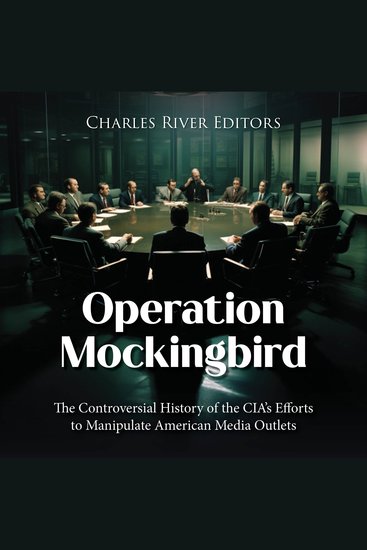
  • Operation Mockingbird: The Controversial History of the CIA’s Efforts to Manipulate American Media Outlets - cover

    Operation Mockingbird: The...

    Editors Charles River

    • 0
    • 0
    • 0
    Freedom of the press isn’t just a fundamental right in America but a key part of the democratic process. When the United States secured its independence against Britain in the War of Independence in 1783, there was no certainty about what the new country would look like in terms of national governance. In 1787, delegates from the various states convened in Philadelphia to draft a constitution that would define this. 
    Freedom of the press became one of the core principles of democracy in the United States. People could only place their votes in an informed way if the press was free to provide information about politicians and their actions. Politicians must also know that their actions were accountable through a press that informed voters honestly and accurately. 
    Up to the 1960s, most Americans were confident they had access to a truly free press, but then series of revelations emerged that suggested the Central Intelligence Agency (CIA) had been subverting journalists in the US and elsewhere through the use of bribery, blackmail, and covert operations. By the late 1970s, this alleged CIA plan had a name: Operation Mockingbird.  
    Many people were understandably horrified at the notion that the federal government had attempted to operate counter to the First Amendment through one of its intelligence agencies, and Operation Mockingbird was widely discussed. These debates continue to the present day, including whether there actually was a covert CIA operation named Mockingbird, whether the operation truly sought to subvert the press in the US and elsewhere, and whether the operation really ended by 1976, as the CIA claimed. As such, nearly 50 years later, Operation Mockingbird remains a controversial topic. 
    Zum Buch
  • Knead to Know - A History of Baking - cover

    Knead to Know - A History of Baking

    Neil Buttery

    • 0
    • 0
    • 0
    In Knead to Know: A History of Baking, food historian and chef Neil Buttery takes the reader on a journey exploring the creation, evolution and cultural importance of some of our most beloved baked foods, whether they be fit for a monarch's table, or served from the bakestone of a lowly farm labourer. This book charts innovations, happy accidents and some of the most downright bizarre baked foods ever created.
    
    Everything has a history, but food history is special because it tells so much about our culture and society, our desires and our weaknesses, from the broad sweep of bread creating human civilisation to the invention of the wedding cake, the creation of the whisk, the purpose of the fish heads in a star-gazy pie, or the fact that mince pies used to be meaty.
    
    When we think of the evolution of something, we think every step is an improvement, an incremental elevation toward some peak of perfection as technology improves. This is not always the case. Sometimes things have to become simpler, sometimes knowledge is lost and skills forgotten. As a baker of historical foods, Neil Buttery demonstrates that forgotten recipes and traditional techniques are worth trying out (and mention a few that should perhaps be left in the past).
    
    The reader will be inspired by the characters, creations and inventions of the past to be better and more adventurous bakers.
    Zum Buch
  • Between Two Worlds - Jewish War Brides after the Holocaust - cover

    Between Two Worlds - Jewish War...

    Robin Judd

    • 0
    • 0
    • 0
    Facing the harrowing task of rebuilding a life in the wake of the Holocaust, many Jewish survivors, community and religious leaders, and Allied soldiers viewed marriage between Jewish women and military personnel as a way to move forward after unspeakable loss. Proponents believed that these unions were more than just a ticket out of war-torn Europe: they would help the Jewish people repopulate after the attempted annihilation of European Jewry. Historian Robin Judd, whose grandmother survived the Holocaust and married an American soldier after liberation, introduces us to the Jewish women who lived through genocide and went on to wed American, Canadian, and British military personnel after the war.
    Zum Buch
  • Emotional Intelligence & CBT: Cognitive Behavioral Therapy Techniques for improving Your Relationships and EQ - Overcome Anxiety Depression Manipulation Narcissistic Abuse and More! - cover

    Emotional Intelligence & CBT:...

    Eva Spencer

    • 0
    • 0
    • 0
    IT’S TIME TO LEAVE BEHIND THOSE INTRUSIVE AND NEGATIVE THOUGHTS THAT HOLD YOU BACK FROM ACHIEVING HAPPINESS 
    We all have our own unique set of thoughts that determine our emotions and sometimes we can’t help but let these emotions control us. Sometimes, a simple thought is all it takes to ruin our mood. 
    But what if we could change those thoughts in order to change our feelings? 
    That's where this audiobook comes in! 
    Cognitive Behavioral Therapy (CBT) and Emotional Intelligence (EQ) can help you overcome your issues and live the life you want to live. 
    By using CBT and EQ techniques, you can learn how to change your thoughts in order to feel better about yourself and others around you. And by learning emotional intelligence skills, such as empathy and self-awareness, it will be easier for you to have successful relationships that last a lifetime! 
    It’s time for you to take control of your life and start living it on your terms! 
    With this audiobook, you’ll discover: 
          ● How to understand your emotions and control your thoughts. 
          ● The best method to rewire your brain and turn negative thoughts into positive ones! 
          ● The secrets to having and maintaining better relationships with yourself and those around you. 
          ● A happier and emotionally stable life! 
          ● Accurate and expert-backed information to ensure a successful learning experience. 
          ● Easy ways to take control of your life and change it for the better! 
    Imagine being able to have better relationships with everyone in your life - friends, family members, coworkers, or even a romantic partner. Imagine feeling confident when talking about yourself or standing up for yourself in any situation because of the skills learned from this audiobook. 
    Learn these powerful tools and change your life forever! 
    GET THIS AUDIOBOOK AND LEARN HOW TO TAKE CONTROL OF YOUR EMOTIONS TODAY!
    Zum Buch
  • If the Allies Had Fallen - The Consequences of Losing D-Day - cover

    If the Allies Had Fallen - The...

    Marcus Draysun

    • 0
    • 0
    • 0
    The success of D-Day was never inevitable. The invasion of Normandy was the most ambitious military operation of the war, requiring precise coordination, secrecy, and an extraordinary amount of luck. The Allies knew that failure would not just be a setback—it could mean the prolonged survival of Nazi Germany and a vastly different world order. Every decision leading up to June 6, 1944, carried immense weight, as the fate of millions hung in the balance. 
    For months, Allied planners debated the best approach for opening a Western Front. The Soviets, engaged in brutal combat with German forces on the Eastern Front, pressured Britain and the United States to act quickly. Churchill, haunted by the disastrous Gallipoli campaign of World War I, feared the consequences of a premature landing. General Dwight D. Eisenhower, the Supreme Allied Commander, had to make the ultimate call: when and where to launch the largest amphibious invasion in history. 
    The chosen location—Normandy—was a calculated risk. Pas de Calais, the closest point between Britain and France, seemed like the most obvious target, and the Germans heavily fortified it. By contrast, Normandy’s beaches offered a less expected but still formidable challenge. Hitler’s Atlantic Wall, a vast network of bunkers, mines, and obstacles, was designed to repel any invasion. The Germans had tens of thousands of troops stationed along the coast, and if they had guessed the true landing site, they could have crushed the invasion before it gained a foothold.
    Zum Buch
  • The History of the American Revolution - cover

    The History of the American...

    Editors Charles River

    • 0
    • 0
    • 0
    The American Revolution is replete with seminal moments that every American learns in school, from the “shot heard ‘round the world” to the Declaration of Independence, but the events that led up to the fighting at Lexington & Concord were borne out of 10 years of division between the British and their American colonies over everything from colonial representation in governments to taxation, the nature of searches, and the quartering of British regulars in private houses. From 1764-1775, a chain of events that included lightning rods like the Townshend Acts led to bloodshed in the form of the Boston Massacre, while the Boston Tea Party became a symbol of nonviolent protest. 
    The political and military nature of the Revolutionary War was just as full of intrigue. While disorganized militias fought the Battles of Lexington & Concord, George Washington would lead the Continental Army in the field while men like Thomas Jefferson drafted the Declaration of Independence in Philadelphia and Benjamin Franklin negotiated overseas in France. Benedict Arnold would become one of his nation’s most vital war heroes and its most notorious traitor, French forces would play a crucial role at the end of the war, and the Treaty of Paris would conclude the Revolution with one last great surprise. 
    The History of the American Revolution chronicles the momentous events before and during the American Revolution, from the beginning of the troubles with Britain in 1764 to the successful conclusion of the Revolution in 1783 with the Treaty of Paris. It comprehensively covers the important battles and the political and military roles played by American legends like Samuel Adams, Thomas Jefferson, Benjamin Franklin, George Washington and more.
    Zum Buch