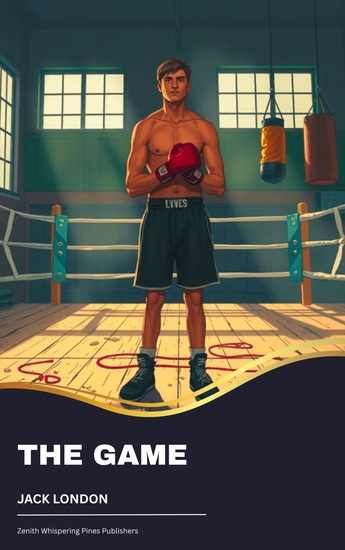
One last fight. One promise of a better life. One night that changes everything.
Joe Fleming is a beloved young boxer who steps into the ring for what should be his final match before marrying his sweetheart, Genevieve. But beneath the cheers and bright lights lies a world of danger, pride, and raw physical power. As tension builds and emotions run high, Joe and Genevieve face the harsh truth of a sport where every victory—and every mistake—comes at a cost.
Praised as "a vivid, emotionally charged portrait of early boxing culture," Jack London's novella delivers gripping realism, sharp dialogue, and unforgettable atmosphere. It remains a powerful exploration of masculinity, risk, and the fragile line between triumph and tragedy.
If you enjoy fast-paced drama, heartfelt emotion, and stories where love stands toe-to-toe with danger, this classic will strike deep.
Step into the ring—open the book and feel the heartbeat of The Game.
A Room with a View is a 1908 novel by English writer E. M. Forster, about a young woman in the restrained culture of Edwardian-era England. Set in Italy and England, the story is both a romance and a humorous critique of English society at the beginning of the 20th century. Merchant Ivory produced an award-winning film adaptation in 1985.
The Modern Library ranked A Room with a View 79th on its list of the 100 best English-language novels of the 20th century (1998).
Edward Morgan Forster OM CH was an English author, best known for his novels, particularly A Room with a View, Howards End, and A Passage to India. He also wrote numerous short stories, essays, speeches, and broadcasts, as well as a limited number of biographies and some pageant plays.
Embark on an unforgettable adventure through the rugged wilderness with Jack London's classic tale, "White Fang," available now as an audiobook.
In this gripping story, follow the journey of White Fang, a fierce and intelligent wolf-dog born into the harsh and unforgiving landscapes of the Yukon Territory. From his early days as a wild and instinct-driven cub to his gradual transformation into a loyal and compassionate companion, White Fang's life is a testament to the resilience of the natural world.
As you listen, you'll be transported to a time when survival was a daily struggle, and only the strongest and most adaptable could thrive. You'll witness White Fang's encounters with both humans and animals, each shaping his character and testing his limits in unexpected ways.
Narrated with passion and authenticity, this audiobook captures the essence of London's masterful storytelling, immersing you in the sights, sounds, and emotions of the wilderness. Whether you're a longtime fan of the novel or experiencing it for the first time, "White Fang" will captivate and inspire you from start to finish.
So, if you're ready to experience the thrill of the wild and the power of the human-animal bond, don't hesitate. Start listening to "White Fang" today and let the adventure begin.
Immerse yourself in the terror of "The Premature Burial," the fifth part of an Edgar Allan Poe short story collection, narrated by Jake Urry. This unsettling tale explores the intense fear of being buried alive, as the narrator recounts various horrifying incidents of premature interment and his own obsessive dread of such a fate. The story delves deep into the psyche, blending horror with the claustrophobic fear of being trapped in one's own grave.
Jake Urry's evocative narration amplifies the suspense and dread of Poe's chilling tale, making this audiobook a captivating and eerie experience. His nuanced voice draws listeners into the narrator's paranoia, creating a palpable sense of fear that lingers long after the story ends.
The bookshelves of British literature are incredible collections that have gathered together centuries of very talented authors. From these Isles their fame spread and whilst among their number many are now forgotten or neglected their talents endure. Among them is Dora Sigerson Shorter.
“The Terrible Solomons” written by Jack London: There is no gainsaying that the Solomons are a hard-bitten bunch of islands. On the other hand, there are worse places in the world. But to the new chum who has no constitutional understanding of men and life in the rough, the Solomons may indeed prove terrible.
Set on an island off the Scottish coast, To the Lighthouse minutely examines the fleeting impressions of a large cast of family, friends, lovers, and hangers-on. Who can we be, Virginia Woolf invites us to ask, if no one can ever know our hearts - if they're unknowable even to ourselves? To the Lighthouse remains one of the most important Modernist novels, exquisitely composed by one of the most gifted writers of the Modernist movement.
The opening section follows the passage of a day with a thwarted objective: to go to the nearby lighthouse. The concluding section revisits this expedition a decade later, when so much is irrevocably changed, as a chance to glimpse interpersonal understandings and connections. The novel provides a brilliant example of stream-of-consciousness writing, and raises questions that provoke us still: questions about whether children are the fullest realization of one's posterity, how women artists are regarded socially, and how money and status enable - or close off - networks, relationships, and the dreams we hold most dear.
As masterful as its technique is, however, the lasting value of this novel for twenty-first-century readers may be its sharp representation of the emotional labor that people - particularly women - perform in order to manage the needs and expectations of others. Woolf wrote in an age when women's participation in society was tightly restricted by class norms and stultifying domesticity. Nearly a century later, scholars still have a great deal to say about Mrs. Ramsay, Lily Briscoe, and the tension between Mr. Ramsay and his son James.
Woolf's fifth novel, and one of her most successful books both critically and commercially, To the Lighthouse was originally published in 1927, simultaneously in England and the United States. Due to a quirk in the management and correction of the proofs, according to scholar Hans Walter Gabler, the two editions were "not identical, since in a significant number of instances Virginia Woolf marked up the first proofs differently" for her two publishers.
Ihr Account wird momentan auf einem anderen Gerät benutzt.
Es ist bereits eine Sitzung auf einem anderen Gerät geöffnet.
Abmelden
Erneut verbinden
Ihr Account wird momentan auf einem anderen Gerät benutzt.
Um darauf zugreifen zu können, müssen die Berechtigungen und obligatorischen Richtlinien (markiert mit *) überprüft und akzeptiert werden.
Wenn Sie Hilfe oder weitere Informationen benötigen, schreiben Sie an support@24symbols.com
Akzeptieren
Ihr Account wird momentan auf einem anderen Gerät benutzt.
OK
Bestätigungs-E-Mail noch einmal schicken
Ihr Account wird momentan auf einem anderen Gerät benutzt.
Wir haben versucht, Ihr Abo abzubuchen, aber es ist uns nicht gelungen. Das teilt uns Ihre Bank/Karte mit:
Wenn Sie weiterlesen möchten, müssen Sie sich möglicherweise an Ihre Bank wenden oder Ihre Zahlungsinformationen hier ändern:
Ich möchte meine Karte aktualisieren!
Haben Sie Fragen? Schreiben Sie uns an support@24symbols.com und wir werden Ihnen weiterhelfen.
Cookies helfen uns bei der Bereitstellung unserer Dienste. Durch die Nutzung unserer Dienste erklären Sie sich damit einverstanden, dass wir Cookies setzen.Mehr erfahren