Rejoignez-nous pour un voyage dans le monde des livres!
Ajouter ce livre à l'électronique
Grey
Ecrivez un nouveau commentaire Default profile 50px
Grey
Abonnez-vous pour lire le livre complet ou lisez les premières pages gratuitement!
All characters reduced
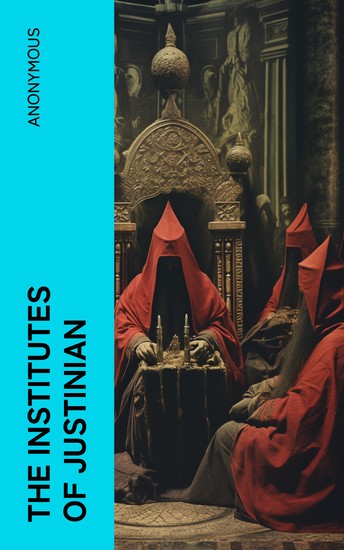
The Institutes of Justinian - cover

The Institutes of Justinian

Anonyme

Traducteur John Baron Moyle

Maison d'édition: e-artnow

  • 0
  • 0
  • 0

Synopsis

The Institutes of Justinian is an anonymous 6th century law book. It provides foundations for civil and common law convention, with plenty of aspects still exhibited in modern legal philosophy.
Disponible depuis: 26/11/2023.
Longueur d'impression: 245 pages.

D'autres livres qui pourraient vous intéresser

  • Can Scientists Succeed Where Politicians Fail? - Johns Hopkins Wavelengths - cover

    Can Scientists Succeed Where...

    Peter Agre, MB BChir Seema Yasmin

    • 0
    • 0
    • 0
    How can science prevail when policies fall short? 


    Sometimes in secret, sometimes as official ambassadors for their governments, scientists trade their white coats for blazers, stepping out of the lab and directly into sensitive, often life-threatening global crises. Think of the Paris Climate Agreement or the Iran Nuclear Deal, the Manhattan Project, and the Antarctic Treaty of 1959. Scientists have played a pivotal role in many of the greatest episodes in political history. 


    But what prompts their involvement in international affairs, and what are some of the impacts of their efforts? Can Scientists Succeed Where Politicians Fail? recounts Nobel laureate Dr. Peter Agre's career as a physician-scientist who went from studying malaria and other diseases to meeting with Fidel Castro in Cuba, discoursing with North Korean officials, and traveling into the Islamic Republic of Iran. 


    The book explores Agre's story alongside those of volcanologists in North Korea, epidemiologists in Latin America, and other scientists who have and are working alongside politicians, from African tribal chiefs to communist leaders, to tackle natural disasters and infectious threats in new ways.
    Voir livre
  • Ukrainian History: 2 Books In 1 - Kievan Rus Cossacks The Ukraine Revolution & Chernobyl - cover

    Ukrainian History: 2 Books In 1...

    HISTORY FOREVER

    • 0
    • 0
    • 0
    ★ Do you want to discover the History of Ukraine? ★ 
    If your answer is yes, get this book now! 
    In book 1 you will discover;History of Ukraine - Ruthenian UnionHistory of Ukraine - Kievan RusUkrainian Origins of Genetic and Cultural HistoryUkraine and the Rus Kingdom 1187-1349Polish-Lithuanian & Turkish Rule 1349-1648The Zaporizhian and Ukrainian Host 1648-1764The Partition of Poland 1772-1795New Russia and Little Russia 1764-1917WURP and Polich Galacia 1772-1939The Ukrainian Revolution in 191712 UPR, Hetmanate, USSR and Korenizatsiya 1917-1941Reichskommissaiat to USSR 1941-1972USSR to Ukraine 1972-1991 
    In book 2 you will discover;Ukraine and Europe as a Nation StateUkraine’s International obligations and freedomUkraine and Taiwan RelationsUkraine and United State RelationsHow Ukraine Became Part of the USSR - The Soviet–Ukrainian WarUkraine after the Fall of the Soviet UnionWhy Ukraine's Orthodox Church split from RussiaGermany's Historical Responsibility For UkraineThe Story Of Volodymyr Zelensky 
    ★ BUY THIS BOOK NOW AND DISCOVER MORE ABUOT UKRAINE TODAY! ★
    Voir livre
  • No Country for Old Age - America's War on Aging from Valley Forge to Silicon Valley - cover

    No Country for Old Age -...

    Mischa Honeck

    • 0
    • 0
    • 0
    Since the birth of their nation, Americans have acted on the belief that theirs was a land of youth, a place destined to offer a fresh start to an aging world. No Country for Old Age tells this story from the founding period to our present moment, but not without exposing its darker side: rejuvenation has often bred grand expectations that end in division and despair. 


    Mischa Honeck reveals how Americans of diverse backgrounds have sought not only to feel and look younger but also to breathe new life into their communities. Whether marching under the banners of science, public health, sexual liberation, physical fitness, nation-building, or world peace, these youth seekers have tended to paint their ventures in utopian colors. However, from the founders to today's Silicon Valley elites, anti-aging ventures have repeatedly magnified social inequalities, often projecting visions of society that have been unmistakably classist, racist, misogynist, and ageist. Today we are experiencing rejuvenation's Janus-faced legacy: As transhumanists rhapsodize about cyber-enhancing human bodies, ghastly pandemics, old-age poverty, and shrinking life expectancies are poised to become the new normal for many twenty-first-century Americans.
    Voir livre
  • Ottoman Empire’s Worst Defeats The: The History and Legacy of the Decisive Battles that Checked the Ottomans’ Expansion into Europe - cover

    Ottoman Empire’s Worst Defeats...

    Editors Charles River

    • 0
    • 0
    • 0
    In the wake of taking Constantinople, the Ottoman Empire would spend the next few centuries expanding its size, power, and influence, bumping up against Eastern Europe and becoming one of the world’s most important geopolitical players. It was a rise that would not truly start to wane until the 19th century. 	The long agony of the “sick man of Europe,” an expression used by the Tsar of Russia to depict the falling Ottoman Empire, could almost blind people to its incredible power and history. Preserving its mixed heritage, coming from both its geographic position rising above the ashes of the Byzantine Empire and the tradition inherited from the Muslim Conquests, the Ottoman Empire lasted more than six centuries. Its soldiers fought, died, and conquered lands on three different continents, making it one of the few stable multiethnic empires in history, and likely one of the last. Thus, it’s somewhat inevitable that the history of its decline is at the heart of complex geopolitical disputes, as well as sectarian tensions that are still key to understanding the Middle East, North Africa and the Balkans.  
    	When studying the fall of the Ottoman Empire, historians have argued over the breaking point that saw a leading global power slowly become a decadent empire. The defeat in the Battle of Lepanto stopped the Ottomans from pushing further into the Mediterranean, and the Battle of Vienna in 1683 was certainly an important turning point for the expanding empire, as the defeat of Grand Vizier Kara Mustafa Pasha at the hands of a coalition led by the Austrian Habsburg dynasty, Holy Roman Empire and Polish-Lithuanian commonwealth marked the end of Ottoman expansionism. It was also the beginning of a slow decline during which the Ottoman Empire suffered multiple military defeats, found itself mired by corruption, and had to deal with the increasingly mutinous Janissaries (the Empire’s initial foot soldiers).
    Voir livre
  • Let Me Tell You a Story - cover

    Let Me Tell You a Story

    Larada Horner-Miller, Harold Horner

    • 0
    • 0
    • 0
    How did a young mail carrier from Oklahoma put together a ranch in southeastern Colorado during the depression when others were losing theirs? 
    This delightful booklet tells the story of how my grandfather, Laurence Horner, put our family ranch together in southeastern Colorado during the depressions. Harold Horner, my dad begins the tale in Oklahoma and how the young Horner's ended up in a small ranching community in southeastern Colorado.  
    Harold details the process of how my grandfather bought homestead near each other to build our family ranch. He shares about his family and beginning experience as a rancher. 
    Take a step back in time and witness this family story unfold.
    Voir livre
  • Atlas Shrugged: Book Summary & Analysis - cover

    Atlas Shrugged: Book Summary &...

    Briefly Summaries

    • 0
    • 0
    • 0
    This is a concise summary and analysis of Atlas Shrugged, by  Ayn Rand.
    It is not the original book and is not affiliated with or endorsed by 
    Ayn Rand.
    Ideal those seeking a quick and insightful overview.


    In a world where society teeters on the brink of collapse, a battle unfolds between the creators and the destroyers. The story follows Dagny Taggart, a brilliant railroad executive, and John Galt, a mysterious figure whose revolutionary vision challenges the foundations of a crumbling society. As Dagny fights to keep her railroad alive, she uncovers the truth about the enigmatic Galt and the force threatening to destroy innovation, ambition, and freedom itself. This gripping tale weaves together themes of philosophy, economics, and human perseverance in a dramatic exploration of individualism and the pursuit of greatness.
    Voir livre