Rejoignez-nous pour un voyage dans le monde des livres!
Ajouter ce livre à l'électronique
Grey
Ecrivez un nouveau commentaire Default profile 50px
Grey
Abonnez-vous pour lire le livre complet ou lisez les premières pages gratuitement!
All characters reduced
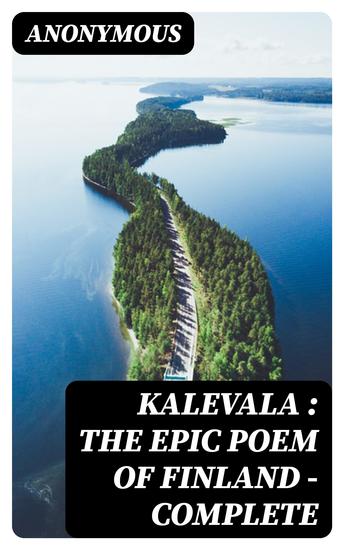
Kalevala : the Epic Poem of Finland — Complete - cover

Kalevala : the Epic Poem of Finland — Complete

Anonyme

Traducteur John Martin Crawford

Maison d'édition: DigiCat

  • 0
  • 0
  • 0

Synopsis

The "Kalevala: the Epic Poem of Finland" is a monumental collection of mythical narratives that intertwine folklore and history, capturing the essence of Finnish culture and identity. Constructed through a masterful assemblage of oral traditions and poetic forms, this epic unfolds a tapestry of heroes, goddesses, and the profound interplay of nature and humanity. Its rich trochaic tetrameter mirrors the oral storytelling practices, creating a rhythmic flow that immerses readers in the enchanting landscapes and conflicts of ancient Finland. The origins of the "Kalevala" are steeped in the dedication of its compiler, Elias Lönnrot, a physician and philologist whose life was marked by a profound commitment to the preservation of Finnish folklore. Lönnrot traveled extensively through rural Finland, collecting songs and tales that had been passed down through generations. This deep engagement with the oral traditions informed his vision of a national epic that not only celebrates Finnish culture but also serves as a resistance against Russian domination in the 19th century. I highly recommend the "Kalevala" to readers interested in mythology, literature, and cultural identity. This timeless epic is not only a reflection of Finnish heritage but also resonates universally, inviting contemplation on the power of storytelling and the collective human experience.
Disponible depuis: 04/09/2022.
Longueur d'impression: 378 pages.

D'autres livres qui pourraient vous intéresser

  • The Story of a Man Who Collapsed Into His Notebook - cover

    The Story of a Man Who Collapsed...

    Ivana Sajko

    • 0
    • 2
    • 0
    . . . I’ve forgotten how to travel, how to surrender to the favor and misfortune of the rails, how one says goodbye, how long one actually stands facing backward watching Point A swiftlydisappearing, and after that how long does he continue standing standing standing . . . I open my notebook, but I have no answer, I write: “traveling from Point A to Point B, from a littleseaside town to Berlin, I gaze out the window at the unfinished houses on the outskirts, warehouses in the industrial zone, stunted trees along the river with plastic bags hanging fromtheir branches like bats . . .”
     
    Sajko teases out the mental state and personal history of the protagonist, posing departure as a major theme that serves as a touchstone not only for our region [of Southeastern Europe] but also for the times we are living in. —Antonela Marušić, Novosti
     
    This is a stylistically superb novel, very readable. . . . And although this is a deeply personal text, it functions much more broadly, giving expression to the experiences, doubts, fears and all things encountered not only by this one, but a whole series of generations. —Matija Prica, booksa.hr
     
    The Story of a Man Who Collapsed Into His Notebook is about departures, childhood, the end of a relationship and the vanishing possibility in today’s world of fleeing to a better place. Written in the first person, each chapter a single sentence, the novel is an internal soliloquy of self-examination, an excavation of a life punctuated by upheaval and loss, hope and disillusionment, ambition and failure. The reader joins the narrator on his journey, both on the train and in his mind—from disjointed memories triggered by his departure from home, through attempts to put his relationships and experiences in some kind of order to find meaning in them and perhaps assign blame, to confronting his most painful memories—finally arriving with him at his destination with a sense of clarity and the possibility of a new beginning.
    Voir livre
  • The Prophet - cover

    The Prophet

    Anonyme

    • 0
    • 0
    • 0
    The Prophet is a book of prose poetry that made its Lebanese-American author Kahlil Gibran famous.
    Originally published in 1923, the book begins with a man named Almustafa living on an island called Orphalese. Locals consider him something of a sage, but he is from elsewhere and has waited twelve years for the right ship to take him home. From a hill above the town, he sees his ship coming into the harbor, and realizes his sadness at leaving the people he has come to know. The elders of the city ask him not to leave. He is asked to tell of his philosophy of life before he goes, to speak his truth to the crowds gathered. What he has to say forms the basis of the book.
    Voir livre
  • Treasure - cover

    Treasure

    Jemima Foxtrot

    • 0
    • 0
    • 0
    "religion's been cruel to people like usthe darkwood sluts      the good time girlsbut god as my witnesssome of us           we're just trying to wrangle our powerback from the species that took it"
    Jemima Foxtrot's Treasure is a shining work of alchemy and liberation which explores power dynamics, sex work, desire, and female friendship with a fresh and playful perspective. Foxtrot investigates shimmering sexualities, the economies of desire, the theft of childhood and pathways towards reclaiming it. Her language is lush: intimate, intricate, full of fertile earth's possibility. The poems of Treasure live up to its name: showing us where the gold is—the joy—how to feed it into the soil of our lives.
    "Treasure is an aptly chosen title for this collection, both as a noun (that quantity of precious ore dug from the stuff of experience) and as a verb (the imperative to seek out, sing, and cherish joy through the sharing of it). Foxtrot is a savvy, sometimes savage, sensualist; her poetic speakers alert to injustice, but alive to pleasure in every way that counts. These are superbly tactile poems, poems of being-in-the-body, and being-in-the-world; they are full of wit, vigour and feminist jouissance. These are also formally exciting poems, poems that showcase a beautifully bold and oddly tender lyric defiance." Fran Lock, Hyena, T.S. Eliot Prize Shortlist
    Voir livre
  • What The Deep Water Knows - Poems - cover

    What The Deep Water Knows - Poems

    Miranda Cowley Heller

    • 0
    • 0
    • 0
    From the #1 New York Times bestselling author of The Paper Palace, a Reese's Book Club Pick, comes a debut poetry collection that paints a moving portrait of a rich life from childhood to love to marriage to motherhood to divorce and beyond. 
     
    "Breathtaking . . . will change the way you see the world." —Daisy Goodwin, author of The American Heiress 
     
    If I could fly backward, I would. To the safety of branches, to the time when my heart still raced for you, twelve hundred beats a minute. 
     
    In poetry that is at once bold and lyrical, affecting and devastatingly frank, Miranda Cowley Heller takes us through childhood, marriage, motherhood, and beyond. Suffused with the natural world and the landscape of Cape Cod, where many of the poems are set, What the Deep Water Knows contemplates love in all the seasons.
    Voir livre
  • Maps You Can't Make - cover

    Maps You Can't Make

    Mariella Saavedra Carquin

    • 0
    • 0
    • 0
    Trauma takes up real space within us, and it can be so difficult to hold. How do we access that place of longing and loss, of fragmented memory and grief? How do we carry it as we walk in the world? There’s no map for this, no clear path through the internal landscape it reshapes, no easy way to make meaning of our lives in that disoriented state. Mariella Saavedra Carquin confronts hard truths in this powerful debut collection, pushing through layered complexities of immigration, race, and identity to find a way forward.
    Voir livre
  • Stories From The Faerie Queene - cover

    Stories From The Faerie Queene

    Edmund Spenser

    • 0
    • 0
    • 0
    "Stories From The Faerie Queene" is a retelling or abridged version of Edmund Spenser's epic poem "The Faerie Queene," which is a richly imaginative allegorical work dedicated to celebrating the Tudor dynasty and Elizabeth I. The poem, originally published in the late 16th century, weaves tales of knights, dragons, maidens, and quests to represent virtues and human struggles. The stories within are adaptations of Spenser's intricate stanzas into prose or shorter narratives that make the text more accessible while maintaining its magical and moral complexity.
    Voir livre