Begleiten Sie uns auf eine literarische Weltreise!
Buch zum Bücherregal hinzufügen
Grey
Einen neuen Kommentar schreiben Default profile 50px
Grey
Jetzt das ganze Buch im Abo oder die ersten Seiten gratis lesen!
All characters reduced
Saudade - The Possibilities of Place - cover

Saudade - The Possibilities of Place

Anik See

Verlag: Coach House Books

  • 0
  • 0
  • 0

Beschreibung

Beside me, on the stone steps of this quiet courtyard, there is a lame man – the sweeper. He is so thin that the end of his belt comes back around to its buckle. He’s trying to feed a puppy the rest of his lunch. He reminds me that we all need something to need us, and that maybe that’s why we Westerners, who are so independent, mostly fail to understand family in this way, and need to come up with things like ‘quality time’ to justify such a base need. Everyone here asks if my family is in Sri Lanka, if that’s why I’ve come here. When I say no, they’re back in Canada, this confuses them. It’s a black mark against me. Why would I leave them? I am a selfish person. (I am.)
   
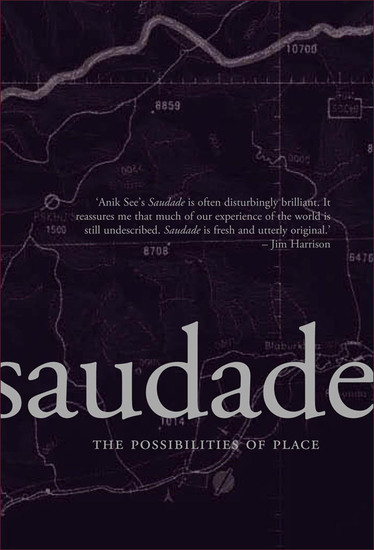
The Portuguese word saudade has no direct English translation. In its simplest sense, it describes a feeling of longing for something that is now gone, and may yet return, but in all likelihood can never be recaptured. In Saudade, traveller Anik See traces her attempts to reclaim this loss in a series of informal essays that take us from the salt plains of Wood Buffalo National Park and the mountains of British Columbia to the fishing ports of Sri Lanka and the rough roads of Tbilisi, Georgia.
   
Whether at a fishfry in the Northwest Territories, at the post-9/11 Canada-US border, on the ultimate road trip through Australia or at a summer carnival in Santiago de Cuba, See is on a continual quest for simplicity, interrogating the perceived distance between privilege and want. Quietly, insistently, these thoughtful essays ask what we might accomplish if we said no to entitlement; if, instead, we used our privilege to help us better understand human nature. Throughout this psychogeographic diary, crowded with rituals of faith, death and renewal, See asks, again and again, 'How much will be enough?'
   
Praise for Saudade:
   
'Anik See's Saudade is often disturbingly brilliant. It reassures me that much of our experience of the world is still undescribed. Saudade is fresh and utterly original.' – Jim Harrison
   
'See's meditations on loss, technology, design, and borders are like long-exposure photographs: richly textured, dreamy, observant of even the slightest movement.'
   
– GLOSS Magazine
Verfügbar seit: 05.10.2008.
Drucklänge: 200 Seiten.

Weitere Bücher, die Sie mögen werden

  • Cries of the Savanna - An Adventure An awakening A journey to understanding African wildlife conservation - cover

    Cries of the Savanna - An...

    Sue Tidwell

    • 0
    • 0
    • 0
    Her first night in a Tanzanian tent began with a prowling lion’s roar. Will the savage terrors open her eyes to an unseen world? 
    Sue Tidwell lived in awe of Africa’s extraordinary wildlife. After years spent appreciating the animals in her imagination, the tenderhearted American hated the idea of joining her husband on a big game hunt. And getting attacked by blood-sucking tsetse flies the moment she stepped off the plane gave no hint of the mind-blowing change of perspective in her future…  
    With her initial animosity turning into curiosity as they breathlessly tracked dangerous beasts, Sue formed a surprising bond with their young, female, government-assigned game scout. And as she became entranced by the tales and wisdom from the Masimba Camp crew, she was humbled by the mystery of the vilified safari and the people who relied on it for survival.  
    Supplementing her own experiences on the elephant-rutted roads with local insights and scientific research into conservation efforts, Tidwell explores how her preconceived beliefs sluiced away under the deluge of reality. And with an evocative narrative peppered with self-deprecating humor, vivid imagery, and over ninety photos and illustrations, you’ll emerge forever changed by the truths this greenhorn found buried in a rugged and romantic landscape. 
    Cries of the Savanna is an unflinching and passionate memoir. If you like awe-inspiring adventures, truth revealed through laughter, and life being stranger than fiction, then you'll adore Sue Tidwell's brush with the wild.  
    Buy Cries of the Savanna to put boots on the ground today! 
    NOTE: The audible version of Cries of the Savanna includes guest narration by Lilian Mremi, the Tanzanian Game Scout featured in the book, as well as the LITERAL cries of the savanna -- lions, hyenas, hippos, elephants, leopards, baboons and more. 
    Zum Buch
  • Mountain Walks Scafell Pike - 15 routes to enjoy on and around the Sca Fell range - cover

    Mountain Walks Scafell Pike - 15...

    Graham Uney

    • 0
    • 0
    • 0
    Mountain Walks Scafell Pike by Graham Uney is a guide to walking routes to the summit of Scafell Pike – England's highest mountain – in the Lake District. Alongside the summit routes, there are also lower-level alternatives for mixed weather or shorter days and those new to mountain walking.
    Written by an experienced local mountain guide, the 15 inspiring routes include an ascent of Scafell Pike from Borrowdale via the Corridor Route, and the Mosedale Horseshoe across the valley, and even those who are familiar with the area will find new and imaginative route ideas to discover. Whether you aspire to climb Scafell Pike from Wasdale Head or you're looking for an alternative adventure, this is the only guidebook you need.
    Together with stunning photography, each route features: Ordnance Survey 1:25,000 maps; easy-to-follow, detailed directions; essential info about public transport and safety advice; details about the terrain and navigation; facilities, refreshments and points of interest; and downloadable GPX files.
    Zum Buch
  • Inca Empire - The Builders of Machu Picchu and Masters of the Andes - cover

    Inca Empire - The Builders of...

    Rolf Hedger

    • 0
    • 0
    • 0
    The story of the Inca Empire begins with a mix of myth and history, deeply rooted in the Andean highlands of South America. According to Inca legend, the empire’s origins trace back to the Sun God, Inti, who sent his son, Manco Cápac, to establish a kingdom on Earth. Manco Cápac and his sister-wife Mama Ocllo emerged from the waters of Lake Titicaca, tasked with finding the place where the sun would set forever. Guided by this divine mission, they journeyed through the Andes, eventually founding the city of Cusco, which would become the heart of the Inca Empire. This mythic narrative blended with historical elements, shaping the early identity of the Incas as a people divinely chosen and destined for greatness. 
    The rise of the Inca Empire began in earnest during the 12th century, but it wasn’t until the 15th century that the Inca began their ambitious expansion under the leadership of Pachacuti. Before this period, the Inca were a small ethnic group living in the valley of Cusco, a modest settlement by the standards of the Andean world. The powerful Wari and Tiwanaku civilizations had already left their marks on the region, and other neighboring cultures, such as the Chanka and the Nazca, vied for dominance in the highlands. However, it was the strategic leadership and military genius of the early Inca rulers that laid the foundation for what would become the largest empire in pre-Columbian America. 
    Manco Cápac, the first Sapa Inca (the title for the emperor), established the social and political framework that would support future conquests. He was followed by a line of rulers who solidified Cusco’s position as the seat of power, but it wasn’t until Pachacuti’s reign that the Inca’s ambitions expanded beyond their small kingdom. Under Pachacuti’s rule, the Inca adopted a highly organized and disciplined military structure, which allowed them to conquer surrounding territories and absorb them into their growing empire.
    Zum Buch
  • CAMBODIA - Cambodia´s History - A Comprehensive Guide to the History of Cambodia and Its People - cover

    CAMBODIA - Cambodia´s History -...

    History Retold

    • 0
    • 0
    • 0
    For anyone seeking a gripping tale of triumph and tragedy, this is the book for you. 
    This epic book of the Cambodian nation takes you on a journey through time. From the glorious days of the Khmer Empire to the darkest hours of the 20th century.Follow the rise and fall of powerful kings and queens, and witness the artistic and cultural achievements of the Khmer civilization.Discover the horrors of war and genocide, as Cambodians endure unimaginable suffering and loss.Witness the resilience and determination of the Cambodian people, as they rebuild and forge a new path forward. 
    You'll learn about the artistic and cultural triumphs of the Khmer Empire during the Angkor era, as well as the devastating consequences of the Khmer Rouge regime led by Pol Pot, responsible for the deaths of millions of people. This book offers a comprehensive and captivating insight into Cambodia's complex and fascinating past. 
    Whether you're a lover of history, a student of geopolitics, or simply seeking a powerful story, This book about the History of Cambodia will leave you spellbound!
    Zum Buch
  • The Pyramids of Giza - Architecture and Engineering Secrets - cover

    The Pyramids of Giza -...

    Omar Khalil

    • 0
    • 0
    • 0
    The story of the Pyramids of Giza begins long before the massive limestone structures rose on the western edge of the Nile. To understand their origins, one must look back to the early burial traditions of ancient Egypt, where the desire to honor and protect the dead laid the foundation for increasingly complex funerary architecture. In the earliest periods, Egypt's elite were buried in simple rectangular tombs called mastabas, built from mudbrick and later stone. These low, flat structures served as a prototype for more ambitious designs that would come to define ancient Egypt’s monumental legacy. 
    As the Egyptian state grew more centralized during the Early Dynastic Period and into the Old Kingdom, the architectural evolution of tombs became a symbol of royal power and divine authority. The concept of the king as a god on earth demanded a burial structure that reflected his eternal status. This shift led to the experimentation with stepped designs, culminating in the Step Pyramid of Djoser at Saqqara, designed by the architect Imhotep during the Third Dynasty. This innovation marked the beginning of the pyramid as a distinct architectural form and demonstrated a newfound mastery of stone construction. 
    With each successive generation, the ambition behind royal tombs expanded. The transition from stepped to smooth-sided pyramids represented not just an aesthetic shift but a symbolic one, intended to reflect the pharaoh's journey to the heavens. By the time the Fourth Dynasty began, kings such as Sneferu pioneered structural advancements, including multiple attempts at pyramid design that culminated in the Bent Pyramid and the Red Pyramid. These efforts set the stage for the apex of pyramid construction: the Pyramids of Giza.
    Zum Buch
  • Kakatiya Dynasty - Fortresses Flourishing Trade and Administrative Genius - cover

    Kakatiya Dynasty - Fortresses...

    Rolf Hedger

    • 0
    • 0
    • 0
    The Kakatiya Dynasty emerged as a formidable power in the Deccan region of India, leaving behind a rich legacy of military strength, administrative brilliance, and cultural contributions. Their origins can be traced back to the 10th century, though historical records regarding their early rulers remain scarce. Initially, the Kakatiyas served as feudatories under the Rashtrakutas and later the Western Chalukyas, gradually expanding their influence over the Telugu-speaking region. 
    The name "Kakatiya" is believed to have originated from their association with the goddess Kakati, a form of Durga, who was worshipped as their family deity. The earliest known ruler, Venna or Beta I, established the dynasty’s foundation, but it was during the reign of Prola I that the Kakatiyas started asserting their independence. Prola II played a crucial role in strengthening their foothold by resisting Chalukyan dominance and expanding Kakatiya control over the eastern Deccan. 
    During this period, the Deccan was a contested space where multiple regional powers sought dominance. The Kakatiyas capitalized on the declining influence of the Western Chalukyas, strategically aligning themselves with or resisting various rulers to carve out an independent identity. Their stronghold was initially located in Hanamkonda, which later evolved into the grand city of Warangal, a center of Kakatiya power and cultural patronage.
    Zum Buch