Begleiten Sie uns auf eine literarische Weltreise!
Buch zum Bücherregal hinzufügen
Grey
Einen neuen Kommentar schreiben Default profile 50px
Grey
Jetzt das ganze Buch im Abo oder die ersten Seiten gratis lesen!
All characters reduced
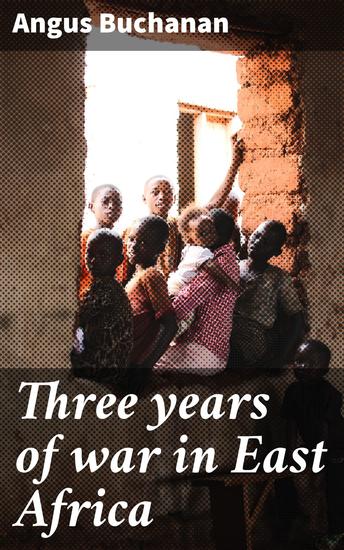
Three years of war in East Africa - Unveiling the African Experience in World War I - cover

Three years of war in East Africa - Unveiling the African Experience in World War I

Angus Buchanan

Verlag: Good Press

  • 0
  • 0
  • 0

Beschreibung

In "Three Years of War in East Africa," Angus Buchanan offers a meticulous and vivid account of the East African theater during World War I. His detailed narrative is reflective of both primary source research and firsthand experience, employing a compelling literary style that combines stark realism with poignant human emotion. Buchanan masterfully weaves together military strategy, environmental challenges, and the disparate experiences of soldiers and civilians, creating an immersive tableau that shines a light on the complexities of colonial engagement and the often-overlooked narratives of this geographical front. Angus Buchanan, a trained historian and veteran of the conflict, draws upon his personal experiences and extensive archival research to inform this work. His deep understanding of the socio-political intricacies of East Africa in the early 20th century, coupled with his passion for illuminating marginalized voices in history, has shaped his perspective. This comprehensive approach not only honors the memory of those involved in the conflict but also provides essential commentary on the impact of war on both individual lives and national identities. "Three Years of War in East Africa" is a significant contribution to the historiography of World War I and is highly recommended for scholars, students, and history enthusiasts alike. Its rich narrative and insightful analysis will not only deepen your understanding of the war's far-reaching implications but also inspire a greater appreciation for the resilience of communities facing tumultuous change.
Verfügbar seit: 09.07.2023.
Drucklänge: 163 Seiten.
Weitere Bücher, die Sie mögen werden

  • Past Imperfect - French Intellectuals 1944-1956 - cover

    Past Imperfect - French...

    Tony Judt

    • 0
    • 1
    • 0
    A “marvelously readable” critique of Sartre, Camus, de Beauvoir, and other French postwar intellectuals that “consistently entertains and provokes” (The Washington Post).   The uniquely prominent role of French intellectuals in European cultural and political life following World War II is the focus of this book by the acclaimed author of Postwar: A History of Europe Since 1945. Tony Judt analyzes this intellectual community’s most divisive conflicts: how to respond to the promise and the betrayal of Communism and how to sustain a commitment to radical ideals when confronting the hypocrisy in Stalin’s Soviet Union, in the new Eastern European Communist states, and in France itself. Judt shows why this was an all-consuming moral dilemma to a generation of French men and women, how their responses were conditioned by war and occupation, and how postwar political choices have come to sit uneasily on the conscience of later generations of French intellectuals. Judt’s analysis extends beyond the writings of fashionable “existentialist” personalities such as Jean-Paul Sartre, Albert Camus, and Simone de Beauvoir to include a wide intellectual community of Catholic philosophers, non-aligned journalists, literary critics and poets, Communist and non-Communist alike—and asserts that what he calls the “moral irresponsibility” of those years damaged France’s cultural standing, and reflected the nation’s larger difficulty in confronting its own ambivalent past.   “A forthright and uncommonly damning study of those intellectually volatile years . . . indicts these intellectuals for their inhumanity in failing to test their political thought against political reality.” —The New York Times Book Review   “Brilliant . . . splendidly written.” —Foreign Affairs
    Zum Buch
  • United Kingdom - History of Scotland and England - cover

    United Kingdom - History of...

    Kelly Mass

    • 0
    • 0
    • 0
    This is a book with 10 different subjects, all related to the history of Great Britain. The subjects are the following: 
    Horatio Nelson 
    The British Raj 
    The Cathars 
    The Great Fire of London 
    Ghosts of Scotland 
    Scottish History 
    Wars of Scottish Independence 
    William Wallace
    Zum Buch
  • The American Operations in WW2: Central Burma - cover

    The American Operations in WW2:...

    U.S. Army Center of Military...

    • 0
    • 0
    • 0
    World War II was the largest and most violent armed conflict in the history of mankind. Highly relevant today, World War II has much to teach us, not only about the profession of arms, but also about military preparedness, global strategy, and combined operations in the coalition war against fascism. This book follows military operations of the US Army in North Ease Asia from 29 January to 15 July 1945. 
    At the beginning of 1945, less than eight months remained before the final surrender of Japan. Those eight months, however, were to see some of the bitterest fighting of the war. Although the final outcome was no longer in doubt, when and how the conflict would end remained unclear. The American naval blockade of Japan, combined with a growing air offensive, was placing a serious strain on Japan's economy. Yet any invasion of the Japanese home islands would most likely be drawn out and extremely costly in lives. There was also the danger that even with the capture of the home islands the war might not end, but continue interminably on the Asian mainland, where large numbers of Japanese troops occupied Korea, Manchuria, and the richest and most populous areas of China.
    While American forces in the Pacific had been making dramatic progress since early 1942, the Allied effort in the China-Burma-India theater had bogged down in a morass of conflicting national objectives. The hope Americans held in the early stages of the war, that Chinese manpower and bases would play a vital role in the defeat of Japan, was unrealized. Americans sought to achieve great aims on the Asian mainland at small cost, looking to the British in India and the Chinese, with their vast reservoirs of manpower, to carry the main burden of the ground conflict. Neither proved capable of exerting the effort the Americans had hoped...
    Zum Buch
  • George Washington: Commander-in-Chief - cover

    George Washington:...

    Sean Sculley

    • 0
    • 0
    • 0
    Explore the secret behind George Washington’s military genius with an award-winning West Point history professor. George Washington came to be known as Father of His Country. In his role as commander in chief of the Continental Army, George Washington defeated the British in the American Revolution and established the United States of America. Through his extraordinary military leadership, he guaranteed that the American Republic would move forward in its revolutionary experiment. So how was Washington able to win this seemingly unwinnable war? This compelling 15-lecture audio course, presented by West Point history professor Seanegan Sculley, answers this and many more questions about one of the most foundational figures in American history. Professor Sculley explores Washington’s singular military career from its beginnings during the French and Indian War through the end of the Revolution. After investigating Washington’s boyhood experiences and his service in the French and Indian War, you’ll look into the first years of the American Revolution, as he attempts to control a disorganized armed force with no institutional structure. Next, you’ll transition into the second half of the war, as Washington learns from his mistakes and builds a more professional army capable of working with allies to defeat the British. Last, you’ll analyze his actions as a strategist and tactician, as a military administrator and commander, and finally as the first president of the United States wrestling with lingering issues from the War for Independence.This publication was privately produced and is not the product of an official of the United States Army acting in an official capacity. The contents of this publication, including words, images, and opinions, are unofficial and not to be considered as the official views of the United States Military Academy, United States Army, or Department of Defense. Neither this publication nor its content are endorsed by the United States Military Academy, United States Army, or Department of Defense.
    Zum Buch
  • Cynicism - Ancient Wisdom for a Modern World - cover

    Cynicism - Ancient Wisdom for a...

    Hector Davidson

    • 0
    • 0
    • 0
    Cynicism, as a philosophical movement, originated in ancient Greece during the 4th century BCE. It emerged in response to the growing complexity of Greek social and political life, which many perceived as rife with corruption and moral decay. The movement sought to critique and challenge these structures through a radical reevaluation of values. The term "Cynicism" itself derives from the Greek word kynikos, meaning "dog-like," a reflection of the movement's provocative and unconventional practices, often likened to the traits of a dog—independent, shameless, and straightforward. 
    The seeds of Cynicism were planted by Antisthenes, a devoted student of Socrates. Rejecting the materialism and social constructs of his time, Antisthenes advocated for a life rooted in virtue as the highest good. He proposed that virtue was attainable through rigorous self-discipline and liberation from societal expectations. In his view, wealth, power, and social status were distractions that led individuals away from true happiness. Antisthenes' emphasis on asceticism laid the groundwork for Cynicism's core principles. 
    Diogenes of Sinope, the most iconic figure in Cynicism, brought the philosophy to life through his dramatic and often confrontational actions. Renowned for his extreme asceticism, he discarded conventional comforts and famously lived in a large ceramic jar, owning only a few possessions. Diogenes used his lifestyle as a form of social critique, questioning the moral foundations of his contemporaries. His legendary act of walking through the city with a lit lantern during the day, claiming to search for an honest man, remains a potent symbol of his scorn for societal hypocrisy and moral pretense. Diogenes embodied the Cynic ideal: a life of radical honesty, self-sufficiency, and rejection of superficial values.
    Zum Buch
  • Powerful Questioning - Strategies for improving learning and retention in the classroom - cover

    Powerful Questioning -...

    Michael Chiles

    • 0
    • 0
    • 0
    Foreword by John Hattie.
    Questioning is a staple feature of a teacher's toolkit across all phases of education. Classrooms are awash with explanation, modelling and feedback, but of all the pedagogical strategies at a teacher's disposal, questioning is one of the most important. It is the heartbeat of a classroom. While the art of asking a question seems relatively straightforward, to what extent do teachers consider the types of questions they're using? Are the questions they ask students actually helping to support learning? InPowerful Questioning,Michael Chiles delves into the complexity of asking questions and how best to use this pedagogical tool as a powerful springboard to support learning in the classroom.
    Teachers are described by many as 'professional question-askers' and the use of questioning in the teaching and learning process dates back to one of the most influential users and developers of questions, the Greek philosopher Socrates. Socrates believed that by asking questions we encourage reflection, and that their use is most effective when we create a continual loop of dialogue between the asker and the receiver, to allow movement from surface to deeper level thinking.Powerful Questioningtakes inspiration from this, providing original theory that relates back to the historical use of questioning in the classroom throughout.
    Offering a fresh perspective on how questioning can be engineered to support effective learning,Powerful Questioningexamines the reasons behind the questions we ask and reveals the power of asking the right questions, in the right way, at the right time. It details a set of core principles, recommendations and classroom-based practical examples that can be used to implement powerful questioning both in the classroom and wider school.
    Michael's aim is to help teachers become research-informed on the theories around the use of questioning in the classroom, whilst also providing a wide range of practical classroom-based strategies. Readers will take away specific examples from a broad range of case studies in which teachers at different phases of education (from Key Stages one to five) share how they use questioning to improve learning and retention.
    Essential reading for all teachers and school leaders.
    Zum Buch