Join us on a literary world trip!
Add this book to bookshelf
Grey
Write a new comment Default profile 50px
Grey
Subscribe to read the full book or read the first pages for free!
All characters reduced
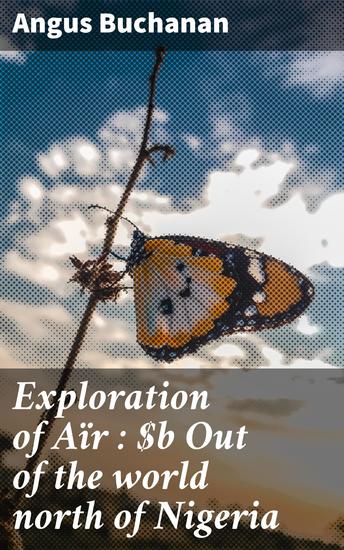
Exploration of Aïr : Out of the world north of Nigeria - Unveiling the Mysterious Aïr Mountains - cover

Exploration of Aïr : Out of the world north of Nigeria - Unveiling the Mysterious Aïr Mountains

Angus Buchanan

Publisher: Good Press

  • 0
  • 0
  • 0

Summary

In "Exploration of A√Ør: Out of the World North of Nigeria," Angus Buchanan presents a compelling narrative that merges travelogue with rich ethnographic detail. The book intricately explores the captivating landscapes and diverse cultures of the A√Ør mountains in Niger, revealing the region's unique geography and its socio-cultural significance. Written in a vivid and descriptive style, Buchanan'Äôs prose invites readers to experience the breathtaking vistas and the complexities of the local tribes, balancing personal reflection with scholarly analysis. This exploration is contextualized within the broader canon of African exploration literature, drawing parallels with the works of earlier explorers while also asserting its own distinctive voice. Angus Buchanan, an accomplished traveler and esteemed scholar in geography, has spent decades studying the cultural and environmental intricacies of the Sahel region. His firsthand experiences in remote areas, combined with a scholarly background in anthropology, have profoundly shaped his understanding of the A√Ør region. Buchanan's passion for connecting with indigenous communities and documenting their narratives further underscores the authenticity of his insights and observations in this work. This book is highly recommended for readers interested in African studies, cultural anthropology, and adventure literature. Buchanan's thoughtful narration not only enlightens but also inspires curiosity about the often-overlooked aspects of Northern Nigeria, making it essential reading for anyone seeking to understand the richness of the A√Ør region.
Available since: 07/11/2023.
Print length: 190 pages.

Other books that might interest you

  • Cambodia - History of Angkor Wat and the Khmer Empire (3 in 1) - cover

    Cambodia - History of Angkor Wat...

    Kelly Mass

    • 0
    • 0
    • 0
    Learn more about the history of those countries. The topics addressed will be these: 
    Angkor Wat-- The temple was built as the state temple for the Khmer Empire at the demand of Suryavarman II in the early 12th century in Yaodharapura (, contemporary Angkor), the Khmer Empire's capital. It was constructed in the early 12th century to honor the Hindu god Vishnu, but by the end of the century, it had been changed to a Buddhist temple. 
    Angkor Wat is a fascinating structure, dating back hundreds of years, and it’s impressive how much of it has remained intact. 
    The Khmer Empire--Historians describe Cambodia as the Khmer State or the Angkorian Empire (Khmer:) from the 9th century to the 15th century, when it was a Hindu/Buddhist empire in Southeast Asia. The empire, which developed from the old societies of Funan and Chenla, governed and/or "vassalized" the majority of mainland Southeast Asia and parts of Southern China, covering from the suggestion of the Indochinese Peninsula northward to modern-day Yunnan province in China, and from Vietnam westward to Myanmar. The Khmer Empire was greater at its peak than the Byzantine Empire (Eastern Roman Empire) that existed at the exact same period. 
    The Siamese-- Siam was just a much different name for what's now referred to as Thailand. The Siamese are the people who live there, though they're never ever called as such any longer. 
    Thailand is a fascinating country, with its own culinary arts, culture, history, royalty, infrastructure, and influence on the world. To learn more about these “Thai” people before they were called Thai, when they were Siamese, is to learn about those people’s roots.
    Show book
  • Why You Should Go to Cape Town - cover

    Why You Should Go to Cape Town

    Mark Ferdinand

    • 0
    • 0
    • 0
    Cape Town is a city framed by natural wonder, where the majestic Table Mountain meets the rolling waves of two oceans. It’s a destination that blends dramatic landscapes with vibrant culture, offering a unique mix of adventure, history, and style. From golden beaches and lush vineyards to colorful neighborhoods and bustling markets, Cape Town delivers an experience like no other. 
    Mark Ferdinand takes you through the city’s highlights and hidden gems: the views from atop Table Mountain, the rich history of Robben Island, the artistry of the Bo-Kaap, and the natural splendor of the Cape Peninsula. Whether you’re hiking, wine-tasting, or simply watching the sun dip into the Atlantic, Cape Town is a place that captures both heart and imagination.
    Show book
  • The Road Unpaved - Border to Border with a Brain Tumor and a Bike - cover

    The Road Unpaved - Border to...

    Risa August

    • 0
    • 0
    • 0
    After a shocking diagnosis for a rare pituitary disease, and with her eighteen-year marriage in shambles, Risa's life has fallen far from picture-perfect. Recovering from brain surgery and desperate to get back to her former self, she signs up for the bike tour of a lifetime-six weeks from Canada to Mexico on the Pacific Coast Highway. 
    The old Risa could have done the ride in her sleep, but for the new Risa, trapped in a body that no longer feels like her own and stuck in the company of her brain tumor, Bubba, the ride becomes a challenge unlike anything she's ever faced. 
    As Risa pedals through rain, pain, and the ghosts of her memories, she wonders if the woman she once was will ever return or whether the new woman rising up in her place might just be the person she was meant to be all along. 
    A remarkable story of transformation and resilience, The Road Unpaved speaks to shifting gears to navigate life's roadblocks and live a life without limits-a life fully unleashed.
    Show book
  • Andean Economies - Shaping Nations Through Wealth and Hardship (3 in 1) - cover

    Andean Economies - Shaping...

    Anya Solace

    • 0
    • 0
    • 0
    Andean Economies explores the economic paths of three key countries—Bolivia, Chile, and Peru—that make up the backbone of the Andean region. This 3-in-1 volume traces how natural resources, policy choices, and historical legacies have shaped the rise and fall of economic fortunes across these nations. From copper and lithium to agriculture and tourism, the Andes are not just mountains—they’re economic lifelines that have brought both prosperity and hardship to those who call this region home. 
    In From Prosperity to Peril, the book examines how sudden wealth from resource booms often led to financial crises and social unrest, especially in countries like Bolivia, where inequality and political tensions persist. Chile’s economic journey highlights one of the most stable and market-driven economies in South America, marked by both praise for reform and criticism for inequality. Finally, Peru’s economic evolution tells a story of resilience—how a country historically plagued by instability and poverty transformed into one of the region’s fastest-growing economies in recent decades. 
    This comprehensive overview is ideal for anyone seeking to understand the forces behind economic change in South America’s Andean corridor—where every boom comes with risk, and every crisis opens the door for transformation.
    Show book
  • Croatian in 40 Minutes: Learn to speak Croatian in minutes with Collins - cover

    Croatian in 40 Minutes: Learn to...

    Anonymous

    • 0
    • 0
    • 0
    Collins makes language learning fun, fast and flexible. Pick up the essentials of the Croatian language with this easy-to-use audio introduction. Covering everything from finding your way to talking about yourself, Collins 40-minute audio can help you learn short and simple phrases quickly by just listening and repeating. 
    Essential words, Asking for things, Numbers, I'd like …, At the café, In a shop, Basic foodstuffs, Quantities, Tickets, Where is …? When is …? Days of the week, Problems, About yourself.
    Show book
  • The Fall of Rome - The Birth of the Middle Ages - cover

    The Fall of Rome - The Birth of...

    Harris Ropes

    • 0
    • 0
    • 0
    At its height, the Roman Empire stood as one of the most powerful and influential civilizations in history. Spanning continents, from the windswept moors of Britain to the deserts of Egypt, Rome’s reach seemed boundless. The strength of the empire lay not only in its vast military conquests but in the complexity and efficiency of its administrative systems. Roman law, engineering, and political structure provided a level of organization that allowed a diverse collection of peoples and cultures to function under a single imperial banner. The Pax Romana, a period of relative peace lasting over two centuries, demonstrated Rome’s ability to maintain stability across its vast territories. 
    Roman culture was a dynamic blend of traditions inherited from earlier civilizations and innovations of its own. Latin served as the unifying language, enabling administration and communication across the empire. The arts flourished, with literature, sculpture, and architecture reaching impressive heights. From the poetry of Virgil and Ovid to the engineering marvels of aqueducts and roads, Roman achievements stood as symbols of sophistication. The grandeur of public spaces like the Colosseum and the Roman Forum reflected the empire’s emphasis on civic life and the power of the state. 
    Governance played a key role in the success of Rome. A highly structured bureaucracy allowed the empire to manage its provinces effectively, while a legal system based on Roman law continued to influence Western societies long after the empire’s decline. Though emperors held supreme power, the Senate, magistrates, and various local officials contributed to a layered political system that managed both urban centers and rural territories. Roman citizenship, which could be extended to people across the empire, fostered a sense of unity and shared identity among diverse populations.
    Show book