Join us on a literary world trip!
Add this book to bookshelf
Grey
Write a new comment Default profile 50px
Grey
Subscribe to read the full book or read the first pages for free!
All characters reduced
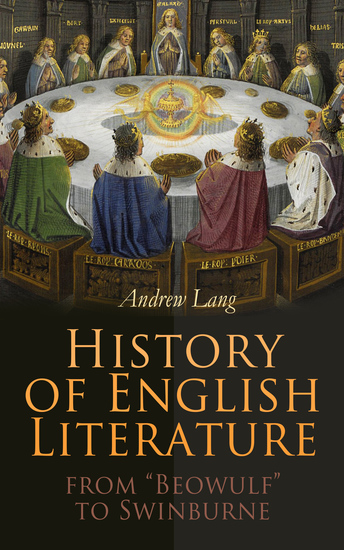
History of English Literature from "Beowulf" to Swinburne - cover

History of English Literature from "Beowulf" to Swinburne

Andrew Lang

Publisher: e-artnow

  • 0
  • 0
  • 0

Summary

The book 'History of English Literature from "Beowulf" to Swinburne' is written by Andrew Lang. Lang was a Scottish writer and literary critic who is best known as a collector of folk and fairy tales. His academic interests extended beyond the literary and he was a noted contributor to the fields of anthropology, folklore, psychical research, history, and classic scholarship, as well as the inspiration for the University of St. Andrew's lectures. A prolific author, Lang published more than 100 works during his career, including twelve fairy books, in which he compiled folk and fairy tales from around the world.
Excerpt:
"The literature of every modern country is made up of many elements, contributed by various races; and has been modified at different times by foreign influences. Thus, among the ancient Celtic inhabitants of our islands, the peoples whom the Romans found here, the Welsh have given us the materials of the famous romances of King Arthur, and from the Gaelic tribes of Ireland and Scotland come the romances of heroes less universally known, Finn, Diarmaid, Cuchulain, and the rest. But the main stock of our earliest poetry and prose, like the main stock of our language, is Anglo-Saxon. The Anglo-Saxon tribes who invaded Britain, and after the departure of the Romans (411) conquered the greater part of the island, must have had a literature of their own, and must have brought it with them over sea."
Available since: 02/27/2022.
Print length: 645 pages.

Other books that might interest you

  • The Effects of ADHD on Children's Social Skills - Think Before You Act And Be Successful In School And Society - cover

    The Effects of ADHD on...

    Jim Colajuta

    • 0
    • 0
    • 0
    ADHD (Attention Deficit Hyperactivity Disease) is a common emotional and behavioral disorder that can disrupt a child's academic and social functioning. ADHD is characterized by inattention, impulsivity, and motor activity that are developmentally inappropriate. Within an educational setting, children with attention problems form a unique group with a wide range of demands. Although there are various issues linked with children who have been diagnosed with ADHD, many parents and educators are concerned about social skill impairments.The most unpleasant element of ADHD-related deficits is not being accepted by one's peer group, feeling separated, strange, unlikeable, and alone, and these experiences have long-term consequences. It's crucial to maintain positive relationships with people. Though children with ADHD really want to make friends and be accepted by their peers, they frequently lack the skills to do so. The good news is that you can assist your child in developing these social abilities and skills.
    Show book
  • Systematic Theology - cover

    Systematic Theology

    Paul Tillich

    • 0
    • 0
    • 0
    “A great voyage of discovery into a rich and deep, and inclusive...vision and understanding of human life in the presence of the mystery of God.” -- H. Richard Niebuhr, author of Christ and Culture   This is the first part of Paul Tillich's three-volume Systematic Theology, one of the most profound statements of the Christian message ever composed and the summation and definitive presentation of the theology of the most influential and creative American theologian of the twentieth century. In this path-breaking volume Tillich presents the basic method and statement of his system—his famous “correlation” of man's deepest questions with theological answers. Here the focus is on the concepts of being and reason. Tillich shows how the quest for revelation is integral to reason itself. In the same way a description of the inner tensions of being leads to the recognition that the quest for God is implied in finite being. Here also Tillich defines his thought in relation to philosophy and the Bible and sets forth his famous doctrine of God as the “Ground of Being.” Thus God is understood not as a being existing beside other beings, but as being-itself or the power of being in everything. God cannot be made into an object; religious knowledge is, therefore, necessarily symbolic.   “Beyond doubt the richest, most suggestive, and most challenging philosophical theology our day has produced.” --John Herman Randall Jr., author of The Making of the Modern Mind
    Show book
  • Journey of Insight Meditation - A Personal Experience of the Buddha’s Way - cover

    Journey of Insight Meditation -...

    Eric Lerner

    • 0
    • 0
    • 0
    This is an audiobook of the classic title Journey of Insight Meditation by Eric Lerner, narrated by Jonathan Nelson.
     
    --------------------------------
     
    "I set out to study and practice Vipassana meditation in India fifty years ago. Then, as now, I characterized myself as both a spiritual seeker and a writer. During the six months that I sojourned in meditation centers and monasteries, observing the strict rules of retreat, I nevertheless spent several hours a day feverishly filling notebooks by lamplight with tightly packed script legible only to me, recording my internal experiences.
     
    I wanted to tell a story, because I am by nature a story teller, but on my return to America I was a bit disconcerted to find that my detailed accounts read like data recorded by a naturalist hidden in the bush observing the behavior of a strange creature in the wild, information that would have little interest to anyone except an extreme specialist in the field.
     
    Up until then my unpublished works were lightly fictionalized autobiographical accounts of my young life, but fiction wouldn’t be accurate enough to tell this tale. Instead, I created a protagonist, a bit of a hero, who was both me and not me, Eric Lerner. I re-created the external world of people and teachers and places he’d encountered, as well as ideas and beliefs adopted and discarded. In other words, a setting and a plot. All of it was real, or real enough, the product of memory and interpretation, a new veracity. A memoir."


    —Eric LernerItaly, March 2023
    Show book
  • Soviet Union - cover

    Soviet Union

    Kelly Mass

    • 0
    • 0
    • 0
    From 1922 till 1991, the Soviet Union, officially the Union of Soviet Socialist Republics (USSR), was a socialist state that covered Europe and Asia. It was in theory a federal union of different sovereign republics; but, till its closing years, its administration and economy were highly centralized.The Bolsheviks, led by Vladimir Lenin, ousted the Provisional Federal government that had formerly toppled the Russian Empire's Romanov family in the October Revolution of 1917, bring to life the Soviet Union. They established the Russian Soviet Republic, the world's first socialist state with a constitution. Stress between the Bolshevik Red Army and some anti-Bolshevik forces across the previous Empire emerged into a civil war, with the White Guard being the most effective faction. The White Horror was a period of violent anti-communist repression by the White Defend Against the Bolsheviks and believed worker and peasant Bolsheviks. Through Red Horror, the Red Army extended and helped regional Bolsheviks in acquiring power, building soviets, and penalizing political challengers and defiant peasants. By 1922, the power balance had moved, and the Bolsheviks had thrived, unifying the Russian, Transcaucasian, Ukrainian, and Byelorussian republics to form the Soviet Union. After the civil war ended, Lenin's administration carried out The New Economic Policy, which led to a partial return of the free enterprise and personal property, and also a period of financial healing.Joseph Stalin rose to power after Lenin's death in the year 1924. Within the Communist Party, Stalin got rid of any political resistance to his rule and developed a command economy. As a consequence, the nation went through a period of quick industrialization and pushed collectivization, which led to great financial development but also a manufactured starvation in the year 1932-- 1933 and the growth of the Gulag labor camp system.
    Show book
  • Learn Spanish for Kids Fun Stories Songs & Vocabulary Words For Beginners - Simple Language Lessons with Easy Phrases Flash Cards and Short Stories to Learn While Sleeping or in Your Car (Complete Audio Course for Children and Dummies) - cover

    Learn Spanish for Kids Fun...

    Damián Carabello

    • 0
    • 0
    • 0
    ¡Hola, future Spanish speaker! Ready to turn learning into an exciting, laughter-filled adventure? "Learn Spanish for Kids. Fun Stories, Songs & Vocabulary Words For Beginners" is not just an audiobook—it’s your passport to a magical world of colors, animals, songs, and playful characters that make learning Spanish absolutely irresistible! Join Sol, your cheerful guide, as you explore vibrant tales like La Familia de los Colores, sing catchy songs, and build real-world vocabulary you'll remember forever. Whether you're coloring at home or riding in the car, you'll be absorbing Spanish naturally—without even realizing you're learning! By the end, you’ll be able to introduce yourself, chat about your favorite things, and sing in Spanish with confidence and joy. This isn't boring classroom stuff—it’s fun, dynamic, and made just for kids like you! So put on your listening ears, take a deep breath, and jump into this unforgettable journey. ¡Vamos! Let’s make Spanish your new superpower!
    Show book
  • On Heroes Hero-Worship and the Heroic in History - cover

    On Heroes Hero-Worship and the...

    Thomas Carlyle

    • 0
    • 0
    • 0
    Though uncompromising, polemical and argumentative, Thomas Carlyle (1795-1881) made a lasting impact on 19th-century culture as a multi-talented man of letters. And though his lengthy history of the French Revolution proved his major scholarly legacy, On Heroes, Hero-Worship and the Heroic in History remains perhaps his most popular and accessible work. It presented his deep-seated belief that ‘Universal History, the history of what man has accomplished in this world, is at bottom the History of the Great Men who have worked here’.  
     
    It is with this bold declaration that Carlyle opened the collection of six lectures that comprise ‘On Heroes’. Initially delivered in 1840, he published them a year later in an expanded form, and the book’s popularity gave him the broader national presence to which he aspired. The six lectures covered a wide range of man’s activities, but of particular interest were the categories, as much as the individual figures.  
     
    Lecture I. The Hero as Divinity: Odin. Paganism: Scandinavian Mythology.  
     
    Lecture II. The Hero as Prophet. Mahomet: Islam.  
     
    Lecture III. The Hero as Poet. Dante, Shakespeare.  
     
    Lecture IV. The Hero as Priest. Luther. Reformation: Knox; Puritanism.  
     
    Lecture V. The Hero as Man of Letters. Johnson, Rousseau, Burns.  
     
    Lecture VI. The Hero as King. Cromwell, Napoleon: Modern Revolutionism.  
     
    These categories challenged opinions from the outset: Carlyle’s fundamental approach, breaking away from an overbearing militaristic description of the hero figure in history, was revolutionary. He chose to take a more radical view, less hide-bound by the conventional constraints of his day, placing the poet, the philosopher and the revolutionary where, in popular imagination, the conqueror and the champion held sway. This was reflected further in the individuals he chose to represent the categories. If modern-day sensibilities may take a less emphatic ‘Great Men’ approach to history, Carlyle’s original work continues to provide an engaging template for contemporary revision.
    Show book