Rejoignez-nous pour un voyage dans le monde des livres!
Ajouter ce livre à l'électronique
Grey
Ecrivez un nouveau commentaire Default profile 50px
Grey
Abonnez-vous pour lire le livre complet ou lisez les premières pages gratuitement!
All characters reduced
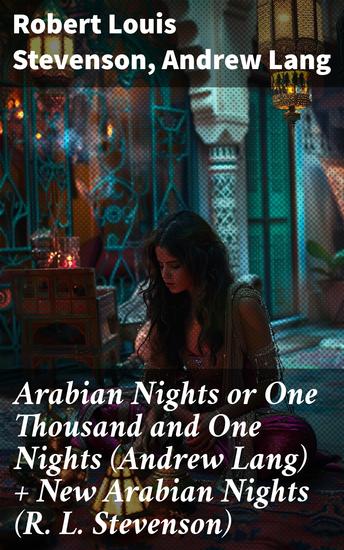
Arabian Nights or One Thousand and One Nights (Andrew Lang) + New Arabian Nights (R L Stevenson) - A Tapestry of Fantasy Adventure and Moral Intricacies - cover

Arabian Nights or One Thousand and One Nights (Andrew Lang) + New Arabian Nights (R L Stevenson) - A Tapestry of Fantasy Adventure and Moral Intricacies

Andrew Lang, Robert Louis Stevenson

Maison d'édition: Good Press

  • 0
  • 0
  • 0

Synopsis

This compelling anthology merges the timeless allure of 'Arabian Nights' with Robert Louis Stevenson's inventive 'New Arabian Nights,' curated by Andrew Lang. Offering a tapestry of tales rooted in Middle Eastern folklore with a Victorian twist, the collection invites readers into realms of mystery and adventure. Uniting traditional narratives with Stevenson's modern interpretation, the anthology spans a vast array of literary styles from fables to thrilling narratives, showcasing the adaptability and enduring nature of these stories. Andrew Lang, celebrated for his fairy tale compendiums, curates this volume with a keen eye for storytelling that transcends cultural boundaries. Meanwhile, Robert Louis Stevenson, a literary giant of his era, infuses his tales with the spirit of the 'Arabian Nights,' reimagining them for a contemporary audience of the 19th century. Together, these authors draw from the wellspring of traditional Arabian folklore while contributing to the late Victorian fascination with exoticism and narrative complexity. This anthology presents a unique literary landscape, providing an opportunity to explore narratives that bridge East and West. Readers can appreciate the anthology not only for its aesthetic and narrative variety but also for its role in fostering cross-cultural dialogue. Ideal for enthusiasts of both classical literature and innovative reinterpretations, this volume uncovers a confluence of voices and styles that enrich our understanding of storytelling traditions.
Disponible depuis: 19/12/2023.
Longueur d'impression: 458 pages.
D'autres livres qui pourraient vous intéresser

  • Two Tales From Ambrose Bierce - cover

    Two Tales From Ambrose Bierce

    Ambrose Bierce

    • 0
    • 0
    • 0
    Ambrose Gwinnett Bierce (June 24, 1842 - 1914) was an American short story writer, journalist, poet, and American Civil War veteran. A prolific and versatile writer, Bierce was regarded as one of the most influential journalists in the United States and as a pioneering writer of realist fiction. In late 1913, Bierce, then age 71, Bierce indicated he was travelling to Mexico to gain first-hand experience of the Mexican Revolution. He disappeared and his death left undocumented. The following recording includes the short stories, "An Occurrence at Owl Creek Bridge" and "The Boarded Window."
    Voir livre
  • Blood - From their pens to your ears genius in every story - cover

    Blood - From their pens to your...

    Hanns Heinz Ewers

    • 0
    • 0
    • 0
    Hanns Heinz Ewers was born on 3rd November 1871 in Düsseldorf, Germany. 
    His first published poem was at 17 on the death, after a reign of only 99 days, of the German Emperor Frederick III. 
    A stint in the German military was cut short after only 44 days because of his myopia.  Writing was to be the way forward for him with a book of satiric verse published in 1901. At the same time he co-founded a literary vaudeville troupe that toured central and eastern Europe before censors and expenses forced its closure.  An inveterate traveller he was in South America when the Great War enveloped Europe and he relocated to New York. 
    From here his story darkens. Although by now a successful and admired author he was arrested in the U S in 1918 as a German Agent on the pretext of his travels and a falsified Swiss passport. Interned, he was released in 1921 and returned to Germany.  He claimed only to be raising money for the German Red Cross. 
    His literary fame is decidedly easier to clarify. His novels beginning with ‘The Sorcerer’s Apprentice’ in 1910 are dark, they bristle with evil intent and are littered with characters who have a dubious moral compass and yet, along with his short stories, are brazen, brilliant feats of literary narrative. 
    He also wrote and published plays, fairy tales, opera librettos, critical essays and lectured for many years on ‘The Religion of Satan’ and was one of the first to write scripts for the cinema, which he considered a legitimate art form. 
    As the Weimar republic began its chaotic death throes Ewers became attracted to the rising Nazi Party.  At first he was warmly received despite disagreeing with its anti-semitism (his most famed literary character had a Jewish mistress) and he was even commissioned by Hitler to write a biography of the Nazi martyr Horst Wessel.  This together with his own homosexuality culminated with his works being banned in 1934 and his assets and property seized.  It took him many years to have the ban lifted.  This association rightfully clouds his personal reputation but has meant his literary contributions are also overlooked and neglected. 
    Hanns Heinz Ewers died of tuberculosis on 12th June 1943 in his Berlin apartment.
    Voir livre
  • Octopussy and the Living Daylights - A James Bond Adventure - cover

    Octopussy and the Living...

    Ian Fleming

    • 0
    • 0
    • 0
    FOUR TALES OF INTRIGUE THAT PUSH 007 TO THE LIMIT 
    In “Octopussy,” a former operative in the Second World War must face the consequences of past sins when James Bond knocks on the door of his Caribbean fortress, and in “The Property of a Lady” Bond deciphers the elaborate codes of a Sotheby’s bidding war in order to catch a KGB agent. “007 in New York” takes Bond to the titular city to warn an ex-agent of her boyfriend’s secret KGB affiliation. And “The Living Daylights” sends Bond to Berlin to protect a British agent before an assassin strikes.
    Voir livre
  • Dies Irae - From their pens to your ears genius in every story - cover

    Dies Irae - From their pens to...

    Kenneth Grahame

    • 0
    • 0
    • 0
    Kenneth Grahame was born on 8th March 1859 in Edinburgh. 
    At age 5 his mother succumbed to puerperal fever.  His father, who had a drinking problem, now sent his 4 children to live with their grandmother at her large house in Cookham, Berkshire. Here the children lived in large open grounds next to the river.  These early experiences would in later years, be retold in his writing through a myriad of characters. 
    Grahame loved being a pupil at St Edward's School, Oxford and wanted to enroll at the university there but his guardian demurred on account of the cost. 
    Instead, a banking career was chosen for him, starting in 1879 at the Bank of England, where he rose steadily to the rank of its Secretary until retiring, with a pension, in 1908 due to ill health. 
    Alongside his commercial career Grahame had written and published various stories and essays in several periodicals. Some were anthologized as ‘Pagan Papers’ in 1893, and two years later ‘The Golden Age’ and later still ‘Dream Days’ and its masterpiece ‘The Reluctant Dragon’ became part of many home libraries.  His ability to view life through the lens of a young and curious child was superb, enabling the reader to easily identify with the character.   
    Grahame married Elspeth Thomson in 1899 and they had one child; Alastair, born semi-blind and plagued by health problems.  In a heart-rending tragedy he would later take his own life whilst attending Oxford University in 1920.   
    In 1908 Grahame reworked many of the bedtime stories he had fashioned for his son into the enduring favourite; ‘The Wind in the Willows’, describing the heart-warming adventures of Mr Toad and his friends.   
    Kenneth Grahame died in Pangbourne, Berkshire, on 6th July 1932.
    Voir livre
  • By Virtue Fall - cover

    By Virtue Fall

    Barbara Anne Machin

    • 0
    • 0
    • 0
    A trio of stories depicting true life struggles for people in all walks of life. How individuals can spoil what is good in life through the very stubbornness in their own nature. Jealously. Harsh words and anger. Misunderstanding that would be easier to face talk about instead of walking away. No problem is insurmountable if faced instead of ignored.
    Voir livre
  • Enlargement - From their pens to your ears genius in every story - cover

    Enlargement - From their pens to...

    John Davys Beresford

    • 0
    • 0
    • 0
    John Davys Beresford was born on 17th March 1873.  His life was blighted by infantile paralysis which left him partially disabled. 
    After an education at Oundle school he trained to be an architect.  However, he quickly decided that his life was to be centred on a literary career.  His first offerings were in drama and as a journalist. 
    As well as being a book reviewer for the Manchester Guardian he contributed to New Statesman, The Spectator, Westminster Gazette, and the Theosophist magazine The Aryan Path.   
    His spiritual journey in early adulthood had claimed him as an agnostic, in defiance of his clergyman father.  This view he later abandoned in preference to describing himself as a Theosophist and a pacifist. 
    As well as many novels, many themed with spiritual and philosophical elements.  Beresford was also a gifted short story writer particularly across the science-fiction, horror and ghost genres. 
    All of these elements helped him to obtain a prominent place in Edwardian Literary London. 
    John Davys Beresford died on the 2nd February 1947. He was 73.
    Voir livre