Rejoignez-nous pour un voyage dans le monde des livres!
Ajouter ce livre à l'électronique
Grey
Ecrivez un nouveau commentaire Default profile 50px
Grey
Abonnez-vous pour lire le livre complet ou lisez les premières pages gratuitement!
All characters reduced
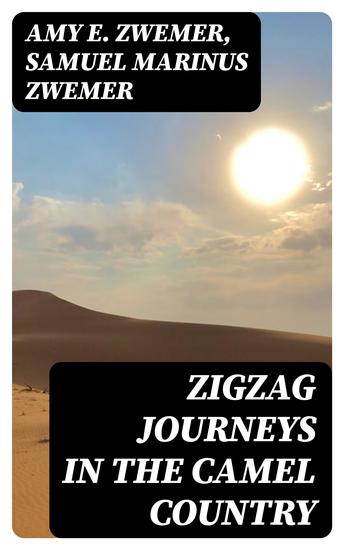
Zigzag Journeys in the Camel Country - Arabia in Picture and Story - cover

Zigzag Journeys in the Camel Country - Arabia in Picture and Story

Amy E. Zwemer, Samuel Marinus Zwemer

Maison d'édition: DigiCat

  • 0
  • 0
  • 0

Synopsis

Zigzag Journeys in the Camel Country is a profound exploration of the Middle Eastern landscape, inviting readers into a tapestry of narrative styles and explorations of cultural complexities. This anthology deftly captures the essence of travelogue, history, and introspection, while weaving together stories of desert voyages and encounters with local traditions. Within its pages, insights into nomadic lifestyles and the timeless interplay between landscapes and human culture are paramount, allowing each narrative to contribute to a larger mosaic of discovery and reflection. Edited by the seasoned Amy E. Zwemer and Samuel Marinus Zwemer, both renowned for their profound literary and cultural explorations, this collection stands as a testament to their expertise in capturing the essence of Middle Eastern journeys. The contributors encompass a diverse array of voices, collectively aligning with historical explorations of the region during pivotal movements of cultural exchange and reflection. Their varied perspectives, enriched by personal experiences and cultural understandings, contribute cohesively to an enriched visualization of the themes undertaken in these zigzag journeys. Readers will find Zigzag Journeys in the Camel Country an indispensable resource to navigate the vast desert narratives that span continents and epochs. Its assortment of tales serves not just as an educational repository but as a catalyst for broader dialogue, traversing the boundaries of geographical and cultural understanding. This volume invites readers into an exhilarating journey through multiplicity, urging them to appreciate the narrative richness and profound insights that each new tale presents, and to reflect on the intrinsic dialogues inspired by the shared and varied lenses within this compelling work.
Disponible depuis: 16/09/2022.
Longueur d'impression: 76 pages.

D'autres livres qui pourraient vous intéresser

  • Life at Full Tilt - The Selected Writings of Dervla Murphy - cover

    Life at Full Tilt - The Selected...

    Ethel Crowley

    • 0
    • 1
    • 0
    Between these covers we follow in the slipstream of the indefatigable Irish travel writer Dervla Murphy (1931–2022). Here we find descriptions of her beloved Afghanistan from her 1963 masterpiece Full Tilt, with accounts from the Peruvian Andes, of bicycling in South and East Africa and most recently of the journeys she made in the troubled territories of Palestine and Israel, published when she was eighty-five. Editor Ethel Crowley has dug into the archive to unearth her first published journalism – about her cycle through Spain in 1956 when she was just twenty-four – and has selected extracts from each of the twenty-four books which were to follow. Dervla's style of travel, to go somewhere that interested her and see who she met, made for fresh encounters every day, recorded faithfully each evening in her journal. She read hungrily to prepare for these journeys and folded her learning seamlessly into her books. What shines through is her passionate engagement both with those she encountered and the injustices they faced, and her utter independence of mind.
    Voir livre
  • Philippines History - The History of Philippines Retold - cover

    Philippines History - The...

    History Retold

    • 0
    • 0
    • 0
    Are you ready to dive into the history of the Philippines? 
    This audiobook is a comprehensive guide to the island nation's rich past, tracing its heritage back thousands of years. With this audiobook, you'll gain an understanding of the people and cultures that have shaped this country, as well as a better appreciation for its unique identity. 
    From ancient civilizations to modern cities, learn about the many eras that have contributed to Filipino culture and society. Explore the Spanish colonial period and discover how it changed the economy and religion of the Philippines. 
    Learn about various rebellions throughout history, from independence movements to peasant uprisings. Discover how world wars impacted life in the country, and find out how Filipino culture has evolved into what it is today. 
    With this audiobook, you'll be able to gain insight into Filipino culture like never before. Get ready to learn about one of Asia's most fascinating countries get your copy Today!
    Voir livre
  • Following Caesar - From Rome to Constantinople the Pathways That Planted the Seeds of Empire - cover

    Following Caesar - From Rome to...

    John Keahey

    • 0
    • 0
    • 0
    In 66 BC, young, ambitious Julius Caesar, seeking recognition and authority, became the curator of the Via Appia. He borrowed significant sums to restore the ancient highway. It was a way to curry favor from Roman citizens in villages along the route, built from Rome to Brindisi between 312-191 BC. After achieving greatness in Rome and the far reaches of Gaul, he led armies along this road to battle enemies in Roman civil wars. And then, across the Adriatic Sea, he joined Via Appia's sister road, the Via Egnatia that began in today's Albania. Other armies followed these two roads that eventually connected Rome to Byzantium, today's Istanbul. In the early second century AD, the emperor Trajan charted a new coastal route between Benevento and Brindisi, later called the Via Traiana. 


    Today, short stretches of the original three roads can be seen in the ruins of ancient Roman cities, now preserved as archaeological wonders, and through the countryside near, and sometimes under, modern highways. Following those routes is the purpose of treading along the path that Caesar and so many others took over the early centuries. Modern eyes, seeing through the mists of more than two thousand years of history, lead the traveler along these three roads coursing through six countries between Rome and Istanbul.
    Voir livre
  • Val d'Aran - Las mejores excursiones - cover

    Val d'Aran - Las mejores...

    César Barba

    • 0
    • 0
    • 0
    Si las montañas se alzan al sur y los ríos corren hacia el norte…, entonces esto es la Val d'Aran. Situado tras el cordón montañoso que forman algunos de los picos emblemáticos de los Pirineos, como los Besiberris, el Tuc de Mulleres o el circo de Colomèrs, la Val d'Aran dormita plácidamente en la cara norte de la cordillera. Es un territorio de fuerte personalidad, el único valle del Pirineo catalán que mira al Atlántico, mientras por el rabillo del ojo otea el Mediterráneo desde el túnel de Vielha. Sus bosques, cumbres y lagos, son el objetivo de las rutas de esta guía.
    La mayoría de los núcleos de población del Aran se alojan a orillas del río Garona, que recorre el valle de este a oeste y forma la auténtica columna vertebral de este territorio. Pero en este valle también abundan las villas encaramadas a las alturas, ya que el 30% de superficie aranesa está situada por encima de los 2000 metros. De hecho, la Val d'Aran es de los primeros en vestirse de blanco cuando, en pleno otoño, las nevadas comienzan a perfilar las cumbres pirenaicas. Es buena época para salir de excursión, pues las nevadas tempranas coinciden con la explosión de color los bosques, un espectáculo que ilumina el valle con infinidad de tonalidades.
    Voir livre
  • Mighty Bad Land - A Perilous Expedition to Antarctica Reveals Clues to an Eighth Continent - cover

    Mighty Bad Land - A Perilous...

    Bruce Luyendyk, Edward J. Larson

    • 0
    • 0
    • 0
    What does it take to prevail in Antarctica? 


    Four geologists and two mountain guides face the brutal beauty of West Antarctica eight hundred miles from the United States main base. Their search reaches far into the treacherous mountains of Marie Byrd Land. Over six weeks of living in tents and traveling by snowmobile, the team endures endless cold and furious blizzards. They cross ice fields and hidden crevasses, which one of the team learns about the hard way. 


    What keeps them going in spite of these dangers? Will the mountains give up their secrets? Can these scientists find evidence of the formation of the ranges many millions of years ago as the giant continent of Gondwana began to break apart? Was a new continent, now known as Zealandia, created by this event? 


    Mighty Bad Land, told firsthand by Bruce Luyendyk, a former professor of geology, reveals his inner battles and challenges: he's almost fifty, asthmatic, and fights chronic pain. Through deft storytelling, listeners are invited into a land of emptiness, beauty, constant daylight, and unseen menace.
    Voir livre
  • The Science of Mummification - Techniques and Secrets Revealed - cover

    The Science of Mummification -...

    Omar Khalil

    • 0
    • 0
    • 0
    Mummification, the art and science of preserving bodies after death, has fascinated both historians and scientists for centuries. In ancient Egypt, mummification was not merely a process of preservation but also a vital part of the culture’s religious beliefs. The Egyptians believed in an afterlife, where the soul would continue to exist in a parallel realm. The preservation of the body was considered essential for the soul’s journey, as it would serve as a vessel for the soul's return. This chapter delves into the origins and purpose of mummification, shedding light on the techniques that evolved over millennia. 
    The practice of mummification is believed to have begun around 3500 BCE, initially as a natural process. Early Egyptians buried their dead in shallow graves in the hot, dry desert sands. The dry conditions naturally desiccated the bodies, preserving them for years or even centuries. However, as Egyptian society developed and religious beliefs became more complex, the need for a more deliberate and refined method of preservation emerged. Over time, the Egyptians developed techniques to prevent decomposition, ensuring that the deceased would be preserved for the afterlife. 
    Mummification’s primary purpose was to ensure the deceased’s body remained intact for the soul’s journey to the afterlife. Ancient Egyptians believed that the body was necessary for the soul to recognize and reunite with the deceased in the next world. The process, therefore, was not just about keeping the body intact; it was about ensuring the deceased's spiritual well-being. Alongside the physical mummification process, elaborate burial rituals were performed, including the offering of food, goods, and prayers to help guide the deceased through the afterlife.
    Voir livre