Begleiten Sie uns auf eine literarische Weltreise!
Buch zum Bücherregal hinzufügen
Grey
Einen neuen Kommentar schreiben Default profile 50px
Grey
Jetzt das ganze Buch im Abo oder die ersten Seiten gratis lesen!
All characters reduced
Foreclosures Surge High - cover

Foreclosures Surge High

Amelia Scott

Übersetzer A AI

Verlag: Publifye

  • 0
  • 0
  • 0

Beschreibung

Foreclosures Surge High examines the confluence of economic, environmental, and social factors that triggered the devastating wave of farm and home foreclosures during the Great Depression, peaking in 1933. This period, marking the deepest economic distress in American history, offers crucial lessons for understanding contemporary economic vulnerabilities. The book uniquely integrates the analysis of flawed economic policies, like those concerning monetary policy and international trade, with the environmental catastrophe of the Dust Bowl and the human cost of mass foreclosures. By understanding the convergence of these elements, readers gain insights into how inadequate social safety nets exacerbated the crisis.

 
The book progresses through three major sections, starting with the economic landscape of the 1920s and the policies setting the stage for the crash. It then explores the Dust Bowl's causes and effects on agricultural communities, before focusing on the foreclosure crisis itself, including the legal processes, governmental responses, and long-term consequences. A key argument is that the events of the 1930s highlight the need for robust and resilient economic systems.

 
The study of 1933 reveals that the crisis was not solely an economic issue but a complex interplay of factors, including ecological disasters and policy decisions.
Verfügbar seit: 27.02.2025.
Drucklänge: 60 Seiten.


Weitere Bücher, die Sie mögen werden

  • Mastering Accelerated Learning - The Art of Rapid Skill Acquisition Memory Enhancement and Lightning-Fast Comprehension - cover

    Mastering Accelerated Learning -...

    Jordan Williams

    • 0
    • 0
    • 0
    Awaken Your Mind's Capabilities for Achieving Lightning-Fast Learning! 
    Are you tired of the slow and tedious process of acquiring new skills? Do you wish there was a way to master any subject with lightning-fast speed? Your search ends here. In this book, you'll learn how to rapidly acquire any skill, cultivate the right mindset, master any subject in record time, embrace diverse learning approaches, ignite your motivation to learn and explore, discover your true calling, and much more! 
    So don't wait; whether you're a college student studying for exams, a professional looking to sharpen your skills, or someone just wanting to learn a new skill, this book will teach you the most valuable skill one can have, which is learning how to learn effectively.
    Zum Buch
  • Archaic Humans: The History of the Different Prehistoric Species in the Genus Homo - cover

    Archaic Humans: The History of...

    Editors Charles River

    • 0
    • 0
    • 0
    The evolutionary path from the original primates to modern man is a long one and has taken many twists and turns, but naturally, as the fossil record grows, scientists gain a more complete understanding of our own mental and physical history in terms of genetics and anatomy. However, the correct order and relationships of the various specimen types are difficult to pin down. Many representative samples have been found in such minute amounts as to not preclude anomalies. They have been discovered in various stages of wear. Modern features did not occur simultaneously or uniformly, taking millions of years to become manifest in later types. Up to the present day’s Homo sapiens, examples of the main types have been hybrids of older and more modern features. 
    	One of the earliest species of the genus Homo to be discovered is Homo habilis, which basically means “handy man.” The name comes from the belief at the time of its discovery that this species was the first to start using stone tools. The first fossils to be uncovered in Olduvai Gorge were from the same stratigraphic layer as simple stone tools. Fossils of the crania and postcranial skeleton for this species have been found in both eastern and southern Africa and date to around 2.5–1.6 million years ago.  
    	Features of Homo erectus suggest an evolution toward modern humans, and the features which separate Homo erectus from the other Homo species are found in the skull. The size of the brain was approximately 900 cc, making it larger than the brain size of Homo habilis. Homo erectus would not have the largest brain capacity of the Homo genus during its existence, with the emergence of Homo heidelbergensis approximately 800,000 years ago. The larger brain size may not matter much when the size of the brain is considered with the size of the body, which also increased. 
    Zum Buch
  • Oceans of Grain - How American Wheat Remade the World - cover

    Oceans of Grain - How American...

    Scott Reynolds Nelson

    • 0
    • 0
    • 0
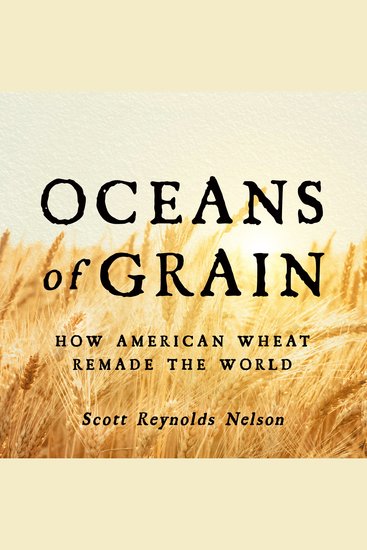
    An "incredibly timely" global history journeys from the Ukrainian steppe to the American prairie to show how grain built and toppled the world's largest empires (Financial Times). To understand the rise and fall of empires, we must follow the paths traveled by grain—along rivers, between ports, and across seas. In Oceans of Grain, historian Scott Reynolds Nelson reveals how the struggle to dominate these routes transformed the balance of world power. Early in the nineteenth century, imperial Russia fed much of Europe through the booming port of Odessa, on the Black Sea in Ukraine. But following the US Civil War, tons of American wheat began to flood across the Atlantic, and food prices plummeted. This cheap foreign grain spurred the rise of Germany and Italy, the decline of the Habsburgs and the Ottomans, and the European scramble for empire. It was a crucial factor in the outbreak of the First World War and the Russian Revolution. A powerful new interpretation, Oceans of Grain shows that amid the great powers’ rivalries, there was no greater power than control of grain.“American cotton changed the world in the first half of the nineteenth century, American wheat in its second half. Scott Reynolds Nelson’s globe-spanning exploration of the powers of a humble grain to topple empires, enable industrialization, build cities, and redirect trade flows is the kind of commodity history one wishes for: attentive to politics, connected as well as comparative in perspective, and with a knack for telling details. After reading this fast-paced book, the wars, revolutions, and empires of the nineteenth century will never seem the same.”―Sven Beckert, author of Empire of Cotton
    Zum Buch
  • Writing on Empty - A Guide to Finding Your Voice - cover

    Writing on Empty - A Guide to...

    Natalie Goldberg

    • 0
    • 0
    • 0
    "From the first moments of Natalie Goldberg's recording of Writing Down the Bones, her classic work on writing and life, listeners know they are hearing something wonderful" —AudioFile on Writing Down the BonesThis program is read by the author.Bestselling author and teacher Natalie Goldberg shares her inspiring personal journey out of a devastating period of writer’s block and back into a life of growth, creativity, and healing.Natalie Goldberg has been writing for the past fifty years. But at the beginning of the pandemic, she suddenly wasn’t able to write anymore. Her imaginative wellspring had dried up, and she was forced to ask herself: what do I do when what has always worked for me doesn’t work anymore?In this beautifully written, inspiring personal account, Natalie shares her harrowing journey out of creative paralysis and back onto the page. When all of her tried and true methods – meditation, sitting still, writing practice – stopped working, she had to take drastic action. She got into her car and left New Mexico in search of a new inventive source. In her journey through the western states, she visited famous literary sites, searching for the spark that would reignite her ability to write.And, next to Hemingway’s grave, she found it. “Get going,” he seemed to say to her, and she did. Now, Natalie shares her story of traveling through literary and personal memory to clarify her way forward, struggling to make sense of her difficult relationships with parents and teachers, and digging into her long-held grief. Ultimately, she discovers how to write through the emptiness in order to fill up the world with compassion, healing, and renewed liveliness.For anyone struggling to reconnect with their own creative source, Writing on Empty is a gentle and instructive guide to remembering what truly matters.A Macmillan Audio production from St. Martin’s Press Essentials.
    Zum Buch
  • Dream Drawings - Configurations of a Timeless Kind - cover

    Dream Drawings - Configurations...

    N. Scott Momaday

    • 0
    • 0
    • 0
    “Momaday must be ranked among the greatest of our contemporary writers.”—American Scholar 
    From Pulitzer Prize winner and revered literary master N. Scott Momaday, a beautiful and enchanting new poetry collection, at once a celebration of language, imagination, and the human spirit. 
    “Language and the imagination work hand in hand, and together they enable us to reveal us to ourselves in story. That is indeed a magical process. . . . We imagine and we dream, and we translate our dreams into language.” —from the Preface 
    A singular voice in American letters, Momaday’s love of language and storytelling are on full display in this brilliant new collection comprising one hundred sketches or “dream drawings”—furnishings of the mind—as he calls them. Influenced by his Native American heritage and its oral storytelling traditions, here are prose poems about nature, animals, warriors, and hunters, as well as meditations that explore themes of love, loss, time, and memory. Each piece, full of wisdom and wonder, showcases Momaday’s extraordinary lyrical talent, the breadth of his imagination, and the transformative power of his writing.  
    Poignant, inspired, and timeless, this is a collection that will nourish the soul.
    Zum Buch
  • Secret Societies: Control and Manipulation - cover

    Secret Societies: Control and...

    Raphael Terra

    • 0
    • 0
    • 0
    This audiobook has been recorded using Text to speech (TTS). 
     
    From the dawn of mankind there have been secret societies. Groups of men and women coming together to gain and maintain power for themselves. As populations grew so too did the power and the need to be extremely creative in methods of control. 
     
    Over the centuries there have been a few elite brotherhoods that have developed incredibly subtle and complex ways to manipulate the people. They have invented religions and mysteries; they have seeded revolution and started wars. Literature, plays, fables, movies, games, belief systems and the internet are all weapons in their growing armoury. 
     
    In this book we will explain how these secret societies manipulate mankind. We will delve into the psychology they use to control the way we buy, vote and believe. Everything we do and think is created for us. Even if we believe we are free. And all of this began many thousands of years ago when they created the religions of the globe. The exact same processes used to entice people to believe are now used to manipulate us. But more than that, we will reveal the people behind the creation of Christianity, Islam and more and the hidden secrets that they guard to this day. From Jesus to Buddha, from Muhammad to Zoroaster, the patterns are the same because they were all created by the same elite group. 
     
    They have made history and rewritten it. They hide in plain sight. We have worshipped them from afar. They are our gods, leaders, priests and revolutionaries. They are the secret societies of the globe and this is their story.
    Zum Buch