Begleiten Sie uns auf eine literarische Weltreise!
Buch zum Bücherregal hinzufügen
Grey
Einen neuen Kommentar schreiben Default profile 50px
Grey
Jetzt das ganze Buch im Abo oder die ersten Seiten gratis lesen!
All characters reduced
Economic Impact - cover

Economic Impact

Amelia Scott

Übersetzer A AI

Verlag: Publifye

  • 0
  • 0
  • 0

Beschreibung

Economic Impact offers a comprehensive analysis of the global economy under pandemic constraints, exploring business adaptation, governmental intervention, and economic shifts. It examines the resilience of businesses, market volatility, and the effectiveness of financial support measures. One intriguing fact is the acceleration of digitalization and automation, exposing vulnerabilities in existing economic structures while creating new opportunities. The book argues that governmental interventions, while crucial, had unintended consequences like increased national debt.

 
The book progresses logically, starting with pre-pandemic conditions and the immediate impacts of lockdowns. It then delves into how various business sectors responded, followed by an examination of market fluctuations and the effectiveness of governmental financial support. Drawing upon macroeconomic data and industry reports, Economic Impact provides an impartial, data-driven assessment of the pandemic's economic consequences.

 
Finally, the book concludes with an exploration of long-term economic trends, offering policy recommendations for building a more resilient economy. The book also uses case studies of successful adaptations and costly failures. A key strength lies in its balanced analysis, avoiding sensationalism and providing future-oriented perspectives valuable for business professionals, policymakers, and anyone interested in economics and current events.
Verfügbar seit: 19.03.2025.
Drucklänge: 68 Seiten.
Weitere Bücher, die Sie mögen werden

  • Leadership from Bad to Worse - What Happens When Bad Festers - cover

    Leadership from Bad to Worse -...

    Barbara Kellerman

    • 0
    • 0
    • 0
    Leadership from Bad to Worse is about how leadership that is bad, invariably, inexorably, gets worse—unless it is somehow, by someone or something, stopped or slowed. 


    This work draws on four cases of bad leadership—two in political leadership, two in business leadership—to show how it goes from bad to worse. Kellerman finds that bad leadership and bad followership go through four phases of development: 1) Onward and Upward; 2) Followers Join In; 3) Leaders Start In; and 4) Bad to Worse. These findings correctly suggest that the book, in addition to being of theoretical interest, is of practical import. It is intended, deliberately, to serve as an early warning system. By breaking bad leadership and followership into phases—each more ominous and ultimately dangerous than the one preceding—their progression will be easier to predict and detect. And easier, therefore, to slow or, preferably, to stop before they turn toxic. 


    Bad leadership is a social disease. But unlike diseases that are physical or psychological, it remains at the margins of our collective concerns. Leadership from Bad to Worse is, then, a corrective. Knowing that bad leadership can be checked before it corrupts is knowing that bad and then worse can be, if not completely precluded, then sometimes short-circuited.
    Zum Buch
  • Manipulation - What It Is Why It's Bad What to Do About It - cover

    Manipulation - What It Is Why...

    Cass R. Sunstein

    • 0
    • 0
    • 0
    New technologies are offering companies, politicians, and others unprecedented opportunity to manipulate us. Sometimes we are given the illusion of power—of freedom—through choice, yet the game is rigged, pushing us in specific directions that lead to less wealth, worse health, and weaker democracy. In Manipulation, nudge theory pioneer and New York Times bestselling author Cass Sunstein offers a new definition of manipulation for the digital age, explains why it is wrong, and shows what we can do about it. He reveals how manipulation compromises freedom and personal agency, while threatening to reduce our well-being; he explains the difference between manipulation and unobjectionable forms of influence, including "nudges"; and he lifts the lid on online manipulation and manipulation by artificial intelligence, algorithms, and generative AI, as well as threats posed by deepfakes, social media, and "dark patterns," which can trick people into giving up time and money. Drawing on decades of groundbreaking research in behavioral science, this landmark book outlines steps we can take to counteract manipulation in our daily lives and offers guidance to protect consumers, investors, and workers.
    Zum Buch
  • The Eighteenth Brumaire of Louis Bonaparte - cover

    The Eighteenth Brumaire of Louis...

    Karl Marx

    • 0
    • 0
    • 0
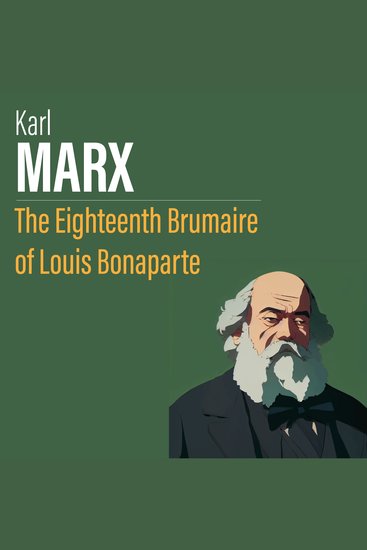
    "The Eighteenth Brumaire of Louis Bonaparte" is a book written by Karl Marx, a German philosopher and economist, in 1852. The book analyzes the political situation in France during the mid-19th century and provides a critique of the bourgeois republicanism that had taken hold there. 
    The title of the book refers to the date of the coup d'état in which Louis Bonaparte, the nephew of Napoleon Bonaparte, seized power in France. Marx used this event as a lens through which to examine the larger historical forces that had led to the rise of Louis Bonaparte and the decline of the bourgeois republic. 
    In the book, Marx argues that the bourgeois republic had failed to address the fundamental economic and social problems facing France, and that this failure had paved the way for the rise of a new form of authoritarian rule. He believed that the only way to truly address these problems was through a proletarian revolution that would overthrow the capitalist system. 
    "The Eighteenth Brumaire of Louis Bonaparte" is considered to be one of Marx's most important works, and it has had a significant impact on the field of political theory. The book's analysis of the relationship between economic and political power has influenced generations of scholars and activists, and it continues to be studied and debated to this day.
    Zum Buch
  • The Virus and the Host - Protect Yourself from Infectious Disease by Reducing Toxicity Improving Immunity and Minimizing Chronic Illness - cover

    The Virus and the Host - Protect...

    Dr. Chris Chlebowski

    • 0
    • 0
    • 0
    There will almost certainly be more pandemics in our future. Yet, during the coronavirus crisis, not a single major public-health official took the simple step of telling Americans what we all need to hear: robust good health?healthy immunity, low inflammation, low toxic burden, and freedom from stealth infection and chronic disease?is our best defense against infectious viral disease. The way our bodies interact with infectious disease is complicated?both a function of the “germ” and the “terrain”?the virus and the host. In The Virus and the Host, Dr. Chlebowski succinctly describes emerging science on the virome and how toxic exposure, chronic inflammation, infections, and chronic diseases interact and predispose us to poor outcomes from acute viral infection. He then clearly outlines the tools needed for better health, including these: -The best nutrients to supercharge your immunity -How to harness the power of botanical medicine -How to detoxify simply and safely at home -Valuable information on simple treatment and recommended diagnostic tests for given conditions As we move forward from the tragedy of COVID-19, it is essential that we come together to learn from our mistakes and work hard?and work together?to prevent a similar crisis in the future. When the next pandemic hits, we need to be better prepared. Now is the time to do something, and it is the best investment we can make so that when the next one hits we can keep our loved ones and ourselves safe and healthy.
    Zum Buch
  • Allen Dulles: The Life of the CIA’s Most Powerful and Notorious Director - cover

    Allen Dulles: The Life of the...

    Editors Charles River

    • 0
    • 0
    • 0
    The 28-year period from 1933-1961, bracketed on one end by Hitler’s rise to power in Germany and on the other by the very height of the Cold War, was marked by a remarkably stable succession of American presidents. In fact, only three men held office in this period, and that predictability led to a general stability among government agencies. Conversely, the CIA had five different directors in its first 15 years, from 1946-1961, and then nine different directors in the next 20, with four of those directors serving less than a year. But of all the CIA’s directors, none wielded the immense influence or power of Allen Dulles, who, together with his brother, Secretary of State John Foster Dulles, became arguably the two most powerful people in the government after the president.  
    	To this day, Dulles’ eight-year tenure in that office is the longest, and as one of the country’s leading experts in international law, intelligence, and spycraft, he became renowned for his unwavering anti-communist ideology and readiness to take decisive measures to counter what he perceived as a menace to American safety. As such, it would be Dulles who sanctioned many of the CIA’s most notorious operations, including the ousting of Iran's democratically elected government in 1953, spying and experimentation on American citizens, and the disastrous Bay of Pigs. That last episode cost him his job, though he continued to play a role in American political life after President John F. Kennedy forced him out of the CIA in 1961.  
    	By then, however, Dulles had already had an outsized influence on the direction of the country, and to this day his legacy can be felt, even as his reputation continues to be a source of much debate. 
    Zum Buch
  • EU Law Unlocked: Mastering Security Defense and Citizens' Rights in the European Union - cover

    EU Law Unlocked: Mastering...

    Linda Maureen Loewer

    • 0
    • 0
    • 0
    Unlock the complexities of European Union law in EU Law Unlocked: Mastering Security, Defense, and Citizens' Rights in the European Union. This comprehensive audiobook provides an accessible guide to understanding the EU’s legal framework, focusing on EU security, defense law, and fundamental citizens' rights. 
    Whether you're a student, legal professional, or EU enthusiast, this audiobook breaks down crucial topics, including:EU Security & Defense Law: Learn how the EU addresses global challenges such as defense cooperation, cybersecurity, and counterterrorism.Citizens' Rights: Discover the rights and protections available to EU citizens, from freedom of movement to non-discrimination and digital rights.EU Legal Framework: Understand the treaties, regulations, and landmark cases shaping the Union's policies. 
    With easy-to-understand explanations and real-life examples, EU Law Unlocked offers deep insights into how EU law impacts the lives of over 500 million citizens, international relations, and global trade. 
    Ideal for EU law students, policy makers, legal professionals, and anyone interested in how the European Union navigates security, human rights, and economic integration. 
    Gain the knowledge you need to master the complexities of EU law and understand the future of European governance, defense, and the rights of citizens in an interconnected world.
    Zum Buch