Rejoignez-nous pour un voyage dans le monde des livres!
Ajouter ce livre à l'électronique
Grey
Ecrivez un nouveau commentaire Default profile 50px
Grey
Abonnez-vous pour lire le livre complet ou lisez les premières pages gratuitement!
All characters reduced
Trenches Of War - cover

Trenches Of War

Amelia Khatri

Traducteur A AI

Maison d'édition: Publifye

  • 0
  • 0
  • 0

Synopsis

Trenches Of War explores the grim realities of trench warfare, focusing on the soldiers' experiences amidst the mud, barbed wire, and constant threat of death. It examines the historical origins and evolution of this brutal combat method from the American Civil War to its prominence in World War I, revealing the devastating conditions endured on the frontlines. The book highlights the psychological toll exacted by trench warfare, a factor that significantly shaped the soldiers and the course of military history itself, leading to unprecedented psychological trauma and challenging traditional narratives of military history.

 
The approach begins by introducing the concept and historical origins of trench warfare, then progresses into daily life within the trenches, detailing the challenges of hygiene, food, and disease. It also covers major battles and the strategic and tactical challenges involved.

 
Drawing on primary sources like soldiers' letters and military records, the book offers a unique perspective by emphasizing the lived experiences of those who fought in the trenches, providing an unflinching account of the horrors and the long-term consequences on military doctrine and society.
Disponible depuis: 17/02/2025.
Longueur d'impression: 56 pages.

D'autres livres qui pourraient vous intéresser

  • Old Creole Days - cover

    Old Creole Days

    George Cable

    • 0
    • 0
    • 0
    These stories reflect the Creole way of life during the transitory post-Civil War period.
    Voir livre
  • Democracy Rules - cover

    Democracy Rules

    Jan-Werner Müller

    • 0
    • 0
    • 0
    A much-anticipated guide to saving democracy, from one of our most essential political thinkers. 


    Everyone knows that democracy is in trouble, but do we know what democracy actually is? Jan-Werner Müller, author of the widely translated and acclaimed What Is Populism?, takes us back to basics in Democracy Rules. In this short, elegant volume, he explains how democracy is founded not just on liberty and equality, but also on uncertainty. The latter will sound unattractive at a time when the pandemic has created unbearable uncertainty for so many. But it is crucial for ensuring democracy's dynamic and creative character, which remains one of its signal advantages over authoritarian alternatives that seek to render politics (and individual citizens) completely predictable. 


    Müller shows that we need to re-invigorate the intermediary institutions that have been deemed essential for democracy's success ever since the nineteenth century: political parties and free media. Contrary to conventional wisdom, these are not spent forces in a supposed age of post-party populist leadership and post-truth. Müller suggests concretely how democracy's critical infrastructure of intermediary institutions could be renovated, re-empowering citizens while also preserving a place for professionals such as journalists and judges.
    Voir livre
  • British Empire - Details of the Largest Empire in Human History - cover

    British Empire - Details of the...

    Kelly Mass

    • 0
    • 0
    • 0
    The British Empire was an extensive network of dominions, colonies, protectorates, mandates, and territories ruled or administered by the United Kingdom and its predecessor governments. This sprawling empire evolved from England's early ventures into overseas territories and trading ports, beginning in the late 16th century and continuing through the early 18th century. The empire grew to become the largest in recorded history, dominating global affairs for more than a century. 
    The roots of the British Empire can be traced back to England’s desire to expand its economic and political influence, driven by competition with other European powers like Spain and Portugal, who were leading the Age of Exploration. These countries had established lucrative colonial empires in the Americas, Africa, and Asia, amassing great wealth and resources. Inspired by their success, England, along with France and the Netherlands, began establishing its own colonies and trading posts, particularly in North America, the Caribbean, and Asia. 
    During the 17th and 18th centuries, the British Empire grew in strength through a combination of military conquests, naval power, and strategic alliances. Following its unification with Scotland through the 1707 Act of Union, Britain emerged as a major colonial power, extending its control across vast regions. The empire's reach expanded dramatically after the series of conflicts with its rivals, including the Anglo-Dutch Wars and the long-standing hostilities with France, culminating in Britain's dominance over North America and its influence over global trade routes.
    Voir livre
  • Spanish Armada and English Armada The: The History of Both Nations’ Ill-Fated Naval Campaigns against Each Other - cover

    Spanish Armada and English...

    Editors Charles River

    • 0
    • 0
    • 0
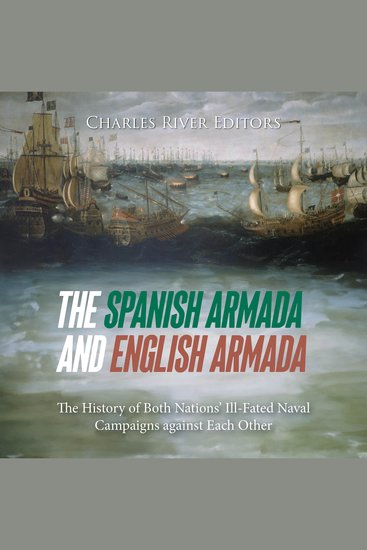
    On July 12, 1588, the legendary Spanish Armada headed for the English Channel. The Spanish plan was to take this invasion, led by the Duke of Parma, to the coast of southeast England, where they would be unleashed to conquer Elizabethan England for Spain’s King Philip II and Catholic Christendom. The Armada included over 150 ships, 8,000 sailors, and 18,000 soldiers, and it boasted a firepower of 1,500 brass guns and 1,000 iron guns. Just leaving port itself took the entire Armada two days.  
    	As everyone who has been taught history now knows, the Armada was one of the most famous military debacles in history. Regardless of the debate over whether it was simple mathematical miscalculation or plain bad luck, coupled with English fire ships assailing the Spanish ships, the Armada was decisively defeated. The Armada ultimately found its reluctant way home in awful conditions, having permanently lost over a third of the ships, and on the Irish coast, the Armada suffered further losses.  
    	What has since been overlooked is that the undeclared Anglo-Spanish War continued, and it would do so until 1604. The English and their Dutch allies responded to the spectacular and unexpected defeat of the Armada with an attempt of their own to attack Spain with a fleet often called the "Counter Armada" in English. In 1589, once the impact of the previous year upon the Hapsburg naval power became clear, Elizabeth ordered Drake to gather the English fleet to take advantage of the situation. Unlike the Spanish, the English had no illusions of being able to invade their opponent's homelands and overthrow their state; instead, the English had far more modest goals. The English wanted to seek out the remainder of the Spanish fleet and burn it, land troops in Portugal and raise a revolution in that country, and capture the Azores Islands. If possible, they would use a base in the Azores to capture the anticipated treasure fleet from the New World. 
    Voir livre
  • James Allen's Book of Meditations - Daily Reflections for Mindful Living - cover

    James Allen's Book of...

    James Allen, Tim Zengerink

    • 0
    • 0
    • 0
    What if a few minutes each day could spark profound personal change—leading you toward clarity, harmony, and purpose? 
    In this beautifully curated collection, James Allen offers succinct meditations designed to uplift and refocus your mind. Adapted for modern readers, these daily reflections tackle themes of perseverance, compassion, and spiritual wisdom. Whether you seek calm, confidence, or creativity, each entry nurtures your inner life and reinforces your highest aspirations. 
    What You’ll Discover in This Modern Translation: 
    - Simple yet powerful prompts for mindful self-reflection 
    - Encouragement to develop gratitude, patience, and moral strength 
    - Techniques for integrating wisdom into everyday routines 
    - An accessible path to building steady inner awareness 
    Imagine starting each day with a guiding light—an inspirational touchstone that shapes your attitude and actions for the better. James Allen’s Book of Meditations is your companion on the journey toward a more centered, meaningful life. 
    Elevate your daily routine. Get your copy now and experience the transformative power of mindful living.
    Voir livre
  • It Can’t Rain All the Time - The Crow - cover

    It Can’t Rain All the Time - The...

    Alisha Mughal

    • 0
    • 0
    • 0
    A passionate analysis of the ill-fated 1994 film starring the late Brandon Lee and its long-lasting influence on action movies, cinematic grief, and emotional masculinity
    		 
    Released in 1994, The Crow first drew in audiences thanks to the well-publicized tragedy that loomed over the film: lead actor Brandon Lee had died on set due to a mishandled prop gun. But it soon became clear that The Crow was more than just an accumulation of its tragic parts. The celebrated critic Roger Ebert wrote that Lee’s performance was “more of a screen achievement than any of the films of his father, Bruce Lee.”
    		 
    In It Can’t Rain All the Time, Alisha Mughal argues that The Crow has transcended Brandon Lee’s death by exposing the most challenging human emotions in all their dark, dramatic, and visceral glory, so much so that it has spawned three sequels, a remake, and an intense fandom. Eric, our back-from-the-dead, grieving protagonist, shows us that there is no solution to depression or loss, there is only our own internal, messy work. By the end of the movie, we realize that Eric has presented us with a vast range of emotions and that masculinity doesn’t need to be hard and impenetrable.
    		 
    Through her memories of seeking solace in the film during her own grieving period, Alisha brilliantly shows that, for all its gothic sadness, The Crow is, surprisingly and touchingly, a movie about redemption and hope.
    		 
    About the Pop Classics Series
    		 
    Short books that pack a big punch, Pop Classics offer intelligent, fun, and accessible arguments about why a particular pop phenomenon matters.
    Voir livre