
Begleiten Sie uns auf eine literarische Weltreise!
Buch zum Bücherregal hinzufügen
Grey
Einen neuen Kommentar schreiben Default profile 50px
Grey
Jetzt das ganze Buch im Abo oder die ersten Seiten gratis lesen!
All characters reduced
The Library System - cover

The Library System

Amelia Khatri

Übersetzer A AI

Verlag: Publifye

  • 0
  • 0
  • 0

Beschreibung

"The Library System" explores the fascinating journey of libraries, from ancient clay tablet repositories to today's global digital networks. It examines how historical events, technological advancements, and social forces have shaped these institutions. The book argues that libraries are not simply storehouses of information but active agents in shaping intellectual discourse and promoting democratic values and highlights their crucial role in knowledge dissemination, community engagement, and cultural preservation. The book traces the evolution of libraries across civilizations, starting with ancient libraries like the Library of Alexandria and progressing through medieval scriptoria to the rise of public libraries. It focuses on the impact of key technologies, such as the printing press and the internet, on cataloging systems, information retrieval, and the emergence of digital libraries. "The Library System" also addresses contemporary challenges like copyright, accessibility, the digital divide, and digital preservation, offering a comprehensive overview of the evolution of the library system. The book is structured chronologically, beginning with the origins of libraries and culminating in an examination of contemporary library systems and their diverse roles in communities. It blends historical narrative with contemporary analysis, making it accessible to a broad audience, including library science students, historians, educators, and policymakers. It emphasizes the library's ability to adapt to technological and social change, highlighting its continued relevance in an increasingly digital world and how libraries combat misinformation.
Verfügbar seit: 12.02.2025.
Drucklänge: 70 Seiten.

Weitere Bücher, die Sie mögen werden

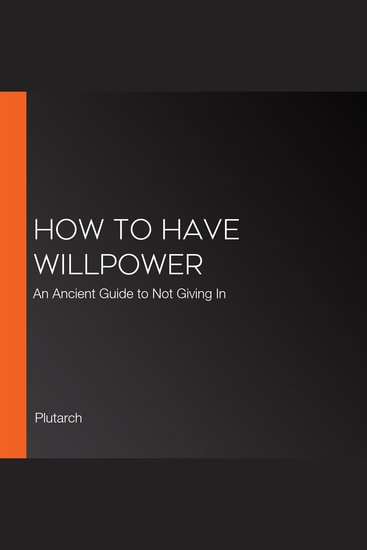
  • How to Have Willpower - An Ancient Guide to Not Giving In - cover

    How to Have Willpower - An...

    Plutarch, Prudentius

    • 0
    • 0
    • 0
    How to Have Willpower brings together two profound ancient meditations on how to overcome pressures that encourage us to act against our own best interests—Plutarch's essay On Dysopia or How to Resist Pressure and Prudentius's poetic allegory Psychomachia or How to Slay Your Demons. Challenging the idea that humans are helpless victims of vice, these works—introduced and presented in vivid, accessible new prose translations by Michael Fontaine—emphasize the power of personal choice and the possibility of personal growth, as they offer insights and practical advice about resisting temptation. 


    In the spirit of the best ancient self-help writing, Plutarch, a pagan Greek philosopher and historian, offers a set of practical recommendations and steps we can take to resist pressure and to stop saying "yes" against our better judgment. And in a delightfully different work, Prudentius, a Latin Christian poet, dramatizes the necessity to actively fight temptation through the story of an epic battle within the human soul between fierce warrior women representing our virtues and vices. 


    Plutarch and Prudentius insist that we allow pressure or temptations to get the best of us. But they also agree that we can do something about it. And their wisdom can help.
    Zum Buch
  • Pep Talks for Writers - 52 Insights and Actions to Boost Your Creative Mojo - cover

    Pep Talks for Writers - 52...

    Grant Faulkner

    • 0
    • 0
    • 0
    Every writer knows that as rewarding as the creative process is, it can often be a bumpy road. Have hope and keep at it! Designed to kick-start creativity, this handbook from the executive director of National Novel Writing Month gathers a wide range of insights and advice for writers at any stage of their career. From tips about how to finally start that story to helpful ideas about what to do when the words just aren't quite coming out right, Pep Talks for Writers provides motivation, encouragement, and helpful exercises for writers of all stripes.
    Zum Buch
  • Running After Paradise - Hope Survival and Activism in Brazil’s Atlantic Forest - cover

    Running After Paradise - Hope...

    Colleen M. Scanlan Lyons

    • 0
    • 0
    • 0
    Brazil’s Atlantic Forest is a paradise to many. In Southern Bahia, surfers, billionaires, travelers, and hippies mingle with environmentalists, family farmers, quilombolas (descendants of formerly enslaved people), and nativos, or “locals.” Each of these groups has connections to the unique environment, culture, and character of this region as their home, their source of a livelihood, or perhaps their vacation escape. And while these connections sometimes converge, at other times they clash. 
    The pressures on this tropical forest are palpable, and people’s responses to these pressures are also varied. What was once the state’s economic mainstay, cacao production, is only now beginning to make a comeback after a disease decimated the crops of large and small farmers alike. Tourism, another economic hope, is susceptible to economic crises and pandemics. And the threat of a massive state-led infrastructure project involving mining, a railroad, and an international port has loomed over the region for well over a decade. 
    Southern Bahia is at a crossroads: develop a sustainable, forest-based economy or risk losing the identity and soul of this place forevermore. Through the lives of environmentalists, farmers, quilombolas, and nativos—people who are in and of this place—this book brings the people alive who are grappling with this dilemma. 
    Anthropologist Colleen M. Scanlan Lyons brings the eye of a storyteller to present this complex struggle, weaving in her own challenges of balancing family and fieldwork alongside the stories of the people who live in this dynamic region. Intertwined tales, friendships, and hope emerge as people both struggle to sustain their lives in a biodiversity hotspot and strive to create their paradise. 
    For those interested, this book is also available in e-book and physical print formats, which contain the table of contents, maps, acknowledgements, pictures of the people and stories featured, footnotes, references, and an index.
    Zum Buch
  • The Brandenburger Commandos - Germany's Elite Warrior Spies in World War II - cover

    The Brandenburger Commandos -...

    Franz Kurowski

    • 0
    • 0
    • 0
    This WWII history chronicles the exploits of an elite German spy unit and offers a rare look into the secret operations of Hitler's military. Directed by the German Army’s intelligence service, the Brandenburgers became legendary for their brutally efficient clandestine operations. Trained to be quick, mobile, and self-reliant and steeped in local customs and languages, they operated behind enemy lines around the world. Across the battlefronts of the Second World War—from Western Europe to Romania, Russia, Egypt, Afghanistan, and beyond—they seized bridges and other strategic targets; engaged in sabotage, espionage, and other daring missions; and often disregarding the rules of war in the process. Although the unit was dissolved in 1944, its tactics influenced special forces around the world both during the war and after.
    Zum Buch
  • Kaushitaki Upanishad - cover

    Kaushitaki Upanishad

    Unknown

    • 0
    • 0
    • 0
    The word Upanishad (upa-ni-shad) consists of, "Upa" means "near;" "ni" means "down;" "shad" means "to sit." Thus, Upanishad is to sit down near the teacher to discuss, learn, practice, and experience. There are some 200 or more Upanishads. Some are lost and are only known about because of being referenced in other Upanishads. Most of the Upanishads were kept secret for centuries, only passed on to others orally in the form of Shloka (a category of verse line developed from the Vedic Anustubh meter).The Kaushitaki Upanishad, also known as Kaushitaki Brahmana Upanishad is an ancient Sanskrit text contained inside the Rigveda; It is associated with the Kaushitaki shakha (branch). However, It is Samanya Upanishad, meaning that it is "common" to all schools of Vedanta. The Kaushitaki Upanishad explores the heavenly world, reincarnation, and consciousness. The Kausitaki Upanishad is a prose text, divided into four Adhyayas (chapters) and their sub sections.The chronology of Kaushitaki Upanishad is unclear; it was probably composed before the middle of the 1st millennium BCE.The 11 principal Upanishads to which Sankara appeals in his great commentary on the Vedanta-Surtras are: Chandogya, Talavakara or Kena, Aitareya, Kaushitaki, Vajasaneyi or Isha, Katha, Mundaka, Taittirtiyaka or Taittiriya, Brihadaranyaka, Svetasvatara, and Prasna. They are also called the 11 classical Upanishads or the fundamental Upanishads of the Vedanta Philosophy. Apart from these, Maitrayana-Brahmana-Upanishad is also considered as an important Upanishad. The Upanishadic literature is not a religious scripture and is free from dogma and doctrines. It is not a part of any religion but is a philosophy for all times and for all. German philosopher Arthur Schopenhauer, impressed by the Upanishads, called the texts "the production of the highest human wisdom". Summary by Jothi.
    Zum Buch
  • Leviathan (Books III and IV) - cover

    Leviathan (Books III and IV)

    Thomas Hobbes

    • 0
    • 0
    • 0
    In Books 3 and 4 of Leviathan, Thomas Hobbes elaborates on the political philosophy set forth in the first two books, by considering the nature of a Christian commonwealth.  Book 3 begins with a wealth of biblical scholarship, directed at establishing the authority of Scripture while at the same time undermining modern claims to supernatural revelation that would subvert civil law.  Hobbes concludes that we cannot be sure of anyone else's divine revelation, and that religious authority is therefore subordinate to civil power.  Book 4, titled “Of the Kingdom of Darkness,” sets forth the various ways in which Scripture has been misinterpreted by the church, according to Hobbes, in mixing pagan elements with Christianity.(Summary adapted from Wikipedia by Leon Mire)
    Zum Buch