Begleiten Sie uns auf eine literarische Weltreise!
Buch zum Bücherregal hinzufügen
Grey
Einen neuen Kommentar schreiben Default profile 50px
Grey
Jetzt das ganze Buch im Abo oder die ersten Seiten gratis lesen!
All characters reduced
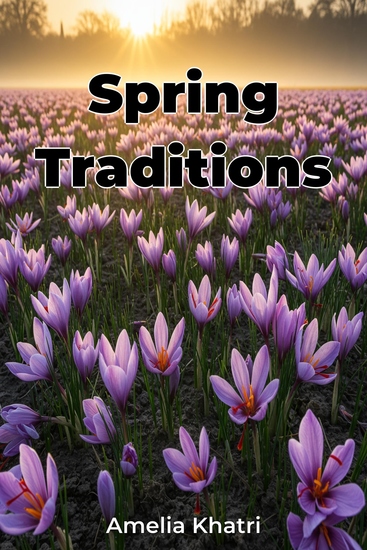
Spring Traditions - cover

Spring Traditions

Amelia Khatri

Übersetzer A AI

Verlag: Publifye

  • 0
  • 0
  • 0

Beschreibung

"Spring Traditions" explores the universal human experience of renewal and hope through the lens of spring festivals around the world. Focusing on Holi, Nowruz, and Easter, the book reveals how diverse cultures celebrate the season of rebirth. These celebrations, despite their unique expressions, share common themes, reflecting humanity's enduring desire for community and a fresh start.

 
Did you know that Nowruz, the Persian New Year, predates Islam by centuries? Or that the vibrant colors of Holi symbolize the triumph of good over evil and the arrival of spring? The book examines the historical context, social structures, and cultural practices that have shaped these celebrations.

 
By tracing the origins and evolution of each festival, "Spring Traditions" provides insights into the cultural, religious, and historical forces that influence human expression. The book progresses by introducing the concept of spring as a symbol of rebirth, then delving into the unique rituals and symbols of Holi, Nowruz, and Easter, culminating in a comparison of these festivals to highlight shared human aspirations. Its comparative approach offers a unique perspective on the diversity of human culture and the underlying unity of human desires.
Verfügbar seit: 06.03.2025.
Drucklänge: 68 Seiten.
Weitere Bücher, die Sie mögen werden

  • James Montgomery - Abolitionist Warrior - cover

    James Montgomery - Abolitionist...

    Robert C. Conner

    • 0
    • 0
    • 0
    The first full biography of James Montgomery, who through his actions before and during the Civil War, contributed towards the abolition of slavery.James Montgomery was a leader of the free-state movement in pre-Civil War Kansas and Missouri, associated with its direct-action military wing. He then joined the Union Army and fought through most of the war.  A close associate and ally of other abolitionists including John Brown, Harriet Tubman, Colonels Thomas Wentworth Higginson and Robert G. Shaw, Montgomery led his African-American regiment along with Tubman and other civilians in the 1863 Combahee River raid, which freed almost 800 slaves from South Carolina plantations. He then commanded a brigade in the siege of Fort Wagner, near Charleston.  In 1864, still in brigade command, he fought at the Battle of Olustee in Florida, helping prevent the collapse and disintegration of Union General Truman Seymour’s army. Later that year he returned home and played a significant role in defeating Confederate General Sterling Price’s great raid, especially at the Battle of Westport.  This is the first published biography of Montgomery, who was and remains a controversial figure. It uncovers and deals honestly with his serious flaws, while debunking some wilder charges, and also bringing to light his considerable attributes and achievements. Montgomery’s life, from birth to death, is seen in the necessary perspective and clear delineation of the complex racial, political and military history of the Civil War era.
    Zum Buch
  • Where Stands a Wingèd Sentry - cover

    Where Stands a Wingèd Sentry

    Margaret Kennedy

    • 0
    • 0
    • 0
    Margaret Kennedy was an acclaimed novelist and playwright best-known for The Constant Nymph. In this autobiographical account, taken from her war diaries, she conveys the tension, frustration, and bewilderment of the progression of the war, and the terror of knowing that the worst is to come, but not yet knowing what the worst will be. 


    English bravery, confusion, stubbornness, and dark humor provide the positive, more hopeful side of her experiences, in which she and her children move from Surrey to Cornwall, to sit out the war amidst a quietly efficient Home Guard and the most scandalous rumors. 


    "Most people knew in their hearts that the lid had been taken off hell, and that what had been done in Guernica would one day be done in London, Paris and Berlin." Margaret Kennedy's prophetic words, written about the pre-war mood in Europe, give the tone of this riveting 1941 wartime memoir: it is Mrs. Miniver with the gloves off. 


    Where Stands A Wingèd Sentry, the title comes from a seventeenth-century poem by Henry Vaughan, was only published in the USA in 1942, and was never published in the UK, until now.
    Zum Buch
  • Special Powers: Civil War Internment at Newbridge Barracks and Tintown Camp 1922-24 - Accessible ePub - cover

    Special Powers: Civil War...

    James Durney

    • 0
    • 0
    • 0
    The untold story of Ireland's forgotten prisoners. In the shadow of civil war, over 5,500 republican prisoners found themselves trapped behind the wire at Newbridge Barracks and the Curragh internment camps — imprisoned by former comrades who had once fought alongside them against the British. There, they discovered a bitter truth and a regime that answered defiance with execution and brutality. Their old allies in the Free State forces proved far more ruthless captors than their colonial predecessors had ever been. While no prisoners had died under British custody during the War of Independence, over two dozen internees would lose their lives at the hands of their ex-brothers-in-arms. Among the internees were men who would make their mark on Irish history, including unrepentant republicans and writers such as Ernie O'Malley and Peadar O'Donnell, as well as Seán Lemass, future Taoiseach, and John Higgins, the father of President Michael D. Higgins. Despite the harsh realities of camp life, the prisoners' spirit remained unbroken. Two legendary escapes followed — 112 men tunnelling to freedom out of Newbridge Barracks, then 71 more from Tintown Camp. The internees staged Ireland's largest hunger strike and maintained their resistance even as their captors' brutality reached the highest levels of government. Drawing on primary sources and firsthand accounts, historian James Durney reveals how the final battles of the Civil War were fought not on battlefields, but in the jails and camps where former comrades became bitter enemies — a dark chapter in Irish history that has remained hidden for too long.
    Zum Buch
  • Carib Civilization - The Warriors of the Caribbean and Their Fight Against Conquest - cover

    Carib Civilization - The...

    Rolf Hedger

    • 0
    • 0
    • 0
    The Carib civilization, known for their resilience and military prowess, was one of the dominant forces in the Caribbean before and during the early phases of European colonization. The Caribs, who were part of the larger Arawakan language family, developed a distinct culture that set them apart from other indigenous groups in the region. Their territory spanned many of the islands in the Lesser Antilles, with notable populations in Dominica, Saint Vincent, and Grenada. While they were widely recognized for their fierce resistance against European colonizers, their rich history and cultural achievements also played a significant role in shaping the Caribbean. 
    The early origins of the Caribs are a subject of ongoing research, but they are believed to have migrated from South America, possibly from the Orinoco River Basin in present-day Venezuela. Over time, they settled in various parts of the Caribbean, with their most prominent presence being on the islands of the Lesser Antilles. The Caribs are often distinguished from their neighbors, the Arawaks, due to their more aggressive and militaristic nature, a characteristic that would become critical in their dealings with the European powers who arrived on their shores. 
    Carib society was organized around a hierarchical structure with a chief, or ouin (sometimes known as karifuna), at the top, followed by warriors, farmers, and fishermen. Despite their reputation as fierce fighters, the Caribs were also skilled agriculturalists and fishermen. Their diet was rich in cassava, corn, fruits, and fish, which they caught using canoes made from hollowed trees. The Caribs' ability to navigate the seas using their advanced knowledge of the stars and ocean currents made them formidable maritime traders and warriors. They built large, ocean-going canoes capable of carrying multiple warriors, enabling them to wage successful raids across the Caribbean islands.
    Zum Buch
  • The Life and Teachings of Thoth Hermes Trismegistus - Ancient Wisdom on Divinity Transformation and the Cosmos - cover

    The Life and Teachings of Thoth...

    Hermes Trimegistus, Tim Zengerink

    • 0
    • 0
    • 0
    What if you could unlock the timeless wisdom of the ancient world, understand the divine mysteries of the cosmos, and transform your life through self-discovery? 
    The Life and Teachings of Thoth Hermes Trismegistus is a modern translation of the legendary Hermetic teachings attributed to Hermes Trismegistus, the mystical figure associated with both the Egyptian god Thoth and the Greek god Hermes. This text offers profound insights into spiritual transformation, the soul’s divine purpose, and the cosmic principles that govern all existence. 
    Through poetic and philosophical dialogues, The Life and Teachings of Thoth Hermes Trismegistus explores humanity’s connection to the divine and provides a practical framework for achieving enlightenment and harmony in an ever-changing world. 
    What You’ll Discover in This Modern Translation: 
    - The Secrets of the Cosmos – Uncover the divine principles that govern creation, balance, and harmony in the universe. 
    - Spiritual Transformation – Learn the ancient practices for self-discovery and aligning with your higher purpose. 
    - Timeless Hermetic Wisdom – Explore the teachings that bridge the material and spiritual realms, offering guidance for everyday life. 
    - The Soul’s Journey – Understand the path to enlightenment and the connection between the soul and the divine. 
    Imagine discovering the ancient truths that connect you to the cosmos, transforming your perspective, and awakening your spiritual potential. The Life and Teachings of Thoth Hermes Trismegistus has inspired seekers of wisdom for millennia—now it’s your turn. 
    Begin your journey of self-discovery and spiritual transformation today. Get your copy now and unlock the eternal wisdom of Hermes Trismegistus.
    Zum Buch
  • 20th Century’s Most Influential Artists The: The Lives and Art of Pablo Picasso Salvador Dali Andy Warhol and Jackson Pollock - cover

    20th Century’s Most Influential...

    Editors Charles River

    • 0
    • 0
    • 0
    In their biography of Pablo Picasso, Hans Ludwig and Chris Jaffe note that “for him, art was always adventure: ‘To find is the thing.’” Indeed, there is perhaps no artist who produced more art than Picasso, whose enormous oeuvre (which spanned most of his 91-year life) contained a countless number of paintings and drawings. Picasso also worked in other mediums as well, notably sculpture and lithography, and his constant experimentation with form makes him a useful case study through which to chart the growth of Modernism as an artistic movement and many of the artistic trends that would dominate the 20th century. At the same time, one of the challenges involved in examining Picasso’s body of work is the sheer breadth of it all.  
    	In his review of Salvador Dali’s first autobiography, George Orwell declared that “One ought to be able to hold in one’s head simultaneously the two facts that Dali is a good draughtsman and a disgusting human being.” Whether or not one agrees with the famous author’s assessment, Orwell captures the polarizing nature of Salvador Dali, and the extent to which his undeniable technical virtuosity often brushed against his penchant for provoking his audiences (not to mention provoking long-entrenched standards of “proper” taste).  
    	To truly grasp the significance of Jackson Pollock in 20th century art, it’s necessary to understand the dramatic departure he initiated away from the straightforward compositions associated with the social realist art of the 1930s, a Depression-era period in which political art offered readily comprehensible narratives that were grasped by viewers with little artistic training.  
    Few artists of the 20th century were as enigmatic as Andy Warhol, who once remarked, “If you want to know all about Andy Warhol, just look at the surface of my paintings and films and me, there I am. There’s nothing behind it.” This statement is hardly out of character for the famous artist.
    Zum Buch