Rejoignez-nous pour un voyage dans le monde des livres!
Ajouter ce livre à l'électronique
Grey
Ecrivez un nouveau commentaire Default profile 50px
Grey
Abonnez-vous pour lire le livre complet ou lisez les premières pages gratuitement!
All characters reduced
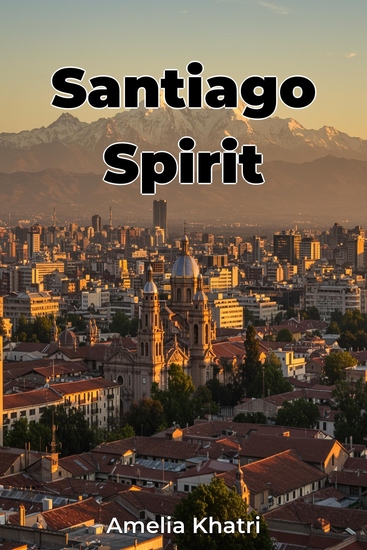
Santiago Spirit - cover

Santiago Spirit

Amelia Khatri

Traducteur A AI

Maison d'édition: Publifye

  • 0
  • 0
  • 0

Synopsis

"Santiago Spirit" explores the captivating history of Santiago, Chile, from its origins as a small colonial outpost to its current status as the nation’s vibrant heart. The book argues that Santiago's unique identity stems from its resilience, adaptability, and its ability to integrate diverse influences, ultimately shaping Chile's national character. This includes the profound impact of Andean influences and the enduring legacy of its colonial past. For instance, the book details how the Spanish conquest transformed pre-Columbian settlements into a strategic foothold, setting the stage for future development.

 
The book offers a chronological and thematic examination of Santiago’s evolution. It begins with its genesis as a Spanish settlement, transitions to the indelible mark of the Andes on its culture and economy, and then analyzes the factors that propelled it to the forefront of Chilean politics. Supported by archival documents, colonial-era chronicles, and archaeological findings, "Santiago Spirit" provides a nuanced exploration of Santiago's history, acknowledging both its growth and the enduring legacies of colonialism and social inequality. This approach allows readers to grasp not only Santiago's specific historical trajectory but also broader themes relevant to urban planning and cultural preservation.
Disponible depuis: 20/02/2025.
Longueur d'impression: 57 pages.
D'autres livres qui pourraient vous intéresser

  • The Faith - What Christians Believe Why They Believe It and Why It Matters - cover

    The Faith - What Christians...

    Anonyme

    • 0
    • 0
    • 0
    Rightly understood and rightly communicated, the Christian faith is one of great joy. It is an invitation to God's kingdom, where tears are replaced by laughter and longing hearts find their purpose and their home. 
    This is the heart of the gospel: God's search to reclaim us and love us as his own. But have we truly grasped this? Those of us who have disdained Christianity as a religion of bigotry--have we repudiated the genuine article or merely demonstrated our own prejudice and ignorance? Those of us who are Christians--have we deeply apprehended the mission of Jesus, and do our ways and character faithfully reflect his beauty? From the nature of God, to the human condition, to the work of Jesus, to God's coming kingdom, and all that lies between, how well do we understand the foundational truths of Christianity and their implications? 
    The Faith is a book for our troubled times and for decades to come, for Christians and non-Christians alike. It is the most important book Chuck Colson and Harold Fickett have ever written: a thought-provoking, soul-searching, and powerful manifesto of the great, historical central truths of Christianity that have sustained believers through the centuries. Brought to immediacy with vivid, true stories, here is what Christianity is really about and why it is a religion of hope, redemption, and beauty.
    Voir livre
  • But you don't look autistic at all - cover

    But you don't look autistic at all

    Bianca Toeps

    • 0
    • 0
    • 0
    Autism – that’s being able to count matches really fast and knowing that 7 August 1984 was a Tuesday, right? Well, no. In this book, Bianca Toeps explains in great detail what life is like when you’re autistic.She does this by looking at what science says about autism (and why some theories can go straight in the bin), but also by telling her own story and interviewing other autistics. Bianca talks in a refreshing and sometimes hilarious way about different situations autistic people encounter in daily life. She has some useful tips for non-autistic people too: what you should do if someone prefers not to look you in the eye, why it is sometimes better to communicate by email, and, most important of all, why it is not a compliment if you say: “But you don’t look autistic at all!”
    Voir livre
  • Picking Presidents - How to Make the Most Consequential Decision in the World - cover

    Picking Presidents - How to Make...

    Gautam Mukunda

    • 0
    • 0
    • 0
    Celebrated leadership expert and political scientist Gautam Mukunda provides a comprehensive, objective, and non-partisan method for answering the most important question in the world: is someone up to the job of president of the United States? 


    In Picking Presidents, Gautam Mukunda sets his sights on presidential candidates, proposing a tested method to assess whether they will succeed or fail if they win the White House. Combining political science, psychology, organizational behavior, and economics, Picking Presidents will enable every American to cast an informed vote. 


    In his 2012 book Indispensable, which all but predicted the Trump presidency, Mukunda explained how both the very best and very worst leaders are "unfiltered"—outsiders who take power without the understanding or support of traditional elites. Picking Presidents provides deep analysis of filtered and unfiltered presidents alike, from failed haberdasher and skillful president Harry Truman, to the exceptionally well-qualified—and ultimately reviled—James Buchanan; from Andrew Johnson, who set civil rights back by a century, to Theodore Roosevelt, who evaded party opposition to transform American society. Picking Presidents lays out a clear framework that anyone can use to judge a candidate and answer the all-important question: are they up to the job?
    Voir livre
  • Some of the Dharma - cover

    Some of the Dharma

    Jack Kerouac

    • 0
    • 0
    • 0
    While his masterpiece On the Road languished on the desks of unresponsive editors, Kerouac turned to Buddhism, and in 1953 began writing reading notes on the subject intended for his friend Allen Ginsberg. As his Buddhist study and meditation practice intensified, what had begun as notes evolved into a vast, all-encompassing work of nonfiction into which he poured his life, incorporating poems, haiku, prayers, journal entries, fragments of letters, ideas about writing, sketches, and more. The final manuscript, completed in 1956, was as visually complex as the writing: each page was unique, typed in patterns and interlocking shapes. The elaborate form that Kerouac so painstakingly gave his books is recreated in this typeset facsimile. 
    Passionate, playful, ecstatic, filled with humor, insight, beautiful language, sorrow, and struggle, Some of the Dharma is a far-ranging and extremely revealing work. 
    "Kerouac's work represents the most extensive experiment in language and literary form undertaken by an American writer of his generation." -THE NEW YORK TIMES BOOK REVIEW
    Voir livre
  • Dome of the Rock The: The History of the Oldest Islamic Shrine in Jerusalem - cover

    Dome of the Rock The: The...

    Charles River Editors

    • 0
    • 0
    • 0
    Among the world’s most recognizable man-made structures, the Dome of the Rock – known in Arabic as the Qubbat as-Sakara – is also one of its most mysterious. Although much of the Dome’s construction, reconstruction, and later additions are well-known from historical texts and archeological work, what it represents, why it was built where it was, and even its use remain the subject of scholarly controversy. Known for its immense size and beauty, and also for being located in the middle of Jerusalem, one of the world’s holiest cities, the Dome of the Rock has been the focus of political leaders who wished to legitimize their rule, religious warriors who believed that it empowered their weapons, and pilgrims who thought it was a site of salvation and enlightenment. As it drew these often diverse and sometimes disparate people to it, it has served the purposes of devout Jews, Muslims, and Christians, who -- although often not peacefully sharing the site -- seem to recognize its spiritual importance. 
    The Dome of the Rock has been many things to many people over the centuries, and historians, art historians, and archaeologists have studied the Dome of the Rock and its background extensively. Academics have created an accurate chronology of its life, as well as details about how the monument was built, including the construction and artistic techniques that were used. The dome was built on the site of what is believed to have been the Solomonic Temple that the Israelites built to worship their god, Yahweh, setting the stage for the entire area to be a holy site for the Abrahamic religions over the following centuries. Historians believe that the Umayyad Muslims saw this background as a prime location to build one of the greatest religious complexes in the Islamic world.
    Voir livre
  • The European Union - Unity and Challenges - cover

    The European Union - Unity and...

    Nova Ashford

    • 0
    • 0
    • 0
    The formation of the European Union (EU) is the result of decades of political, economic, and social evolution, shaped by the aftermath of two World Wars and the desire for long-lasting peace and prosperity in Europe. The idea of a united Europe emerged from the devastation of the Second World War, with leaders recognizing that unity among European nations could prevent future conflicts and create a foundation for collective economic growth. 
    The origins of European integration can be traced back to the 1950s, following the end of World War II. The primary motivation was the need to secure peace and ensure stability in a continent scarred by war. The first major step in the process was the creation of the European Coal and Steel Community (ECSC) in 1951. The ECSC, established by the six founding members—Belgium, France, Italy, Luxembourg, the Netherlands, and West Germany—was a pioneering effort in economic cooperation. By pooling coal and steel production, the ECSC aimed to make war between these countries materially impossible, as it would require the cooperation of nations whose economies were intertwined. 
    The next pivotal moment came in 1957, with the signing of the Treaty of Rome, which established the European Economic Community (EEC). The Treaty of Rome sought to deepen economic cooperation and foster a common market, removing trade barriers, creating a customs union, and enabling the free movement of goods, services, capital, and people. This was a significant step towards realizing the vision of a unified Europe.
    Voir livre