Begleiten Sie uns auf eine literarische Weltreise!
Buch zum Bücherregal hinzufügen
Grey
Einen neuen Kommentar schreiben Default profile 50px
Grey
Jetzt das ganze Buch im Abo oder die ersten Seiten gratis lesen!
All characters reduced
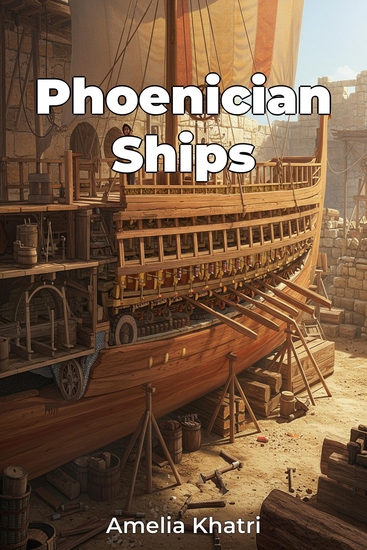
Phoenician Ships - cover

Phoenician Ships

Amelia Khatri

Übersetzer A AI

Verlag: Publifye

  • 0
  • 0
  • 0

Beschreibung

Phoenician Ships: How Innovation at Sea Forged an Empire of Trade explores how this civilization achieved maritime dominance through groundbreaking shipbuilding. The Phoenicians, despite their relatively small population, leveraged technological advancements in naval architecture to establish extensive trade routes and far-reaching colonies across the Mediterranean.

 
Discover how their mastery allowed them to overcome limited natural resources and competing empires, influencing economies and cultural exchanges throughout the ancient world. The book delves into various ship types, including the bireme and merchant vessels, examining construction methods and materials like Lebanese cedar.

 
It progresses from introducing Phoenician civilization and its geographical context to analyzing the economic and sociocultural impacts of their maritime prowess. This approach, integrating archaeological findings with historical accounts, provides a comprehensive picture of how ship design intertwined with the social, economic, and political aspects of Phoenician society, offering valuable insights into ancient shipbuilding and trade.
Verfügbar seit: 29.03.2025.
Drucklänge: 61 Seiten.

Weitere Bücher, die Sie mögen werden

  • The New Kingdom of Egypt - Empire and Expansion - cover

    The New Kingdom of Egypt -...

    Omar Khalil

    • 0
    • 0
    • 0
    The rise of the New Kingdom marks one of the most pivotal periods in Egyptian history, signaling the transformation of Egypt from a regional power to an expansive empire. This era began with the fall of the Middle Kingdom, a time of political instability and foreign invasions. As Egypt struggled with weak leadership and incursions from Asiatic and Nubian forces, the foundations were laid for the emergence of a new, more robust regime. 
    The decisive moment came with the reign of Ahmose I, who is credited with founding the 18th Dynasty and expelling the Hyksos invaders from the Delta region. Ahmose's victory over these foreign rulers was symbolic not only of military prowess but also of a reassertion of Egyptian identity and unity. This victory allowed the pharaohs of the New Kingdom to solidify their power and embark on territorial expansion that would characterize much of their rule. 
    Ahmose's successors built upon his military success. They began to push Egypt's borders further into Nubia to the south and the Levant to the north, extending Egypt’s reach and influence. The New Kingdom was thus defined by an ambitious policy of imperial expansion, which required a well-organized military and a stable central government. The initial successes of the 18th Dynasty laid the groundwork for the period's most famous rulers, such as Thutmose III, whose campaigns in Syria and Palestine created an empire that stretched far beyond Egypt’s traditional borders.
    Zum Buch
  • The Quaking of America - cover

    The Quaking of America

    Resmaa Menakem

    • 0
    • 0
    • 0
    The New York Times bestselling author of MY GRANDMOTHER'S HANDS surveys America's deteriorating democracy and offers embodied practices to help us protect ourselves and our country. In THE QUAKING OF AMERICA, therapist and trauma specialist Resmaa Menakem takes readers through somatic processes addressing the growing threat of white-supremacist political violence.Through the coordinated repetition of lies, anti-democratic elements in American society are working to incite mass radicalization, widespread chaos, and a collective trauma response in tens of millions of American bodies. Currently, most of us are utterly unprepared for this potential mayhem. This book can help prepare us—and possibly prevent further destruction. This preparation focuses not on strategy or politics, but on practices that can help usBuild presence and discernment in our bodiesSettle our bodies during the heat of conflictMaintain our safety, sanity, and stability in dangerous situationsHeal our personal and collective racialized traumaPractice embodied social actionTurn toward instead of on one anotherTHE QUAKING OF AMERICA is a unique and perfectly timed guide to help us navigate our widespread upheaval and build an antiracist culture."Resmaa Menakem is one of our country's most gifted racial healers. His brilliant new book could not be more timely."—Michael Eric Dyson, author of Entertaining Race and Long Time Coming"Resmaa Menakem is a visionary, and his work is absolutely essential for antiracist practice.”—Robin DiAngelo, PhD, New York Times bestselling author of White Fragility and Nice Racism
    Zum Buch
  • Intermediate Mexican Spanish: The Ultimate Guide to Building Fluency and Cultural Insight for Everyday Conversations - cover

    Intermediate Mexican Spanish:...

    Lingo Publishing

    • 0
    • 0
    • 0
    Intermediate Mexican Spanish: Journey Beyond the Basics  
    Embark on an exhilarating journey to fluency with "Intermediate Mexican Spanish: The Ultimate Guide to Building Fluency and Cultural Insight for Everyday Conversations." This audiobook isn't just a course; it's your passport to the rich tapestry of Mexican culture, a bridge to connect you deeply with the Spanish-speaking world. 
    Whether you're planning to navigate the bustling streets of Mexico City, dive into the literary genius of Octavio Paz, or simply aim to enrich your linguistic skills, this guide is your next step. It builds on the foundations laid by beginners, offering a more nuanced understanding of the Mexican language and its myriad of expressions. 
    Inside, discover chapters that mimic the flow of life itself, from the simplicity of "Lunes: Personalities" to the reflective depth of "Domingo: Present and Future Wishes." Each day of the week brings a new theme, a new adventure in language, immersing you in scenarios that range from describing personalities with vivid adjectives to navigating the future tense with ease and confidence. 
    Dive deeper into the nuances of Mexican Spanish with:A rich palette of vocabulary that colors your conversations with authenticity.Grammar that unlocks the structures and mechanics of more sophisticated communication.Cultural insights that do more than teach you to speak; they teach you to understand and to be understood.Engaging exercises that test your knowledge and refine your skills, ensuring that every lesson leaves its mark. 
    Are you ready to turn the page? Click "Add to Cart" and take your place among the fluent speakers of one of the world's most beautiful languages. Your adventure awaits!
    Zum Buch
  • The Meaning of Truth - cover

    The Meaning of Truth

    William James

    • 0
    • 0
    • 0
    "The Meaning of Truth" by William James is a philosophical exploration of the nature of truth and its role in human life. James argues that truth is not a static, absolute concept, but rather a dynamic and evolving process that is shaped by the experiences and perspectives of individual human beings. He proposes a pragmatic theory of truth, which emphasizes the practical consequences of beliefs and actions rather than their correspondence to an objective reality. Throughout the book, James engages with the ideas of other philosophers, including Plato, Kant, and Hegel, and critiques their views on truth. He also examines the implications of his pragmatic theory for various areas of inquiry, such as religion, science, and morality. James ultimately suggests that the pursuit of truth should be seen as a vital part of human life, as it enables individuals to better understand and navigate the world around them. Read in English, unabridged.
    Zum Buch
  • Royalty - The 6 in 1 Historical Kings and Queens Bundle - cover

    Royalty - The 6 in 1 Historical...

    Kelly Mass

    • 0
    • 0
    • 0
    This book focuses on the history of several kings and queens, which are the following: 
    Anne Boleyn: Her Execution for Treason, and Her Political and Religious Upheaval 
    Bloody Mary: Mary Tudor, the Queen Who Took on the Protestant Revolt 
    Charlemagne: King of the Franks, King of Lombardy, and Emperor of the Romans 
    Eleanor of Aquitaine: One of the Wealthiest and Most Influential Women in western Europe 
    Marie Antoinette: The Last Queen of France before the French Revolution 
    Queen Victoria: The British Monarch Who Ruled the Longest 
    Richard the Lionheart: The Famous King of England during the 12th Century
    Zum Buch
  • Persecution of Jews in Medieval Spain The: The History of the Discrimination and Expulsion of Spanish Jews during the Reconquista and Inquisition - cover

    Persecution of Jews in Medieval...

    Editors Charles River

    • 0
    • 0
    • 0
    The term “Reconquista” is a Spanish word transferred to the English language to represent the nearly 800 years in which the Moors and Christians struggled against one another for control of the Iberian Peninsula. Although the phrase typically refers to the time when the numerous Christian kingdoms mobilized to overthrow the Islamic Caliphates set up in the peninsula, the term can additionally be used to refer to the entire situation starting in the 8th century, when Islamic civilization slowly moved out of North Africa, across the Mediterranean Sea, and into southern Iberia.  
    	Not surprisingly, three religions attempting to coexist during medieval times resulted in nearly incessant conflicts, marked by high taxation, disparate societies, rigid cultural controls, and systemic violence. Despite the odds, these three religions managed to live in a state of quasi-acceptance and peace in most of the major cities like Cordoba and Toledo, with sporadic warfare occurring on the borders between Al-Andalus and the Christian kingdoms near the Pyrenees Mountains. Muslims, Christians, and Jews would attempt to reorganize their societies several times over the centuries through warfare, always with Jews on the lower rungs and Christians and Muslims fighting it out above them.   
    	By the end of the 14th century, the distrust and prejudice against Jewish communities quickly spread to Spain. In 1391, James II of Aragon boarded the bandwagon; backed into a corner by the Roman Catholic Church, he established a law that banned Jews from Spain altogether. Jews were shunned in droves, and the remaining were given an ultimatum to either convert/revert to Catholicism or face immediate death. Yet another wave of gory pogroms ensued across the country, especially in Barcelona.
    Zum Buch