Rejoignez-nous pour un voyage dans le monde des livres!
Ajouter ce livre à l'électronique
Grey
Ecrivez un nouveau commentaire Default profile 50px
Grey
Abonnez-vous pour lire le livre complet ou lisez les premières pages gratuitement!
All characters reduced
Mail-In Voting Facts - cover

Mail-In Voting Facts

Amelia Khatri

Traducteur A AI

Maison d'édition: Publifye

  • 0
  • 0
  • 0

Synopsis

Mail-In Voting Facts offers a comprehensive exploration of remote voting, a crucial element in contemporary democratic processes. The book examines the history of mail-in voting from the Civil War era to modern elections, highlighting the evolution driven by technology and societal changes. It also investigates the security infrastructure, including signature verification and ballot tracking, providing a balanced assessment of the strengths and vulnerabilities inherent in these systems. A key insight is that while mail-in voting enhances accessibility, it necessitates rigorous oversight to maintain public trust. The book argues that the politicization of mail-in voting has led to misinformation, threatening democratic governance. It progresses logically, beginning with fundamental concepts and historical context, then delving into the mechanics of ballot distribution and completion. The analysis culminates in an exploration of ongoing debates, offering recommendations for election reform. By drawing upon government reports, academic studies, and state-level election data from 2000-2022, this book offers a neutral, evidence-based perspective, making it invaluable for anyone seeking an unbiased understanding of this vital voting method.
Disponible depuis: 15/02/2025.
Longueur d'impression: 75 pages.

D'autres livres qui pourraient vous intéresser

  • NYS Notary Public Success: Strategies for Winning Connections - "Unlock your NYS Notary Public success! Dive into engaging audio lessons for unbeatable connection strategies!" - cover

    NYS Notary Public Success:...

    Percival Wrenford

    • 0
    • 0
    • 0
    NYS Notary Public Success: Strategies for Winning Connections 
    ⭐⭐ Simplified Audio Guide with Explanations ⭐⭐ 
    Are you eager to advance in your career and deepen your expertise by mastering the essentials of notary public skills? 
    Are you on the hunt for an all-encompassing guide that covers everything you need to elevate your professional credibility as a notary? 
    Look no further! 
    This audiobook is your ultimate resource for enhancing your knowledge, honing your skills, and engaging in practical exercises. With this guide in hand, you're on the path to success. 
    Updated for the 2024 Notary Public standards. 
    Key features of this comprehensive guide: 
    - In-depth insights into becoming a successful Notary Public 
    - Detailed explanations of notary duties and responsibilities 
    - Effective strategies for preparing for notary examinations and practical scenarios 
    Our guide stands out through its thoroughness, ensuring you have all the tools necessary for your success. Topics are explored in depth, rather than brushed over. 
    Crafted with a logical structure and accessible language, our Notary Public guide guarantees seamless transitions between topics. Say goodbye to complex jargon and embrace clear, precise, and technically accurate content. 
    So, why wait? Click the BUY NOW button, secure your guide, and embark on your journey to mastering notary skills and elevating your professional credibility! 
    NYS Notary Public Success: Strategies for Winning Connections is your go-to guide for achieving success in the world of notary public services.
    Voir livre
  • The Shocking Truth about Public Transportation - cover

    The Shocking Truth about Public...

    Zoey Fraisers

    • 0
    • 0
    • 0
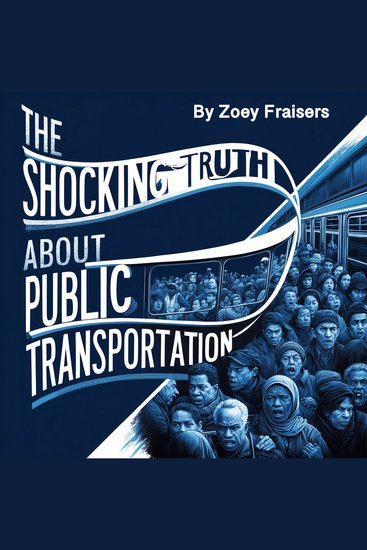
    Public transportation is often presented as the backbone of modern cities, a vital system that connects people to jobs, schools, and essential services. Advocates promote it as an affordable, eco-friendly, and efficient alternative to private vehicles, reducing congestion and improving urban mobility. Governments and transit agencies highlight its benefits, claiming it serves the public good while advancing sustainability goals. However, beyond the polished image of well-maintained buses, sleek trains, and promises of convenience, there lies a far more complicated and often troubling reality.  
      
    The public is frequently told that mass transit is the key to reducing traffic and lowering pollution, yet many systems fail to deliver on these promises. Trains break down, buses run late, and commuters find themselves packed into overcrowded vehicles, often feeling unsafe. Meanwhile, taxpayers pour billions into these systems, only to see fare increases, service cuts, and poorly maintained infrastructure. The question arises: If public transportation is supposed to be a solution, why does it so often feel like a problem?  
      
    Another significant issue is safety. Crime rates on buses, subways, and train platforms have become a growing concern, with riders facing theft, assault, and harassment. Many transit systems lack sufficient security measures, leaving passengers vulnerable. The psychological stress of commuting through unsafe environments can be overwhelming, particularly for women, the elderly, and other vulnerable populations. Despite these risks, officials frequently downplay crime statistics, insisting that public transit remains a safe option. 
    Voir livre
  • Sulla and Gaius Marius: The Lives and Legacies of the Leaders Who Fought Rome’s First Civil War - cover

    Sulla and Gaius Marius: The...

    Editors Charles River

    • 0
    • 0
    • 0
    Caesar is still remembered for winning a civil war and helping bring about the end of the Roman Republic, leaving a line of emperors in its place, but it’s quite possible that none of what Caesar did would’ve happened without the template for such actions being set 40 years earlier. At the time, when Caesar was in his teens, war was being waged both on the Italian peninsula and abroad, with domestic politics pitting the conservative, aristocratic optimates against the populist, reformist populares, and this tension ultimately escalated into an all-out war. One of the leading populares was Caesar’s uncle, Gaius Marius, a military visionary who had restructured the legions and extended the privileges of land ownership and citizenship to legionaries on condition of successful completion of a fixed term of service. In the late 2nd century BCE, Marius had waged a successful campaign against several Germanic tribes, and after earning eternal fame in the Eternal City, Marius was appointed a consul several times. In 88 BCE, he entered into conflict with his erstwhile protégé, the optimate Sulla, over command of the army to be dispatched against Mithridates VI of Pontus, a long-time enemy of Rome and its Greek allies.   
    	Ironically, Marius’s reforms had made the legions fiercely loyal to their individual generals rather than the state, which allowed Sulla to march his army against Rome and force Marius into exile. With that, Rome’s first civil war was officially underway, but Sulla’s triumph proved short-lived. Just as Sulla departed for a campaign, Marius returned at the head of a scratch army of veterans and mercenaries, taking over the city and purging it of Sulla’s optimate supporters, and though Marius died in 86 BCE, his party remained in power. 
    Voir livre
  • Social Capital: Life online in the shadow of Ireland’s tech boom - cover

    Social Capital: Life online in...

    Aoife Barry

    • 0
    • 0
    • 0
    A David and Goliath story about Ireland’s role as prime real estate for the world’s largest tech multinationals, and the considerable impact it has had on us as individuals. 
    At the start of the millennium, the Tech giants landed on Ireland’s shores. Dublin, once one of Europe’s poorest cities, became a beacon of Silicon Valley’s promise of progress and power. As the face of the capital was remade in the image of Big Tech, Irish society embraced technology like no other. Romantic Ireland was dead and gone: social media was here to stay. 
    In this provocative account, Aoife Barry explores the human cost of Ireland’s Faustian pact with Big Tech, from the local communities uprooted by Google to the traumatised moderators squirrelled in the capital’s pockets, keeping the internet safe at a terrible price. Unsettling, insightful, and wryly funny, she paints a portrait of a country addicted to the internet, refreshing the news, refreshing Twitter, scrolling and scrolling towards a feverish future. She turns an equally honest eye on her own life online, from her humble beginnings using dial-up in her parent’s kitchen to working for Ireland’s first digital-only newsroom, and asks what we bargain in exchange for life in the metaverse. 
    Social Capital is the coming of age story of Ireland 3.0: set against the backdrop of the tech revolution, it chronicles how we collapse the boundary between physical and virtual reality, and where we might go from here. 
    Barry's new book, Social Capital, is a popular science exploration into the world of computers and information technology. It's a top pick for anyone interested in the intersection of culture, economics, and the latest developments in the tech industry. 
    For fans of Bill Gifford (Ledyard), Britney Spears (The woman in me), Dolly Alderton (Everything I Know About Love), Bono (Surrender), and Ian H. Robertson (How Confidence Works). 
    HarperCollins 2023
    Voir livre
  • Black Tax - Burden or Ubuntu? - cover

    Black Tax - Burden or Ubuntu?

    Niq Mhlongo (Ed.)

    • 0
    • 0
    • 0
    The real significance of this book lies in the fact that it tells us more about the everyday life of black South Africans. It delves into the essence of black family life and the secret anguish of family members who often battle to cope. – Niq Mhlongo 
    A secret torment for some, a proud responsibility for others, ‘black tax’ is a daily reality for thousands of black South Africans. In this thought-provoking and moving anthology, a provocative range of voices share their deeply personal stories. 
    With the majority of black South Africans still living in poverty today, many black middle-class households are connected to working-class or jobless homes. Some believe supporting family members is an undeniable part of African culture and question whether it should even be labelled as a kind of tax. 
    Others point to the financial pressure it places on black students and professionals, who, as a consequence, struggle to build their own wealth. Many feel they are taking over what is essentially a government responsibility. 
    The contributions also investigate the historical roots of black tax, the concept of the black family and the black middle class. In giving voice to so many different perspectives, Black Tax hopes to start a dialogue on this widespread social phenomenon.
    Voir livre
  • Misinformation Nation - Foreign News and the Politics of Truth in Revolutionary America - cover

    Misinformation Nation - Foreign...

    Jordan E. Taylor

    • 0
    • 0
    • 0
    In Misinformation Nation, Jordan E. Taylor reveals how foreign news defined the boundaries of early American politics and ultimately drove colonists to revolt against Britain and create a new nation. 


    News was the lifeblood of early American politics, but newspaper printers had few reliable sources to report on events from abroad. Though frequently false, the information that Americans encountered in newspapers, letters, and conversations framed their sense of reality, leading them to respond with protests, boycotts, violence, and the creation of new political institutions. Fearing that their enemies were spreading fake news, American colonists fought for control of the news media. As their basic perceptions of reality diverged, Loyalists separated from Patriots and, in the new nation created by the revolution, Republicans inhabited a political reality quite distinct from that of their Federalist rivals. 


    The American Revolution was not only a political contest for liberty, equality, and independence (for white men, at least); it was also a contest to define certain accounts of reality to be truthful while defining others as false and dangerous. Misinformation Nation argues that we must also conceive of the American Revolution as a series of misperceptions, misunderstandings, and uninformed overreactions.
    Voir livre