Rejoignez-nous pour un voyage dans le monde des livres!
Ajouter ce livre à l'électronique
Grey
Ecrivez un nouveau commentaire Default profile 50px
Grey
Abonnez-vous pour lire le livre complet ou lisez les premières pages gratuitement!
All characters reduced
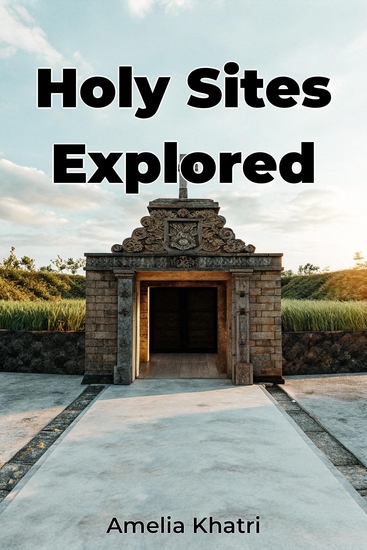
Holy Sites Explored - cover

Holy Sites Explored

Amelia Khatri

Traducteur A AI

Maison d'édition: Publifye

  • 0
  • 0
  • 0

Synopsis

Holy Sites Explored examines the profound significance of locations revered across diverse faiths and cultures, arguing that these sites are living embodiments of faith, history, and collective memory. The book explores how these places shape belief systems and influence world history. It delves into the historical background, religious significance, architectural features, and associated rituals of sites like Mecca, the spiritual center of Islam, and Jerusalem, sacred to Judaism, Christianity, and Islam. The book also considers how religious sites are impacted by conflict, pilgrimage, and modernization.

 
Beginning with a definition of "sacred space," the book progresses through in-depth explorations of specific holy sites, drawing from archaeological findings, historical texts, and ethnographic studies. Understanding the cultural interpretations of these sites offers insight into the complex interplay between religion, culture, and human identity. It provides a fact-based and respectful exploration of sacred spaces, avoiding sensationalism and offering an accessible account suitable for a broad audience interested in religious history and culture.
Disponible depuis: 14/02/2025.
Longueur d'impression: 61 pages.

D'autres livres qui pourraient vous intéresser

  • Bookends - Collected Intros and Outros - cover

    Bookends - Collected Intros and...

    Anonyme

    • 0
    • 0
    • 0
    A brilliant, idiosyncratic collection of introductions and afterwords (plus some liner notes) by New York Times bestselling and Pulitzer Prize winning author Michael Chabon—“one of contemporary literature’s most gifted prose stylists” (Michiko Kakutani, New York Times). 
    In Bookends, Pulitzer Prize winning author Michael Chabon offers a compilation of pieces about literature—age-old classics as well as his own—that presents a unique look into his literary origins and influences, the books that shaped his taste and formed his ideas about writing and reading. 
    Chabon asks why anyone would write an introduction, or for that matter, read one. His own daughter Rose prefers to skip them. Chabon's answer is simple and simultaneously profound: ""a hope of bringing pleasure for the reader."" Likewise, afterwords—they are all about shared pleasure, about the ""pure love"" of a work of art that has inspired, awakened, transformed the reader. Ultimately, this thought-provoking compendium is a series of love letters and thank-you notes, unified by the simple theme of the shared pleasure of discovery, whether it's the boyhood revelation of the most important story in Chabon's life (Ray Bradbury's ""The Rocket Man""); a celebration of ""the greatest literary cartographer of the planet Mars"" (Edgar Rice Burroughs, with his character John Carter); a reintroduction to a forgotten master of ghost stories (M. R. James, ironically ""the happiest of men""); the recognition that the worlds of Wes Anderson's films are reassembled scale models of our own broken reality (as is all art); Chabon's own rude awakening from the muse as he writes his debut novel, The Mysteries of Pittsburgh; or a playful parody of lyrical interpretation in the liner notes for Mark Ronson's Uptown Special, the true purpose of which, Chabon insists, is to ""spread the gospel of sensible automotive safety and maintenance practices."" 
    Galaxies away from academic or didactic, Bookends celebrates wonder—and like the copy of The Phantom Tollbooth handed to young Michael by a friend of his father he never saw again—it is a treasured gift.
    Voir livre
  • Medieval England: An Enthralling Overview of the English Middle Ages - cover

    Medieval England: An Enthralling...

    Enthralling History

    • 0
    • 0
    • 0
    If you want to discover the enthralling history of medieval England, then keep listening... 
    Knights, monks, kings, plague, war, Vikings, revolts, and so much more appear in the six hundred or so years known as the medieval period of English history. Our culture has romanticized many of these elements, and the Middle Ages has become full of stereotypes and tropes that appear again and again in movies, books, and even in our imaginations. But what was it really like? 
    This audiobook will separate the myth from reality and reveal what you know about medieval England and what you only think you know. It covers a sweeping overview of the period and dives into many of the fascinating facts and stories that have made people love the Middle Ages for so long. 
    In this audiobook, you’ll learn about:       How England got started       What it took to be the best and worst English king       Why you wouldn’t want to be a peasant in the Middle Ages       How one of the greatest catastrophes in human history, the Black Death, unfolded       The harsh punishments that kept the peace       How the church became the most powerful organization of the period       Why armored cavalry stopped being used in battles       What medieval people did for fun       And much, much more!
    Voir livre
  • The Dandy - A People's History of Sartorial Splendour - cover

    The Dandy - A People's History...

    Peter K. Andersson

    • 0
    • 0
    • 0
    The historical figure of the dandy has commonly been described as an upper-class gentleman. But there is a broader history to be told about the dandy—one that incorporates unknown men from the lower strata of society.The Dandy: A People's History constitutes the first history of those dandies who emanated from the less privileged layers of the populace—the lowly clerks, shop assistants, domestic servants, and laborers who increasingly during the modern age have emerged as style-conscious men about town.A series of fascinating in-depth studies of the wide variety of dandy subcultures that have surfaced around the world in the last two centuries tell the story of how the shaping of fashions and the image of men became increasingly democratized, with the arbiters of taste increasingly coming from the other end of the social spectrum. We encounter such long-forgotten groups as the mashers, the knuts, the Paris gandins and the Berlin transgender dandies, alongside unexplored figures like the zoot suiter, the teddy boy, and the New Romantic.This is a story of how fundamental aspects of modern culture such as fashion, style, and conduct have been shaped from below just as much as from above.
    Voir livre
  • Indigenous Spirituality and Global Wisdom - Discover how Indigenous spirituality reveals the timeless truths shared by all great religions - cover

    Indigenous Spirituality and...

    Mayur Katariya

    • 0
    • 0
    • 0
    What if the key to a more connected and mindful life lies in ancient wisdom, we've overlooked?  
    This audiobook explores the spiritual traditions of Indigenous Australians, with a focus on the practice of Dadirri—a deep form of listening and contemplation.  
    It also examines parallels between Indigenous spirituality and other global wisdom traditions, such as Zen Buddhism, Vedic traditions, and Christian mysticism. By the end of the book, learners will develop a deeper understanding of Indigenous spirituality, its holistic worldview, and how these practices can be integrated into their personal and spiritual lives.  
    This is not just a journey into history—it may transform the way you approach your own spiritual and personal growth.  
    This is a lesson in why the wisdom of Indigenous cultures remains profoundly relevant today, for all of us.
    Voir livre
  • The Darién Gap - A Reporter's Journey through the Deadly Crossroads of the Americas - cover

    The Darién Gap - A Reporter's...

    Belén Fernández

    • 0
    • 0
    • 0
    The narrow Darién Gap, the only land bridge connecting South and Central America, encompasses a spectacularly hostile jungle, covered in steep mountains, dense rainforests, and flood-prone marshes. Known in Spanish as el infierno verde, or “the green hell,” it is one of the most inhospitable places in the world. Its terrain is too treacherous for roads, yet hundreds of thousands of refuge seekers contend with its horrors every year in the hopes of reaching the United States, still some three thousand miles away. And of the countless who set out for the border, an untold number never arrive. In this book, journalist Belén Fernández travels through the Darién Gap to report on the dehumanizing and deadly stretch of land that has become a mass graveyard for migrants. Fernández’s journey brings her into contact with refuge seekers, people smugglers, law enforcement officials, and many more whose stories bring life to a place overwhelmingly associated with death. Combining history, on-the-ground reporting, travelogue, memoir, and searing politico-economic analysis, she shines light on a largely made-in-the-USA crisis that has come to define our modern era. 
    Voir livre
  • How to Make Money - An Ancient Guide to Wealth Management (series: Ancient Wisdom for Modern Readers) - cover

    How to Make Money - An Ancient...

    PLINY

    • 0
    • 0
    • 0
    Ancient Romans liked money. But how did they make a living and sometimes even become rich? The Roman economy was dominated by agriculture, but it was surprisingly modern in many ways: the Romans had companies with CEOs, shareholders, and detailed contracts regulated by meticulous laws; systems of banking and taxation; and a wide range of occupations, from merchant and doctor to architect and teacher. The Romans also enjoyed a relatively open society, where some could start from the bottom, work, invest, and grow rich. How to Make Money gathers a wide variety of ancient writings that show how Romans thought about, made, invested, spent, lost, and gave away money. 


    The Roman elite idealized farming and service to the state but treated many other occupations with suspicion or contempt, from money lending to wage labor. But whatever their attitudes, pecunia made the Roman world go round. In the Satyricon, Trimalchio brags about his wealth. Seneca accumulated a fortune—but taught that money can't buy happiness. Eumachia inherited a brick factory from her father, married well, and turned to philanthropy after she was widowed. How to Make Money also takes up some of the most troubling aspects of the Roman economy, slavery and prostitution, which the elite deemed unrespectable but often profited from.
    Voir livre