Rejoignez-nous pour un voyage dans le monde des livres!
Ajouter ce livre à l'électronique
Grey
Ecrivez un nouveau commentaire Default profile 50px
Grey
Abonnez-vous pour lire le livre complet ou lisez les premières pages gratuitement!
All characters reduced
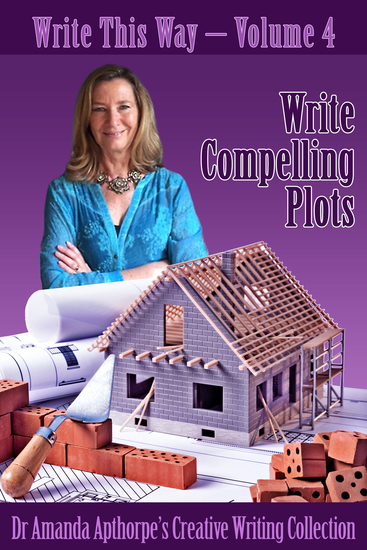
Write Compelling Plots - cover

Write Compelling Plots

Amanda Apthorpe

Maison d'édition: Next Chapter

  • 0
  • 0
  • 0

Synopsis

We are enthralled by stories – tales told around the campfire, acted on stage, written down, filmed, painted, danced and sung. Why? Because we want to be entertained, to be inspired, to escape, to enter virtual worlds, to understand and to relate to others like and unlike ourselves.
 
It’s said that there are only seven storylines, but those seven have generated an extraordinary number of tales because their creators have told them from their own perspectives, their own point of difference.
 
The fourth book in Amanda Apthorpe's Write This Way series, 'Write Compelling Plots’, identifies the difference between plot and story, guides external and internal structural organisation and explains the significance of the narrative arc. You will discover how your central character’s desire, their limitations and their fear entwine to create the conflict that will drive your story. Drawing on the content within these pages, and your own point of difference, you too can create compelling plots.
 
In addition, this book explores the elements of setting and description. Part 3: Editing Toolbox identifies and corrects common editing errors in creative writing.
Disponible depuis: 06/10/2022.
Longueur d'impression: 80 pages.

D'autres livres qui pourraient vous intéresser

  • Colorful Palate - A Flavorful Journey Through a Mixed American Experience - cover

    Colorful Palate - A Flavorful...

    Raj Tawney

    • 0
    • 0
    • 0
    WINNER, 2024 BEST INDIE BOOK AWARD, CULINARY MEMOIR 


    WINNER, 2024 LIVING NOW BOOK AWARD, INSPIRATIONAL MEMOIR—MALE (BRONZE) 


    A NEW YORK PUBLIC LIBRARY & FOREWORD REVIEWS BOOK OF THE DAY ● NAMED A BEST BOOK OF 2023 BY ZED BOOK CLUB & INDIA CURRENTS ● LA WEEKLY BOOK PICK ● RECOMMENDED BY BOOK RIOT & ELECTRIC LITERATURE 


    A timely self-examination of the "mixed" American experience featuring exclusive recipes from the author's multicultural family. 


    As citizens continue to evolve and diversify within the United States, the ingredients that make up each flavorful household are waiting to be discovered and devoured. In Colorful Palate, author Raj Tawney shares his coming-of-age memoir as a young man born into an Indian, Puerto Rican, and Italian American family, his struggles with understanding his own identity, and the mouthwatering flavors of the melting pot from within his own childhood kitchen.
    Voir livre
  • How to Make a Home - An Ancient Guide to Style and Comfort - cover

    How to Make a Home - An Ancient...

    Vitruvius

    • 0
    • 0
    • 0
    An entertaining and enlightening collection of ancient Roman writings about home design and decoration 


    The idea that our homes can communicate professional as well as personal identities may seem as new as the work-from-home revolution. But it was second nature to the ancient Romans, for whom the home was in many ways the center of public and private life. Roman authors saw infinite practical and symbolic value in houses, and they have much to say about them. How to Make a Home presents some of the best Roman writings on houses—from buying and selling to designing and decorating. 


    Edited and elegantly translated by Marden Fitzpatrick Nichols, How to Make a Home gathers selections by Cicero, Vitruvius, Seneca, and others. These writings reveal the pleasures and pitfalls of the Roman practice of making one's home a cornerstone of self-expression. While the ideal home enshrined Roman virtues and could make a career, lavish building projects could lead to financial ruin and moral condemnation. These authors memorably describe such travails as deceptive staging, decorators run amok, know-it-all owners, unsupervised contractors, and buyer's remorse. Along the way, they also explain why simplicity is bliss, privacy is for nobodies, a neglected house is a sign of a neglected soul, and much more.
    Voir livre
  • The Roman Empire Uncovered - Secrets of a Superpower - cover

    The Roman Empire Uncovered -...

    Rogan Fish

    • 0
    • 0
    • 0
    The Roman Empire, one of history's most influential superpowers, traces its origins to a blend of myth, legend, and historical reality. Understanding the foundations of Rome requires examining the myths surrounding its birth, its early expansion as a republic, and the eventual transformation into a dominant empire. These formative stages laid the groundwork for centuries of imperial dominance, establishing Rome as a cultural and political epicenter. 
    The story of Rome's foundation begins with the legendary tale of Romulus and Remus. According to Roman mythology, the twin brothers were abandoned by the river Tiber, only to be rescued and nurtured by a she-wolf. Eventually, Romulus would go on to establish the city on Palatine Hill in 753 BCE, becoming its first king after a violent dispute with Remus. Though historians debate the factual accuracy of this tale, it symbolizes Rome’s resilience and its origins rooted in struggle and survival. This myth, coupled with archaeological evidence from early settlements on the hills of Rome, provides insight into how Romans viewed their beginnings as both divine and destined for greatness. 
    Following its legendary foundation, Rome gradually transformed from a small settlement into a robust city-state. Initially, it was ruled by a series of kings who laid the foundations of Roman society, including political and religious institutions. However, the overthrow of the monarchy in 509 BCE marked the beginning of the Roman Republic, a period characterized by shared power between elected officials and a complex system of checks and balances. The Republic's political structure, with the Senate as a central governing body, reflected a commitment to preventing any single ruler from holding excessive power. This early model of governance would profoundly influence later empires and modern political systems.
    Voir livre
  • AuDHD - Blooming Differently - cover

    AuDHD - Blooming Differently

    Leanne Maskell

    • 0
    • 0
    • 0
    Living with AuDHD is like being a unicorn—misunderstood, contradictory, and often invisible to others. You shine with creativity and innovation, but struggle to fit in - always feeling 'too much'. Autism and ADHD pull you in opposite directions, creating a lifetime of contradictions no one else can see. 
    AuDHD isn’t listed in diagnostic manuals because until 2013, you couldn’t be diagnosed with both conditions - despite a co-occurrence rate of approximately 50-70%. These two neurotypes often clash, like opposing magnets in the brain.ADHD craves novelty; autism resists change.ADHD misses details; autism hyper-focuses on them.ADHD perceives time as ‘now or not now’; autism sticks rigidly to schedules.ADHD seeks stimulation; autism is easily overwhelmed.ADHD thrives in chaos; autism needs structure.ADHD says yes; autism says no.Autism makes the rules, ADHD breaks them.If you’re exhausted reading this, just imagine what it’s like to live it. 
    Leanne Maskell was diagnosed with ADHD at 25, but it took 7 more years to learn she was also autistic. AuDHD: Blooming Differently chronicles her turbulent journey—from a childhood of vulnerability and trauma to a high-achieving model and lawyer, outwardly successful but inwardly struggling. 
    The book exposes the relentless burnout of not understanding your brain and the power of self-awareness in finally thriving. Today, Leanne is a successful author, coach, and National Specialist Coach of the Year. 
    More than just a memoir, this book offers practical insights for AuDHD individuals and those who support them—essential for psychiatrists, educators, and anyone seeking to understand neurodivergence. 
    With lived experience and professional expertise, AuDHD: Blooming Differently is an honest and transformative guide to rewriting the neurodivergent narrative.
    Voir livre
  • Janissaries and Sipahi The: The History of the Elite Infantry and Cavalry that Fueled the Ottoman Empire’s Expansion - cover

    Janissaries and Sipahi The: The...

    Editors Charles River

    • 0
    • 0
    • 0
    In terms of geopolitics, perhaps the most seminal event of the Middle Ages was the successful Ottoman siege of Constantinople in 1453. The city had been an imperial capital as far back as the 4th century, when Constantine the Great shifted the power center of the Roman Empire there, effectively establishing two almost equally powerful halves of antiquity’s greatest empire. Constantinople would continue to serve as the capital of the Byzantine Empire even after the Western half of the Roman Empire collapsed in the late 5th century. Naturally, the Ottoman Empire would also use Constantinople as the capital of its empire after their conquest effectively ended the Byzantine Empire, and thanks to its strategic location, it has been a trading center for years and remains one today under the Turkish name of Istanbul.  
    	In the wake of taking Constantinople, the Ottoman Empire would spend the next few centuries expanding its size, power, and influence, bumping up against Eastern Europe and becoming one of the world’s most important geopolitical players. It was a rise that would not truly start to wane until the 19th century. 
    Among those who were responsible for the projection of Ottoman power, few deserve as much credit as the Janissaries. Established by Murad I, the Janissaries became an elite infantry force that was loyal only to the sultan. Their mission was to protect only him and in battles they were always the closest to him, forming a human shield.  
    Civilizations across the steppes and the Middle East relied heavily on cavalry, and the Sipahi were elite cavalry units during medieval times for a couple of powers. That said, they were a massive contributor to the success of Ottoman warfare, and during good times for the empire, the Sipahi were rewarded, to the extent that they became their own social class, much like the Janissaries. 
    Voir livre
  • A Reading of the Inaugural Address of President Zachary Taylor - cover

    A Reading of the Inaugural...

    President Zachary Taylor

    • 0
    • 0
    • 0
    Zachary Taylor (November 24, 1784 – July 9, 1850) was an American military officer and politician who was the 12th president of the United States, serving from 1849 until his death in 1850. Taylor was a career officer in the United States Army, rising to the rank of major general and becoming a national hero for his victories in the Mexican–American War. As a result, he won election to the White House despite his vague political beliefs. His top priority as president was to preserve the Union. He died 16 months into his term from a stomach disease. Taylor had the third-shortest presidential term in U.S. history. The following is a reading of President Taylor's inaugural address delivered on March 05, 1849.
    Voir livre