Rejoignez-nous pour un voyage dans le monde des livres!
Ajouter ce livre à l'électronique
Grey
Ecrivez un nouveau commentaire Default profile 50px
Grey
Abonnez-vous pour lire le livre complet ou lisez les premières pages gratuitement!
All characters reduced
No Excuses - Turning around one of Britain's toughest schools - cover

No Excuses - Turning around one of Britain's toughest schools

Alison Colwell

Maison d'édition: Biteback Publishing

  • 0
  • 0
  • 0

Synopsis

"Eye-popping" – Sunday Times
"Brilliant" – Iain Dale
***
An unputdownable true account of how a tenacious head teacher led one of the most challenging schools in the country to excellence.
No Excuses charts an extraordinary principal's journey from the moment she took over at a failing secondary school in a deprived area, where less than a quarter of children attained five or more A*–C GCSEs, and how she set about the gruelling task of transforming its reputation using her zero-tolerance, tough-love approach.
Armed only with a wicked sense of humour, fearless energy and a powerful vision, Alison Colwell put in place a stringent set of rules, including a strict uniform policy and a complete ban on mobile phones, provoking resistance and hostility from some parents, the wider community and on social media.
This is the darkly funny, moving story of how, together, teachers and their – often troubled – pupils rebuilt a school and community, with an inspirational head at the helm.
Charming, touching and full of brilliant leadership advice, this is the diary of the woman the Daily Mail labelled Britain's strictest head teacher.
Disponible depuis: 24/03/2022.
Longueur d'impression: 272 pages.

D'autres livres qui pourraient vous intéresser

  • White Thinking - Behind the Mask of Racial Identity - cover

    White Thinking - Behind the Mask...

    Lilian Thuram

    • 0
    • 0
    • 0
    What does it mean to be white? Beyond just a skin colour, is it also a way of thinking? If so, how did it come about, and why? 
     
    In this book, drawing on history, personal experience and activist literature, the former footballer and World Champion Lilian Thuram looks at the origins and workings of white thinking, how it divides us and how it has become ubiquitous and accepted without challenge. He demonstrates how centuries of white bias and denial justified slavery and colonialism, and have reinforced norms and structures of oppression, limiting the roles and horizons of both non-whites and whites alike. 
    Crucially, while White Thinking is a critique of ingrained structural inequities, it calls for an inclusive approach to solving the problem, and aims to raise awareness and imagine a new world in which all of humanity is given equal weight. 
    “White Thinking patiently demonstrates… how European societies, through their creation of Black people, also invented White people.” LE MONDE 
    “Strikes another blow in his battle against racial stereotypes.” LA VIE 
    “This book is not interested in repentance or white guilt but in the ability to face up to historical reality and to the fact that others might have a very different understanding of that history.” REVUE DES DEUX MONDES 
    “He is almost unique amongst retired sportspeople, having left his old life behind him in the dressing room. Today, the activist has replaced the footballer.” LIBÉRATION
    Voir livre
  • The Sioux Wars - The History of the Conflicts Between the Sioux and US Army - cover

    The Sioux Wars - The History of...

    Charles River Editors

    • 0
    • 0
    • 0
    From the “Trail of Tears” to Wounded Knee and Little Bighorn, the narrative of American history is incomplete without the inclusion of the Native Americans that lived on the continent before European settlers arrived in the 16th and 17th centuries. Since the first contact between natives and settlers, tribes like the Sioux, Cherokee, and Navajo have both fascinated and perplexed outsiders with their history, language, and culture. 
    	The history of the Sioux is replete with constant reminders of the consequences of both their accommodation of and resistance to American incursions into their territory by pioneering white settlers pushing further westward during the 19th century. Some Sioux leaders and their bands resisted incoming whites, while others tried to accommodate them, but the choice often had little impact on the ultimate outcome. Crazy Horse, who was never defeated in battle by U.S. troops, surrendered to them in 1877, only to be bayoneted to death by soldiers attempting to imprison him. Black Kettle, who flew a large American flag from his lodge to indicate his friendship with the white man, was shot to death by soldiers under George Custer’s command in 1868. Throughout the 19th century, the U.S. government and its officials in the West adopted a policy of dividing the Sioux into two groups: “Treaty Indians” and “Non-treaty Indians.” Often they used these groups against each other or used one group to influence another, but the end was always the same. They were forced off the land where they resided, their populations were decimated by disease, and they were forced onto reservations. 
    	Despite being one of the most erstwhile foes the U.S. government faced during the Indian Wars, the Sioux and their most famous leaders were grudgingly admired and eventually immortalized by the very people they fought. Sitting Bull and Crazy Horse remain household names due to their leadership of the Sioux at the fateful Battle of the Little Bighorn.
    Voir livre
  • Masters of Mayhem - Lawrence of Arabia and the British Military Mission to the Hejaz - cover

    Masters of Mayhem - Lawrence of...

    James Stejskal

    • 0
    • 0
    • 0
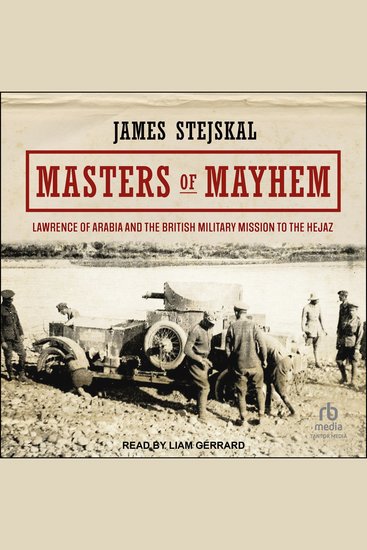
    Striking where the enemy is weakest and melting away into the darkness before he can react. Never confronting a stronger force directly, but using audacity and surprise to confound and demoralize an opponent. Operations driven by good intelligence, area knowledge, mobility, speed, firepower, and detailed planning, and executed by a few specialists with indigenous warriors—this is unconventional warfare. 


    T. E. Lawrence was one of the earliest practitioners of modern unconventional warfare. His tactics and strategies were used by men like Mao and Giap in their wars of liberation. Both kept Lawrence's Seven Pillars of Wisdom close at hand. This book examines the creation of the "Hedgehog" force, looks at the formation of armored car sections and other units, and focuses on the Hejaz Operations Staff, the Allied officers and men who took Lawrence's idea and prosecuted it against the Ottoman Turkish army, assisting Field Marshal Allenby to achieve victory in 1918. 


    Stejskal concludes with an examination of how Hedgehog influenced special operations and unconventional warfare, including Field Marshal Wavell, the Long Range Desert Group, and David Stirling's SAS.
    Voir livre
  • Nervous System Reset - Simple Techniques to Soothe Anxiety Relieve Stress and Reclaim Your Inner Peace - cover

    Nervous System Reset - Simple...

    Dr. Anna Calmer

    • 0
    • 0
    • 0
    Are you constantly battling stress and anxiety? Do you long for simple, effective ways to find calm amidst the chaos? 
    In Nervous System Reset, Dr. Anna Calmer, your expert guide to inner peace, offers a lifeline. Discover easy-to-implement techniques to soothe anxiety, relieve stress, and finally reclaim your inner calm. This practical book demystifies your nervous system, providing actionable exercises – from breathing and mindfulness to movement and lifestyle adjustments – that reset your system for lasting tranquility. 
    Learn to understand your stress triggers, balance your nervous system, and cultivate a peaceful state of being. Perfect for those seeking natural, effective solutions for stress and anxiety. 
    Ready to reset your nervous system and unlock lasting peace? Purchase your copy of Nervous System Reset today and begin your journey to a calmer, more centered you!
    Voir livre
  • Feeding the Nine Billion - Strategies for Global Food Security - cover

    Feeding the Nine Billion -...

    P Agrawal

    • 0
    • 0
    • 0
    This audiobook is narrated by an AI Voice.   
    Feeding the Nine Billion: Strategies for Global Food Security is a clear, practical, and hopeful roadmap for ensuring that every person can access nutritious food in a warming, crowded, and rapidly changing world. Written in simple, bookish language and grounded in real-world experience, it moves from the scale of a single farm to global markets and institutions, showing how the pieces fit together to create resilient, fair, and nourishing food systems. It opens with the central challenge—feeding a projected nine billion people—by unpacking what food security truly means: not only producing enough calories, but guaranteeing equitable access and balanced diets that support health, dignity, and opportunity. 
    The book surveys the current landscape of hunger and malnutrition, explaining why people go hungry even when the world grows enough food. It explores how conflict, climate shocks, poverty, weak infrastructure, and inequality disrupt access to meals, and it highlights the quiet crisis of hidden hunger—micronutrient deficiencies that limit learning, productivity, and well-being. With this foundation, the narrative turns to solutions that work on the ground: sustainable agriculture practices that build living soils, conserve water, reduce waste, and weave biodiversity into the heart of farming; and innovations in crop science, breeding, and biotechnology that add resilience to heat, drought, pests, and disease while improving taste, nutrition, and storage life.
    Voir livre
  • Australia - A History of the Land Down Under - cover

    Australia - A History of the...

    Lillian Brooks

    • 0
    • 0
    • 0
    Australia is a land of remarkable geological history, shaped over millions of years by natural forces. Its distinctive landscapes, vast deserts, tropical rainforests, and rugged mountain ranges offer a glimpse into the ancient past of the continent. The story of Australia's land begins long before human habitation, when it was part of the supercontinent Gondwana. 
    Approximately 300 million years ago, Gondwana began to break apart, and Australia, once connected to Antarctica, began its slow drift northward. Over millions of years, Australia became isolated, allowing unique plants and animals to evolve in this distant, isolated environment. This geological isolation contributed to the development of Australia’s unique biodiversity, with species found nowhere else on Earth. The landscape was sculpted by forces such as tectonic shifts, volcanic activity, and erosion, leading to the creation of natural wonders like the Great Barrier Reef, the outback, and the Blue Mountains. 
    When the first humans arrived on the continent, around 65,000 years ago, Australia’s land was already a place of immense natural beauty and complexity. The Aboriginal peoples, the continent’s first inhabitants, established deep and enduring connections to the land. For Indigenous Australians, the land is not just a physical space but a living, spiritual entity that is central to their cultural identity. This profound connection is expressed through stories, rituals, and a deep understanding of the natural world.
    Voir livre