

Rejoignez-nous pour un voyage dans le monde des livres!
Ajouter ce livre à l'électronique
Grey
Ecrivez un nouveau commentaire Default profile 50px
Grey
Abonnez-vous pour lire le livre complet ou lisez les premières pages gratuitement!
All characters reduced
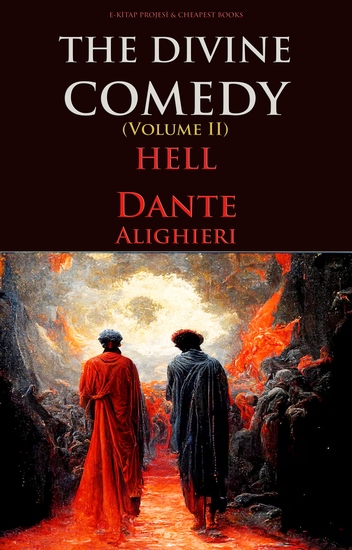
The Divine Comedy (Volume II) - Hell - cover

The Divine Comedy (Volume II) - Hell

Alighieri Dante, H. F. Cary

Maison d'édition: E-Kitap Projesi & Cheapest Books

  • 0
  • 0
  • 0

Synopsis

The Divine Comedy describes Dante's journey through Hell (Inferno), Purgatory (Purgatorio), and Paradise (Paradiso), guided first by the Roman poet Virgil and then by Beatrice, the subject of his love and of another of his works, La Vita Nuova. While the vision of Hell, the Inferno, is vivid for modern readers, the theological niceties presented in the other books require a certain amount of patience and knowledge to appreciate. Purgatorio, the most lyrical and human of the three, also has the most poets in it; Paradiso, the most heavily theological, has the most beautiful and ecstatic mystic passages in which Dante tries to describe what he confesses he is unable to convey (e.g., when Dante looks into the face of God: "all'alta fantasia qui mancò possa" — "at this high moment, ability failed my capacity to describe," Paradiso, XXXIII, 142).

"IN the midway of this our mortal life, I found me in a gloomy wood, astray Gone from the path direct: and e'en to tell It were no easy task, how savage wild That forest, how robust and rough its growth, Which to remember only, my dismay Renews, in bitterness not far from death.." (Dante)

IN the midway of this our mortal life,
I found me in a gloomy wood, astray
Gone from the path direct: and e'en to tell
It were no easy task, how savage wild
That forest, how robust and rough its growth,
Which to remember only, my dismay
Renews, in bitterness not far from death.


Yet to discourse of what there good befell,
All else will I relate discover'd there.
How first I enter'd it I scarce can say,
Such sleepy dullness in that instant weigh'd
My senses down, when the true path I left,
But when a mountain's foot I reach'd, where clos'd
The valley, that had pierc'd my heart with dread,
I look'd aloft, and saw his shoulders broad
Already vested with that planet's beam,
Who leads all wanderers safe through every way.

Then was a little respite to the fear,
That in my heart's recesses deep had lain,
All of that night, so pitifully pass'd:
And as a man, with difficult short breath,
Forespent with toiling, 'scap'd from sea to shore,
Turns to the perilous wide waste, and stands
At gaze; e'en so my spirit, that yet fail'd
Struggling with terror, turn'd to view the straits,
That none hath pass'd and liv'd. My weary frame
After short pause recomforted, again
I journey'd on over that lonely steep,
The hinder foot still firmer. Scarce the ascent
Began, when, lo! a panther, nimble, light,
And cover'd with a speckled skin, appear'd,
Nor, when it saw me, vanish'd, rather strove
To check my onward going; that ofttimes
With purpose to retrace my steps I turn'd.
Disponible depuis: 25/01/2024.
Longueur d'impression: 300 pages.

D'autres livres qui pourraient vous intéresser

  • The Tenderness of Silent Minds - Benjamin Britten and his War Requiem - cover

    The Tenderness of Silent Minds -...

    Martha C. Nussbaum

    • 0
    • 0
    • 0
    The human body is the primary instrument of war, yet those waging war often confront soldiers' bodies in a detached or merely intellectual way. In The Tenderness of Silent Minds, Martha C. Nussbaum, a leading thinker on emotion, morality, and justice, conducts a pioneering study of Benjamin Britten's musical representations of the tender male body amidst the brutality of war, and their ability to transform consciousness by evoking potent, non-personal emotions. 


    Offering a reading of Britten's views about the value and beauty of the body that situates these in the context of his thirty-nine year partnership with his lover, the singer Peter Pears, and also surveying pacifist themes in works written both before and after War Requiem, Nussbaum presents a compelling framework for critically assessing Britten's oeuvre. Nussbaum engages with a remarkably wide range of Britten's works, examining his treatment of aggression and its roots in his collaborations with the poet W. H. Auden, offering readings of the value placed on the body in early partnerships with Britten's beloved and singer Peter Pears, and surveying pacifist themes in Britten's earlier works. The analysis throughout is enriched with perspectives from Britten's personal letters and thoughtful study of the social and political backdrop of fear and homophobic disgust in mid-twentieth century Britain.
    Voir livre
  • Scandalous Vultures - Be Careful Who You Trust - cover

    Scandalous Vultures - Be Careful...

    Shantress Nicole

    • 0
    • 0
    • 0
    Be careful who you trust; no one is excluded — close companions, friends, and lovers a relationship that turns into betrayal and infidelity. Lies people tell to keep the peace and status the reality for 26-year-old Sherri is that she loves the wrong man that she has known since adolescence the rumors to blurred lies that have shaped her rage and personality the love of her life Lamont which rules the night and streets with the help of his brother. The question remains, who is loyal?
    Voir livre
  • Top 10 Poets – England The - The East - Five poems each from poets born in the English East - cover

    Top 10 Poets – England The - The...

    William Cowper, Amelia Opie,...

    • 0
    • 0
    • 0
    The language of Poetry is an art that most of us attempt at some point in our lives.  Although its commonplace exposure has been somewhat marginalised in today’s often fast-paced lives we all recognise good verse that can empathise with our thoughts or open us up to experience new things in new ways, to better understand and to enjoy the many strands of our lives. 
    But finding a starting point can be overwhelming, even off-putting, so in this series we offer up our Top 10 classic poets, who brim with talent and verse, on a range of subjects and themes that we can all enjoy. 
    For centuries England has always had a leading and admired reputation for its poets and poetry.  In this volume we explore those born in the East of England who created such revered, enduring and respected verse.
    Voir livre
  • The Poetry of Radclyffe Hall - Eton and Oxford educated lesbian pioneer and icon in modern literature - cover

    The Poetry of Radclyffe Hall -...

    Radclyffe Hall

    • 0
    • 0
    • 0
    Marguerite Radclyffe-Hall was born on August 12th, 1880 to wealthy parents who separated while she was still an infant.  Her parents thereafter paid little attention to her. Hall was educated privately, and then at King’s College London. Later she travelled to Europe, settling in Dresden, Germany.  With the death of her paternal grandfather she inherited a large estate and was then able to live as she pleased. 
    In Germany, Hall met Mabel Batten and fell in love despite the twenty-three year age difference. Batten gave Hall the nickname ‘John’ by which she was henceforward known in every circumstance throughout her life except in her work as an author. 
    In 1915, Hall met and, in 1917 moved in with sculptor Una Troubridge, with whom she would remain for the rest of her life. 
    Hall wrote poetry all throughout her twenties and thirties. She had published Dedicated to Arthur Sullivan as early as 1894, and five further volumes of collected works were released before she stopped writing poetry and published her first novel, The Forge, in 1924. 
    That same year also saw publication of The Unlit Lamp, the first work for which Hall was known as simply Radclyffe Hall. 
    The Well of Loneliness, the most important novel of Hall’s career, was published in 1928 to immediate sensation and controversy. It is Hall’s most direct artistic expression of her own personal sexual orientation. 
    After the controversy of The Well of Loneliness, Hall would publish only two more novels and a collection of short stories. 
    After years spent travelling in Italy and France and a series of long lasting affairs with other women (of which Troubridge was apparently aware), Hall retired with Troubridge to Rye, in East Sussex. Here, suffering from tuberculosis, she also underwent eye surgery and thereafter had difficulty reading and writing. 
    On October 7, 1943, Radclyffe Hall died from colon cancer at the age of sixty-three. She is buried in Highgate Cemetery in London. 
    This volume comes to you from Portable Poetry, a specialized imprint from Deadtree Publishing.  Our range is large and growing and covers single poets, themes, and many compilations.
    Voir livre
  • The Lover's Complaint - One of the greatest love poems ever written - cover

    The Lover's Complaint - One of...

    William Shakespeare

    • 0
    • 0
    • 0
    Despite William Shakespeare being regarded as the most significant figure in the Western literary canon, relatively little is known about his early life and his later ‘lost years’.  Even the exact date of his birth is uncertain. 23rd April generally accepted to be the date of his birth, could be a scholarly mistake amplified by the coincidence of it also being the date of his death.  
     
    What is known for certain is that Shakespeare was born to middle class, but probably illiterate parents, John and Mary, in Stratford-upon-Avon in 1565 and baptised there on the 26th April.  He was the third of eight children and the first and eldest surviving son of the remaining five.  
     
    It’s assumed he attended, King’s New School the nearby grammar school, but no records from the time still exist.  However, information on the standardised curriculum that did exist, introduced the young Shakespeare to the disciplines of mathematics, Greek, law, classical history and Latin which greatly influenced his writing. 
     
    At 18, in some haste, he married Anne Hathaway, his senior by 8 years and pregnant with their first child Susanna who was to be followed by the twins, Hamnet and Judith.   Little else is known until in 1590 Shakespeare probably comes to London as by 1592 he becomes relatively well known – first as an actor and then, of course, as a playwright despite some early criticism for having a writing style of his better educated contemporaries and not of his own lower status.  
     
    His iconic status now spans global literature and stems directly from the magnitude of his plays, both tragedies and comedies, and his poetry which is often cited as some of the greatest love poetry ever written.  His legacy endures despite the passing of centuries. 
     
    William Shakespeare died at Stratford-upon-Avon on the April 23rd, 1616.  He was 52.
    Voir livre
  • Laughing Boy - (stage version) - cover

    Laughing Boy - (stage version)

    Stephen Unwin

    • 0
    • 0
    • 0
    'So much magic. So much love. So much laughter. So much work. So much rage. And so many tears.'
    Connor is, well, Connor. He loves buses, Eddie Stobart and Lego. He also has learning disabilities. When he dies an entirely preventable death in NHS care, his mum, Sara, can't get a straight answer as to how it happened.
    But Sara and her family won't stop asking questions and soon an extraordinary campaign emerges. Demanding the truth, it uncovers a scandal of neglect and indifference that goes beyond Connor's death to thousands of others.
    Sara Ryan's impassioned, frank and surprisingly funny memoir Justice for Laughing Boy is adapted for the stage by Stephen Unwin. It was first performed at Jermyn Street Theatre, London, in 2024, in a co-production with Theatre Royal Bath.
    Voir livre
