Unisciti a noi in un viaggio nel mondo dei libri!
Aggiungi questo libro allo scaffale
Grey
Scrivi un nuovo commento Default profile 50px
Grey
Iscriviti per leggere l'intero libro o leggi le prime pagine gratuitamente!
All characters reduced
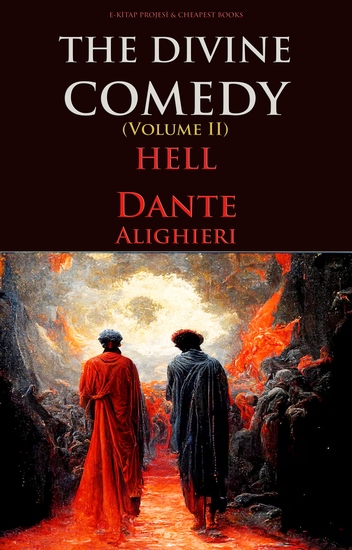
The Divine Comedy (Volume II) - Hell - cover

The Divine Comedy (Volume II) - Hell

Alighieri Dante, H. F. Cary

Casa editrice: E-Kitap Projesi & Cheapest Books

  • 0
  • 0
  • 0

Sinossi

The Divine Comedy describes Dante's journey through Hell (Inferno), Purgatory (Purgatorio), and Paradise (Paradiso), guided first by the Roman poet Virgil and then by Beatrice, the subject of his love and of another of his works, La Vita Nuova. While the vision of Hell, the Inferno, is vivid for modern readers, the theological niceties presented in the other books require a certain amount of patience and knowledge to appreciate. Purgatorio, the most lyrical and human of the three, also has the most poets in it; Paradiso, the most heavily theological, has the most beautiful and ecstatic mystic passages in which Dante tries to describe what he confesses he is unable to convey (e.g., when Dante looks into the face of God: "all'alta fantasia qui mancò possa" — "at this high moment, ability failed my capacity to describe," Paradiso, XXXIII, 142).

"IN the midway of this our mortal life, I found me in a gloomy wood, astray Gone from the path direct: and e'en to tell It were no easy task, how savage wild That forest, how robust and rough its growth, Which to remember only, my dismay Renews, in bitterness not far from death.." (Dante)

IN the midway of this our mortal life,
I found me in a gloomy wood, astray
Gone from the path direct: and e'en to tell
It were no easy task, how savage wild
That forest, how robust and rough its growth,
Which to remember only, my dismay
Renews, in bitterness not far from death.


Yet to discourse of what there good befell,
All else will I relate discover'd there.
How first I enter'd it I scarce can say,
Such sleepy dullness in that instant weigh'd
My senses down, when the true path I left,
But when a mountain's foot I reach'd, where clos'd
The valley, that had pierc'd my heart with dread,
I look'd aloft, and saw his shoulders broad
Already vested with that planet's beam,
Who leads all wanderers safe through every way.

Then was a little respite to the fear,
That in my heart's recesses deep had lain,
All of that night, so pitifully pass'd:
And as a man, with difficult short breath,
Forespent with toiling, 'scap'd from sea to shore,
Turns to the perilous wide waste, and stands
At gaze; e'en so my spirit, that yet fail'd
Struggling with terror, turn'd to view the straits,
That none hath pass'd and liv'd. My weary frame
After short pause recomforted, again
I journey'd on over that lonely steep,
The hinder foot still firmer. Scarce the ascent
Began, when, lo! a panther, nimble, light,
And cover'd with a speckled skin, appear'd,
Nor, when it saw me, vanish'd, rather strove
To check my onward going; that ofttimes
With purpose to retrace my steps I turn'd.
Disponibile da: 25/01/2024.
Lunghezza di stampa: 300 pagine.

Altri libri che potrebbero interessarti

  • Get Well Soon - Poems - cover

    Get Well Soon - Poems

    Jamie Sharpe

    • 0
    • 1
    • 0
    In the spring of 2020, Jamie Sharpe was in New Brunswick, purportedly studying the famed Magnetic Hill outside Moncton. A dog-walker discovered Sharpe in a ditch, disrobed except for his backpack containing a manuscript …
    		 
    With his fifth collection, Get Well Soon, Sharpe reaffirms “he is utter master of his language. Whether [Sharpe’s] poems are the result of long lucubration or the inspiration of the moment, they bear no mark of effort, and it is not without admiration, nor even without astonishment, that one is carried along — by the noble, unswerving amble of those gorgeous stanzas, proud white hackneys harnessed in gold — into the glory of the evenings. Rich and subtle, [Jamie Sharpe]’s poetry is never merely lyrical; it always encloses an idea within the garland of its metaphors, and however vague or general that idea may be, it serves to strengthen the necklace; the pearls are secured by a thread that, though sometimes invisible, is ever sure.”
    Mostra libro
  • This Way to Change - Poems Prose Practices - cover

    This Way to Change - Poems Prose...

    Jezz Chung

    • 0
    • 0
    • 0
    Artist, poet, and performer Jezz Chung (they/them) focuses on cultural change through personal transformation. In This Way to Change, Jezz shares contemporary poetry, accessible prose, and healing practices from different therapeutic modalities to explore subjects like healing your inner child, nourishing friendships, decolonizing your thinking, deconstructing binaries, and intentional community-making. The interactive healing practices in this book include writing and reflection prompts, somatic exercises, guided meditations, and more to help listeners tap into their powers of self-healing on their journey through change. 


    For anyone interested in: 


    ● Healing through the lens of race, gender, trauma, disability, and neurodivergence 


    ● Building community to address collective crisis, interdependence as the intersection of self care and community care 


    ● Transforming yourself to transform the world 


    ● Holistic and alternative approaches to wellness including guided meditations, reflection prompts, somatic practices 


    ● AAPI listeners interested in Jezz Chung's Korean American perspective on identity, sociopolitical engagement, and intergenerational trauma 


    ● Self-Love Poetry, Heart Talk, and such bestselling authors as Alexandra Elle and Yung Pueblo
    Mostra libro
  • Short Poetry Collection 014 - cover

    Short Poetry Collection 014

    Various

    • 0
    • 0
    • 0
    Librivox’s Short Poetry Collection 014: a collection of 20 public-domain poems.
    Mostra libro
  • Hue & Cry - cover

    Hue & Cry

    Deirdre Kinahan

    • 0
    • 0
    • 0
    Two Dublin cousins, Damian and Kevin, are reunited for a family funeral in a highly charged encounter full of disillusion, denial and dark laughter.
    Deirdre Kinahan's short play Hue & Cry was first staged by Tall Tales theatre company at Bewley's Café Theatre, Dublin, in 2007.
    Mostra libro
  • Heavy Is the Head - cover

    Heavy Is the Head

    Sumaya Enyegue

    • 0
    • 0
    • 0
    "Where does all the grief go when it's not tugging at your wrist?" Enyegue's debut collection is an ode to girlhood, to Blackness, to generational trauma, sexual assault, and mental health. 
     
    This collection does not aim to heal anyone who reads it, but instead help them confront their own healing. Rather than sugar-coated bullets that enter you lightly, these poems are designed to hurt.  
     
    They are for the girls with difficult names, the boys with softness at their core, and the people with neither. They are meant for the people who are Black, and the people who are not—because we are all tethered together by the heaviness of the human experience.
    Mostra libro
  • Ode on St Cecilia's Day - Pope is one of our greatest poets here he once again demonstrates his brilliant talents - cover

    Ode on St Cecilia's Day - Pope...

    Alexander Pope

    • 0
    • 0
    • 0
    Alexander Pope was born on May 21st, 1688 in London into a Catholic family.   
    His education was affected by the recent Test Acts, upholding the status of the Church of England and banning Catholics from teaching.  In effect this meant his formal education was over by the age of 12 and Pope was to now immerse himself in classical literature and languages and to, in effect, educate himself.    
    From this age too he also suffered from numerous health problems including a type of tuberculosis (Pott’s disease) which resulted in a stunted, deformed body.  Only to grow to a height of 4’ 6”, with a severe hunchback and complicated further by respiratory difficulties, high fevers, inflamed eyes and abdominal pain all of which served to further isolate him, initially, from society.  
    However his talent was evident to all. Best known for his satirical verse, his translations of Homer and the use of the heroic couplet, he is the second-most frequently quoted writer in The Oxford Dictionary of Quotations, after Shakespeare.  
    With the publication of Pastorals in 1709 followed by An Essay on Criticism (1711) and his most famous work The Rape of the Lock (1712; revised and enlarged in 1714) Pope became not only famous but wealthy.  
    His translations of the Iliad and the Odyssey further enhanced both reputation and purse.  His engagement to produce an opulent new edition of Shakespeare met with a mixed reception.  Pope attempted to "regularise" Shakespeare's metre and rewrote some of his verse and cut 1500 lines, that Pope considered to be beneath the Bard’s standard, to mere footnotes.  
    Alexander Pope died on May 30th, 1744 at his villa at Twickenham (where he created his famous grotto and gardens) and was buried in the nave of the nearby Church of England Church of St Mary the Virgin.   
    Over the years and centuries since his death Pope’s work has been in and out of favour but with this distance he is now truly recognised as one of England’s greatest poets.
    Mostra libro