Begleiten Sie uns auf eine literarische Weltreise!
Buch zum Bücherregal hinzufügen
Grey
Einen neuen Kommentar schreiben Default profile 50px
Grey
Jetzt das ganze Buch im Abo oder die ersten Seiten gratis lesen!
All characters reduced
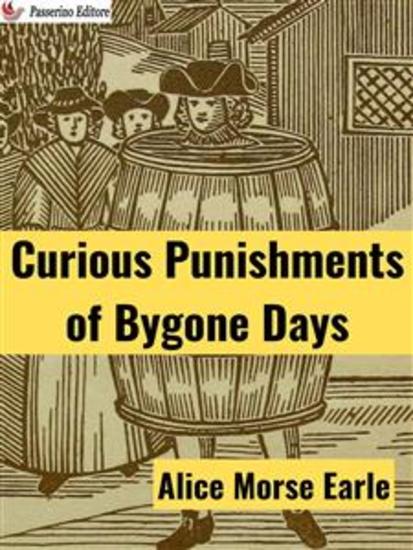
Curious Punishments of Bygone Days - cover

Curious Punishments of Bygone Days

Alice Morse Earle

Verlag: Passerino

  • 0
  • 0
  • 0

Beschreibung

Curious Punishments of Bygone Days is a history book published in 1896. It was written by Alice Morse Earle and printed by Herbert S. Stone & Company. Earle was a historian of Colonial America, and she writes in her introduction:

In ransacking old court records, newspapers, diaries and letters for the historic foundation of the books which I have written on colonial history, I have found and noted much of interest that has not been used or referred to in any of those books. An accumulation of notes on old-time laws, punishments and penalties has evoked this volume.

As the title suggests, the subject of the chapters is various archaic punishments. Morse seems to make a distinction between stocks for the feet, in the Stocks chapter, and stocks for the head, described in the Pillory article- which itself clashes with the modern day understanding of a pillory as a whipping post.

Alice Morse Earle (April 27, 1851 – February 16, 1911) was an American historian and writer from Worcester, Massachusetts.
Verfügbar seit: 18.04.2024.

Weitere Bücher, die Sie mögen werden

  • The Life of Ancient Romans - cover

    The Life of Ancient Romans

    Francis Caputo

    • 0
    • 0
    • 0
    In 27 BC, when Augustus turned into the first sovereign of the Roman Empire, introducing the supreme period, the country he governed was more than 700 years of age. Rome's rulers had controlled an immense region that stretched out into northern Europe, parts of Africa, and Asia for quite a long time. The city of Rome was the most delightful and refined on the planet. It was filled with parks and gardens, marble curves and sculptures, lavish royal residences, immense amphitheaters, and rambling colleges. All were connected by an unpredictable organization of streets furthermore water-bearing reservoir conduits. Rome was a focal point of world culture as the capital of the most impressive country on Earth. By AD 98, majestic Rome arrived at its most extreme size, becoming the most significant realm ever. The vast domain contained around 60 million individuals, or around one-fourth of Earth's populace. Romans, who spoke Latin, alluded to their properties as the imperium sine fine, or "domain without end." The realm extended through the advanced countries of Spain, France, England, Netherlands, and Germany. It incorporated quite a bit of eastern Europe, including Slovenia, Romania, Armenia, and what's more, Croatia. The domain without end spread across North Africa from Morocco to Egypt and east into Turkey, Syria, and Iraq. Every one of the regions was joined under the Roman principle, wherever the official language was Latin. All over the place, installments were made in sestertii (Roman brass coins). All over, there was just a single law: Roman law.Most Roman subjects lived in separated ancestral networks where life had changed minimally in millennia. Provincial Romans chased, fished, developed small harvests, and tended domesticated animals. During the royal period, London and Paris were minimal more than a few military stations with less than 8,000 individuals. A considerable lot of the inhabitants were Roman officers called legionnaires. In any case, the realm a
    Zum Buch
  • Heaven - cover

    Heaven

    Emerson Whitney

    • 0
    • 0
    • 0
    Emerson Whitney writes, "Really, I can't explain myself without making a mess." What follows is that mess-electrifying, gorgeous, defiant.
     
    At Heaven's center, Whitney seeks to understand their relationship to their mother and grandmother, those first windows into womanhood and all its consequences. Whitney retraces a roving youth in deeply observant, psychedelic prose-all the while folding in the work of thinkers like Judith Butler, Donna Haraway, and C. Riley Snorton-to engage transness and the breathing, morphing nature of selfhood.
     
    An expansive examination of what makes us up, Heaven wonders what role our childhood plays in who we are. Can we escape the discussion of causality? Is the story of our body just ours? With extraordinary emotional force, Whitney sways between theory and memory in order to explore these brazen questions and write this unforgettable book.
    Zum Buch
  • Swift Sword - The True Story of the Marines of Mike 3 5 in Vietnam 4 September 1967 - cover

    Swift Sword - The True Story of...

    Doyle Glass

    • 0
    • 0
    • 0
    Monday, 4 September 1967 
    Marine Lance Corporal Jack Swan crested the face of a bare, rocky knoll in 
    the Que Son Valley of South Vietnam. Following Swan were the 164 Marines of 
    Mike Company, Third Battalion, Fifth Marines, First Marine Division. Their 
    mission was to locate and rescue two understrength and isolated companies 
    of felow Marines who were under attack by the North Vietnamese Armv 
    The sight of a quiet and serene rice paddy and shrub covered valley greeted 
    Swan. Too serene, he thought, as he caught sight of a trembling bush. "I think 
    I just saw that bush move!" he shouted. "If it moves again, shoot it!" his squad 
    leader commanded he bush moved Swan hired. and the hush went down 
    Then hell on earth broke loose. 
    Rocket-propelled grenades, AK-47 fire, mortars, and machine guns engulfed 
    the exposed Marines. The vaunted 2nd NVA Division, six thousand, five hundred 
    men strong and expertly camouflaged, had sprung their well-laid trap. 
    Instead of coming to the rescue of their embattled comrades, it was now the 
    men of Mike 3/5 who were about to be annihilated. Burdened with a rifle, the 
    M16, that would often malfunction, how could they hope to beat back a vastly 
    superior foe bent on their destruction? 
    Outnumbered, out-gunned, and exposed, would any of the men of Mike 3/5 survive?
    Zum Buch
  • Medieval Ukraine: The History of Ukraine in the Middle Ages - cover

    Medieval Ukraine: The History of...

    Phaistos Publishers

    • 0
    • 0
    • 0
    Shortly before invading Ukraine in February 2022, President Vladimir Putin of Russia claimed that Russia and Ukraine were one nation artificially divided. In the previous year, he wrote an essay entitled On the Historical Unity of Russians and Ukrainians, in which claims that modern Ukraine is an “anti-Russian project,” a monstrosity turning its back on its heritage and borrowing culture for the corrupt West. This assessment may ring true to many Westerners, many of whom are unaware of the aspirations to Ukrainian nationhood until it declared its independence from the dying Soviet Union on August 24, 1991. 
    The Russian Federation and Ukraine do indeed share a common heritage, but their history and culture led them along divergent paths. Many readers might be surprised to learn that the historical center of Russia was not Moscow, but Kiev, the capital of modern Ukraine. In the 9th century, Norse traders and warriors, known as Varangians, settled along the Dnieper, Volga and other rivers between the Baltic and Black Seas. They imposed themselves – or, according to Russian folklore – were invited – upon the Slav inhabitants. According to The Primary Chronicle, a history written by the Varangians themselves, they brought order to a troubled land: “They said to themselves, ‘Let us seek a prince who may rule over us, and judge us according to the Law.” They accordingly went overseas to the Varangian Rus'. … The Chuds, the Slavs, the Krivichs and the Ves then said to the Rus', “Our land is great and rich, but there is no order in it. Come to rule and reign over us.’ They thus selected three brothers with their kinfolk, who took with them all the Rus' and migrated.”
    Zum Buch
  • Breaking Free of Habits - Easy Way Out With Small Changes Positive Results - cover

    Breaking Free of Habits - Easy...

    Dr. Elijah Pierce

    • 0
    • 0
    • 0
    Breaking Free of Habits by Dr. Elijah Pierce aims to help readers develop and maintain good habits that will lead to success in various aspects of life. The book provides a step-by-step guide to understanding the science of habit formation and offers practical strategies for building better habits that can transform individuals, teams, and organizations. 
    The author emphasizes the importance of small, incremental changes that can have a profound impact over time, and provides a framework for implementing these changes. By breaking down the habit loop readers can better understand the underlying mechanisms of their behavior and make intentional changes to their habits. 
    Through numerous examples, anecdotes, and scientific studies, Dr. Pierce demonstrates how habits shape our identity, influence our decision-making, and ultimately determine our success in life. He shows how good habits can compound over time to create significant progress, while bad habits can lead to setbacks and failures. 
    Whether readers are looking to improve their health, relationships, finances, or productivity, Breaking Free of Habits provides a practical and actionable guide to achieving lasting change. With its clear and engaging writing style, backed by research and real-world examples, this book is a valuable resource for anyone seeking to transform their habits and lead a more fulfilling life.
    Zum Buch
  • Robespierre - The Architect of the French Reign of Terror - cover

    Robespierre - The Architect of...

    Kelly Mass

    • 0
    • 0
    • 0
    Imagine you are sick of the government. Bureaucrats and aristocrats are constantly telling you what to do, basically enforcing a totalitarian regime. Maybe this is not so hard to imagine after what has been happening in recent years. And then imagine you protest. But the government has come up with a new method to kill people: The guillotine. Way more efficient than simple beheading, some jerk at the top then decides that anyone who is suspicious of rebellion needs their head chopped off, like the crazy lady in Alice in Wonderland. 
    This is Robespierre’s legacy. The evil French guy knew hardly any boundaries. He was vicious, murderous, and not to be taken lightly. 
    One of the most widely known figures of the Reign of terror was Maximilien François Marie Isidore de Robespierre, a French attorney and statesman. He promoted universal manhood suffrage and the removal of both clergy celibacy and oppression as a member of the Constituent Assembly and the Jacobin Club. In 1791, Robespierre ended up being a singing advocate of male residents without a political voice, promoting for their limitless entry to the National Guard, public workplaces, and the right to bear arms in self-defense. Robespierre was a key figure in the agitation that led to the deposition of the French monarchy on August tenth, 1792, and the assembling of a National Convention. His purpose was to establish a single, indivisible France, equality before the law, the abolition of authorities, and the defense of direct democratic ideal visions. 
    Read or listen to the book to learn more!
    Zum Buch