Rejoignez-nous pour un voyage dans le monde des livres!
Ajouter ce livre à l'électronique
Grey
Ecrivez un nouveau commentaire Default profile 50px
Grey
Abonnez-vous pour lire le livre complet ou lisez les premières pages gratuitement!
All characters reduced
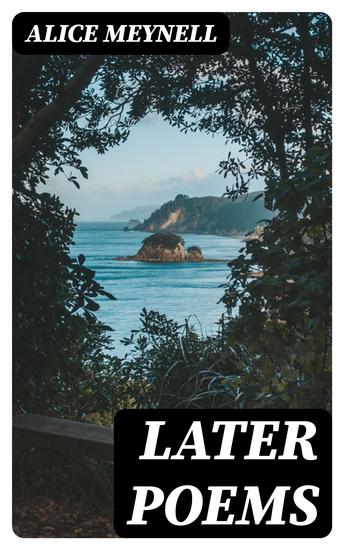
Later Poems - cover

Later Poems

Alice Meynell

Maison d'édition: DigiCat

  • 0
  • 0
  • 0

Synopsis

In "Later Poems," Alice Meynell showcases a refined blend of lyrical beauty and contemplative introspection that encapsulates the essence of her poetic evolution. Composed during a period marked by profound personal reflection and societal change, these poems resonate with themes of nature, faith, and the transient nature of existence. Meynell's distinctive literary style is characterized by her mastery of imagery and rhythm, conveying profound emotions through concise yet vivid language, all while reflecting the broader movement of late Victorian poetry that sought to merge art with deeper existential inquiry. Alice Meynell, a prominent figure of the late 19th and early 20th centuries, was not only a poet but also an influential critic and editor who championed the works of her contemporaries. Her literary journey is deeply intertwined with her experiences as a woman in a male-dominated landscape, and her exploration of faith and spirituality profoundly influenced her work. Her keen observations on the world, paired with personal trials and societal shifts, led Meynell to seek a poetic form that could articulate the complexities of human experience, profoundly mirrored in "Later Poems." I highly recommend "Later Poems" to enthusiasts of lyrical poetry and those interested in the exploration of the human condition through the lens of nature and spirituality. Meynell's eloquent verse offers an enriching experience that invites readers to ponder their own existence, making this collection a poignant addition to any literary archive.
Disponible depuis: 04/09/2022.
Longueur d'impression: 105 pages.
D'autres livres qui pourraient vous intéresser

  • SWANSEA AUTOMATIC (Second Edition) - cover

    SWANSEA AUTOMATIC (Second Edition)

    Rhys Trimble

    • 0
    • 0
    • 0
    "This book has shaped this piece of text [ITSELF] already—by neighbouring it (& in my mind) co-opted it, made it something other than an essay—part of SWANSEA culture—We obey these local rules slavishly—and fail to exploit them—[NOT SURE WHAT I'M ON ABOUT HERE]"Authorial violence: Swansea Automatic was published 10 years ago, around the last year of the snake to 0 acclaim except for by those who read it of course. I even did a little residency, which was more like squatting ina little shop on the High Street, Swansea but as time has passed, I came to consider this one of my few, if not only book that can boast the synthesis of my extreme late modernist tendencies and some attempt to fit into the aesthetic of popular fiction. nonetheless it doesn't pull too many punches, it's comedy, it's poetry, it's deconstructed pros,e even philosophy, textual analysis, cynghanedd, and more.Spinning Around the dirty first person narrative is the self-referential Vonegut and recycled psychogeographic of the Fiery Elephant of Johnson, Brooke-Rose, and Sinclair. An attempt to exercise the Demon of Swansea from my formative years. But actually set in North Wales just as much. Swansea is a dream city that could just as easily be London, Glasgow, Belfast, Lublin or Cairo...A second bite the cherry: a second edition is occurring, along with the audiobook and kindle edition and the album (movie!), hopefully generatinga hammer blow on the collective unconscious of our post-media universe. Swansea Automatic justifies itself to me because 2015 was also the very last gasp of the fin de siècle of the apocalyptic contemporary, where the post beats, post flaneur metanarratives where still just about alive. It's rare for me to look back, but I had an idea this one could be a cult book somehow. Help it become so and consume as such, cultishly. 
      
    RT
    Voir livre
  • Testament to Beauty - A former Poet Laureate demonstrates his poetic talents in this tender and beautiful verse - cover

    Testament to Beauty - A former...

    Robert Seymour Bridges

    • 0
    • 0
    • 0
    Robert Seymour Bridges, OM was born on 23rd October 1844 at Walmer in Kent where he spent his early childhood in a house overlooking the anchoring ground of the British fleet.  
    His father died aged only 47 in 1853. A year later his mother remarried and the family relocated to Rochdale, where his stepfather was the vicar.  
    In 1854 Bridges was sent to Eton College and attended until 1863.  After Eton he went to Corpus Christi College at Oxford. There he became good friends with Gerard Manley Hopkins and would later compile an edition of his poems that is now considered a major contribution to English literature. 
    He graduated from Oxford, in 1867, with a second-class degree in literae humaniores.  Initially he planned to join the Church of England and travelled to the Middle East to broaden his religious horizons.  However, he soon decided that life as a physician would be a better path and, after 8 months studying German (that being the language of many scientific papers at the time) he began his study of medicine at St. Bartholomew's Hospital in 1869.  His long-term ambition was that by the age of forty he could retire from medicine to devote himself to writing. 
    Unfortunately Bridges failed his final medical examinations in 1873 and, as unable to immediately retake the papers, spent six months in Italy learning Italian as well as immersing himself in its art. In July 1874 he went to Dublin to continue his medical studies. Re-examined in December he passed and became a house physician at St Bartholomew's Hospital. It was whilst here that he engaged in a series of highly critical remarks about the Victorian medical establishment. One such was his claim that whilst working as a young doctor he saw a staggering 30,940 patients in one year. 
    A bout of severe pneumonia and lung disease forced his retirement from the medical profession in 1882 and so, slightly ahead of schedule, he began his literary career in earnest.  He already been writing for several years and had published his first poetry collection in 1873.  
    After his illness and a trip to Italy, Bridges moved, with his mother, to Yattendon in Berkshire.  It was during this time, from 1882 to 1904, that Bridges wrote most of his best-known lyrics as well as eight plays and two masques, all in verse.  
    It was also here, in 1884, that he married Monica Waterhouse. They would go on to have three children and spend the rest of their lives in rural seclusion, in an idyllic marriage, first at Yattendon, then at Boars Hill, Oxford. 
    Bridges made an important contribution to hymnody with the publication in 1899 of his Yattendon Hymnal. This collection of hymns became a bridge between the Victorian hymnody of the late 19th century and the modern hymnody of the early 20th century. He was also a chorister at Yattendon church for 18 years. 
    In 1902 Monica and his daughter Margaret became seriously ill with tuberculosis, and a move from Yattendon to a healthier climate was in order. After several temporary homes they moved abroad to spend a year in Switzerland before returning to settle again in England at Chilswell House, which Bridges had designed, and built on Boar's Hill overlooking Oxford University.   
    His greatest achievement though was still some years ahead of him.  The office of Poet Laureate was held by Alfred Austin but with his death it was offered first to Rudyard Kipling, who refused it, and then to Bridges. He was appointed Poet Laureate in 1913 by George V, the only medical graduate to have ever held the office. Bridges, at this time, was neither highly regarded nor well known but a safe pair of hands in a World rapidly being overshadowed by the storms about to erupt over Europe and the First World War. 
    The events of this War, including the wounding of his son, Edward, had a sobering effect on Bridges' poetry. His work became fiercely patriotic. In 1915 edited a volume of prose and poetry, The Spirit of Man, intended to appeal to readers living in war time
    Voir livre
  • Born in England – Exploring English Poetry - The West Midlands - A celebration of English poems - cover

    Born in England – Exploring...

    Wilfred Owen, Michael Drayton, A...

    • 0
    • 0
    • 0
    Poetry. A form of words that seems so elegantly simple in one verse and so cleverly complex in another.  Each poet has a particular style, an individual and unique way with words and yet each of us seems to recognise the path and destination of where the verses lead, even if sometimes the full comprehension may be a little beyond us. 
     
    Through the centuries every culture has produced verse to symbolize and to describe everything from everyday life, natural wonders, the human condition and even in its more hubristic moments, the crushing triumph of an enemy. 
     
    In the volumes of this series, we take a look at poetry through the prism of individual regions of England, or sometimes more quaintly known as ‘Albion’, or ‘Blighty’, through the centuries of its gloried history. 
     
    England, despite its perception of reserve and under-statement has, in reality, strode the global stage at various time in many things, both good and bad, from Empire to long distance running. Here our focus in on its literature.  Famed for its fiction and dramas, it is equally admired for its plethora of gifted poets and the dazzling verse which has added so much to its artistic legacy.  These classic poets are wonders of their age and of their art.  Genius is written in their names. 
     
    In this volume we explore the West Midlands, land-locked, yet containing its second largest city, it is a cornucopia of landscapes and contrasts that make it distinct and yet a part of the whole.  And whether the poets are famous or obscure their talents remind us all of our inheritance of words.
    Voir livre
  • Useful Junk - cover

    Useful Junk

    Erika Meitner

    • 0
    • 0
    • 0
    A master of documentary poetry, Erika Meitner takes up the question of desire and intimacy in her latest collection of poems.In her previous five collections of poetry, Erika Meitner has established herself as one of America’s most incisive observers, cherished for her remarkable ability to temper catastrophe with tenderness. In her newest collection Useful Junk, Meitner considers what it means to be a sexual being in a world that sees women as invisible—as mothers, customers, passengers, worshippers, wives. These poems render our changing bodies as real and alive, shaped by the sense memories of long-lost lovers and the still thrilling touch of a spouse after years of parenthood, affirming that we are made of every intimate moment we have ever had. Letter poems to a younger poet interspersed throughout the collection question desire itself and how new technologies—Uber, sexting, Instagram—are reframing self-image and shifting the ratios of risk and reward in erotic encounters.With dauntless vulnerability, Meitner travels a world of strip malls, supermarkets, and subway platforms, remaining porous and open to the world, always returning to the intimacies rooted deep within the self as a shout against the dying earth. Boldly affirming that pleasure is a vital form of knowledge, Useful Junk reminds us that our selves are made real and beautiful by our embodied experiences and that our desire is what keeps us alive.
    Voir livre
  • A Rare Recording of Allen Ginsberg Reading His Poem "America" - cover

    A Rare Recording of Allen...

    Allen Ginsberg

    • 0
    • 0
    • 0
    Irwin Allen Ginsberg (June 3, 1926 - April 5, 1997), born in Newark NJ, was an American poet and writer. As a student at Columbia University in the 1940s, he began friendships with Lucien Carr, William S. Burroughs and Jack Kerouac, forming the core of the Beat Generation. He vigorously opposed militarism, economic materialism, and sexual repression, and he embodied various aspects of this counterculture with his views on drugs, sex, multiculturalism, and hostility to bureaucracy. "America" is a poem by Ginsberg written in 1956. 
    Voir livre
  • The Unfriend - (West End edition) - cover

    The Unfriend - (West End edition)

    Steven Moffat

    • 1
    • 1
    • 0
    'We're dying of manners. We're under siege from personal embarrassment. This is not sane. This is not rational. That woman is a monster!'
    While on holiday, Peter and Debbie befriend Elsa: a lusty, Trump-loving widow from Denver, USA. She's less than woke but kind of wonderful. They agree to stay in touch – because no one ever really does, do they?
    When Elsa invites herself to stay a few months later, they decide to look her up online. Too late, they learn the truth about Elsa Jean Krakowski. Deadly danger has just boarded a flight to London! But how do you protect all that you love from mortal peril without seeming, well, a bit impolite? Because guess who's coming... to murder!
    Steven Moffat's play The Unfriend takes a hilarious and satirical look at middle-class England's disastrous instinct always to appear nice. It was first performed at the Minerva Theatre, Chichester, in 2022, before transferring to London's West End – first to the Criterion Theatre, then to Wyndham's – in 2023.
    Steven Moffat is an award-winning writer whose internationally successful television shows include Doctor Who, Sherlock and Dracula – the latter two co-written with actor and writer Mark Gatiss, who made his stage directorial debut with The Unfriend.
    Voir livre