Join us on a literary world trip!
Add this book to bookshelf
Grey
Write a new comment Default profile 50px
Grey
Subscribe to read the full book or read the first pages for free!
All characters reduced
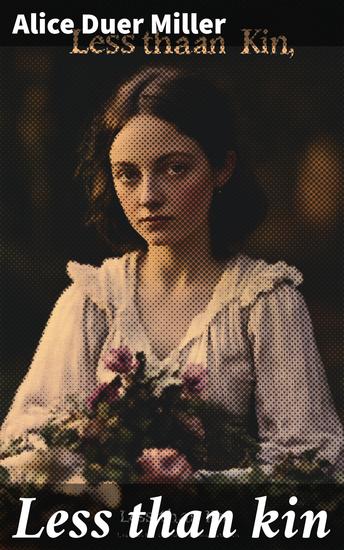
Less than kin - cover

Less than kin

Alice Duer Miller

Publisher: Good Press

  • 0
  • 0
  • 0

Summary

In "Less than Kin," Alice Duer Miller deftly weaves a complex narrative that explores the intricacies of familial relationships and the burdens that come with them. Written in a richly descriptive literary style, this novel is notable for its psychological depth and keen social commentary. Set against the backdrop of early 20th-century America, Miller delves into themes of identity, inheritance, and the societal expectations that shape individual choices, crafting a story that resonates with the readers' own experiences of loyalty and obligation within families. Alice Duer Miller was an accomplished writer and suffragist, experiences that undoubtedly informed her poignant exploration of women's roles in society and family dynamics. Her varied background—including poetry, essays, and activism—allowed her to inject feminism and social critique into her narratives. This multifaceted perspective enriches "Less than Kin," allowing Miller to illuminate how the societal constraints of her time clashed with personal desires and ambitions, revealing the often-unspoken burdens women bear in familial settings. "Less than Kin" is a compelling read for those interested in early 20th-century literature, as well as for anyone drawn to nuanced explorations of human connections and societal pressures. Miller's insightful portrayal of characters grappling with their identities makes this novel not only a reflection of its time but also a timeless meditation on the complexities of kinship and self-actualization.
Available since: 03/02/2025.
Print length: 200 pages.

Other books that might interest you

  • Notes From Underground - cover

    Notes From Underground

    Fyodor Dostoevsky

    • 0
    • 0
    • 0
    Dive into the mind of the Underground Man, a disillusioned and isolated figure who grapples with the complexities of existence in Fyodor Dostoyevsky's groundbreaking novel, Notes from Underground. First published in 1864, this novella is considered one of the earliest and most influential works of existentialist literature.In this haunting narrative, the Underground Man recounts his thoughts and experiences, revealing a soul in turmoil and a mind at odds with society. Through his confessions, Dostoyevsky explores themes of free will, alienation, and the darker aspects of human nature. The protagonist's internal battles and his critical perspective on the rationalist ideas of his time provide a profound commentary on the human condition.Notes from Underground is a timeless classic that delves into the depths of the human psyche, challenging readers to confront their own beliefs and assumptions. It remains a must-read for those seeking to understand the roots of existentialist thought and the enduring complexities of the human soul.
    Show book
  • The Legend of St Julian the Hospitaller - and Other Stories - cover

    The Legend of St Julian the...

    Maryland Allen, Lord Dunsany,...

    • 0
    • 0
    • 0
    Step into the captivating world of legendary tales with our digital audiobook collection, "The Legend of St. Julian the Hospitaller." Immerse yourself in a mesmerizing journey through time and imagination as you explore four timeless stories expertly narrated for your listening pleasure. 
     
    Dive deep into the realms of mystery and adventure with "The Urge" by Maryland Allen, where the boundaries between reality and the supernatural blur, leaving you on the edge of your seat with every twist and turn. 
     
    Transport yourself to the fantastical realm of Lord Dunsany's "The Sword of Welleran," where ancient swords wield unimaginable power and heroes rise to face unimaginable challenges, weaving a tapestry of courage and honor. 
     
    Experience the profound moral dilemmas and redemption in Gustave Flaubert's "The Legend of St. Julian the Hospitaller," as the nobleman Julian embarks on a quest for redemption, confronting the depths of his soul in a timeless tale of grace and salvation. 
     
    Delve into the rich tapestry of Rudyard Kipling's "The Tree of Justice," where justice is meted out beneath the spreading branches of an ancient tree, exploring themes of morality, retribution, and the human condition. 
     
     
    The Urge	Maryland Allen 
     
    The Sword of Welleran	Lord Dunsany 
     
    The Legend of St. Julian the Hospitaller	Gustave Flaubert 
     
    The Tree of Justice	Rudyard Kipling
    Show book
  • Thérèse Raquin - Audiobook - cover

    Thérèse Raquin - Audiobook

    Émile Zola, Classic Audiobooks,...

    • 0
    • 0
    • 0
    Thérèse Raquin is Émile Zola's chilling psychological novel about passion, guilt, and the destructive power of suppressed desire. Trapped in a loveless marriage, Thérèse begins a dangerous affair with her husband's friend, leading to a crime that will haunt them both. As their shared guilt festers, Zola examines the dark corners of human conscience with cold precision.Written in stark, naturalistic style, this early masterpiece shocked readers of the 19th century and still unsettles today. Thérèse Raquin is a gripping and tragic exploration of moral decay, suffocating domesticity, and the consequences of forbidden love.
    Show book
  • The Nine Billion Names of God - cover

    The Nine Billion Names of God

    Arthur C. Clarke

    • 0
    • 0
    • 0
    "The Nine Billion Names of God" is a 1953 science fiction short story by British writer Arthur C. Clarke. The story was among the stories selected in 1970 by the Science Fiction Writers of America as one of the best science fiction short stories published before the creation of the Nebula Awards. It was reprinted in The Science Fiction Hall of Fame, Volume One, 1929–1964.In a Tibetan lamasery, the monks seek to list all of the names of God. They believe the Universe was created for this purpose, and that once this naming is completed, God will bring the Universe to an end. Three centuries ago, the monks created an alphabet in which they calculated they could encode all the possible names of God, numbering about 9,000,000,000 ("nine billion") and each having no more than nine characters. Writing the names out by hand, as they had been doing, even after eliminating various nonsense combinations, would take another 15,000 years; the monks wish to use modern technology to finish this task in 100 days.They rent a computer capable of printing all the possible permutations, and hire two Westerners to install and program the machine. The computer operators are skeptical but play along. After three months, as the job nears completion, they fear that the monks will blame the computer (and, by extension, its operators) when nothing happens. The Westerners leave slightly earlier than their scheduled departure without warning the monks, so that it will complete its final print run shortly after they leave. On their way to the airfield they pause on the mountain path. Under a clear night sky they estimate that it must be just about the time that the monks are pasting the final printed names into their holy books. Then they notice that "overhead, without any fuss, the stars were going out."
    Show book
  • Life and Adventures of Jack Engle An Autobiography - cover

    Life and Adventures of Jack...

    Walt Whitman

    • 0
    • 0
    • 0
    Walter Whitman was an American poet, essayist and journalist. A humanist, he was a part of the transition between transcendentalism and realism, incorporating both views in his works. Whitman is among the most influential poets in the American canon, often called the father of free verse. His work was controversial in its time, particularly his 1855 poetry collection Leaves of Grass, which was described as obscene for its overt sensuality. Whitman's own life came under scrutiny for his presumed homosexuality.Born in Huntington on Long Island, as a child and through much of his career, he resided in Brooklyn. At age 11, he left formal schooling to go to work. Later, Whitman worked as a journalist, a teacher, and a government clerk. Whitman's major poetry collection, Leaves of Grass, was first published in 1855 with his own money and became well known. The work was an attempt at reaching out to the common person with an American epic. He continued expanding and revising it until his death in 1892. During the American Civil War, he went to Washington, D.C. and worked in hospitals caring for the wounded. His poetry often focused on both loss and healing. On the death of Abraham Lincoln, whom Whitman greatly admired, he wrote his well-known poems, "O Captain! My Captain!" and "When Lilacs Last in the Dooryard Bloom'd", and gave a series of lectures. After a stroke towards the end of his life, Whitman moved to Camden, New Jersey, where his health further declined. When he died at age 72, his funeral was a public event.Whitman's influence on poetry remains strong. Mary Whitall Smith Costelloe argued: "You cannot really understand America without Walt Whitman, without Leaves of Grass ... He has expressed that civilization, 'up to date,' as he would say, and no student of the philosophy of history can do without him." Modernist poet Ezra Pound called Whitman "America's poet ... He is America.
    Show book
  • This Side of Paradise (Book One: The Romantic Egotist) - cover

    This Side of Paradise (Book One:...

    F Scott itzgerald

    • 0
    • 0
    • 0
    Book One: The Romantic Egotist
    Amory Blaine, a young Midwesterner, believes that he has a great destiny, but the precise nature of this destiny eludes him. He attends a preparatory school where he becomes a football quarterback. He grows estranged from his eccentric mother Beatrice Blaine and becomes the protégé of Monsignor Thayer Darcy, a Catholic priest. During his sophomore year at Princeton, he returns to Minneapolis over Christmas break and falls in love with Isabelle Borgé, a wealthy debutante whom he first met as a boy. Amory and Isabelle embark upon a romance.
    Show book