Rejoignez-nous pour un voyage dans le monde des livres!
Ajouter ce livre à l'électronique
Grey
Ecrivez un nouveau commentaire Default profile 50px
Grey
Abonnez-vous pour lire le livre complet ou lisez les premières pages gratuitement!
All characters reduced
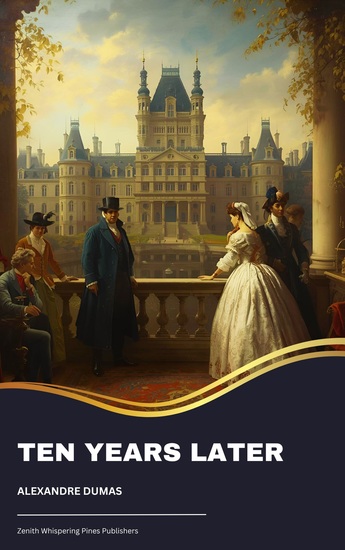
Ten Years Later - cover

Ten Years Later

Alexandre Dumas

Maison d'édition: Zenith Whispering Pines Publishers

  • 0
  • 0
  • 0

Synopsis

Ten years can change a kingdom—but not the courage of the Musketeers.
In this sweeping continuation of the D'Artagnan saga, old friends reunite as France stands on the edge of political upheaval. Intrigue brews around the young Louis XIV, secret plots move in the shadows, and every choice carries the weight of destiny. D'Artagnan, Athos, Porthos, and Aramis face battles of loyalty, ambition, and honor as alliances fracture and hidden enemies rise.

Praised as "one of Dumas's richest and most dramatic works," this novel blends adventure, romance, and political tension with the irresistible energy that made the Musketeers legendary. Readers love its vivid characters, fast-moving plot, and unforgettable emotional stakes.

If you crave grand adventure and the timeless heroism of the Musketeers, this gripping novel will keep you captivated to the final page.

Return to the world of swords, secrets, and honor—start reading now.
Disponible depuis: 02/12/2025.
Longueur d'impression: 583 pages.

D'autres livres qui pourraient vous intéresser

  • Five Children and It - cover

    Five Children and It

    Edith Nesbit

    • 0
    • 0
    • 0
    After moving into a house in kent, five children go exploring and in a gravel pit, find a Sand Fairy, known as a "Psammead" who says he will give them one wish each day. What follows are eleven misadventures where it is discovered that making a good wish is actually much harder than it first appears... The first in E.Nesbit's "The Psammead" trilogy, published in the Strand Magazine from 1902.  
    Narrated by Michael
    Voir livre
  • Moby Dick - cover

    Moby Dick

    Herman Melville

    • 0
    • 0
    • 0
    Dive into the heart of the sea with Moby-Dick, a timeless tale of adventure, obsession, and the relentless pursuit of the unattainable. Written by one of the greatest literary minds, this audiobook captures the riveting journey of Ishmael, a wanderer who joins the crew of the whaling ship Pequod. Led by the enigmatic and vengeful Captain Ahab, the ship's mission becomes a perilous chase for the elusive white whale, Moby Dick—a creature as mysterious as the ocean itself. 
    This audiobook masterfully blends gripping storytelling with profound reflections on humanity, nature, and the deep mysteries of life. With rich, immersive narration, every chapter unveils new challenges, philosophical musings, and the raw power of the sea. 
    Perfect for listeners who crave epic adventures and thought-provoking themes, Moby-Dick will transport you to a world of stormy seas, relentless ambition, and uncharted depths. Whether you're a lifelong fan or discovering this classic for the first time, this audiobook offers a captivating journey you won’t forget.
    Voir livre
  • Candide - cover

    Candide

    Voltaire

    • 0
    • 0
    • 0
    Candide, ou l'Optimisme is a French satire first published in 1759 by Voltaire, a philosopher of the Age of Enlightenment. The novella has been widely translated, with English versions titled Candide: or, All for the Best (1759); Candide: or, The Optimist (1762); and Candide: Optimism (1947). It begins with a young man, Candide, who is living a sheltered life in an Edenic paradise and being indoctrinated with Leibnizian optimism by his mentor, Professor Pangloss. The work describes the abrupt cessation of this lifestyle, followed by Candide's slow and painful disillusionment as he witnesses and experiences great hardships in the world. Voltaire concludes Candide with, if not rejecting Leibnizian optimism outright, advocating a deeply practical precept, "we must cultivate our garden", in lieu of the Leibnizian mantra of Pangloss, "all is for the best" in the "best of all possible worlds".
    Candide is characterized by its tone as well as by its erratic, fantastical, and fast-moving plot. A picaresque novel with a story similar to that of a more serious coming-of-age narrative (Bildungsroman), it parodies many adventure and romance clichés, the struggles of which are caricatured in a tone that is bitter and matter-of-fact. Still, the events discussed are often based on historical happenings, such as the Seven Years' War and the 1755 Lisbon earthquake. As philosophers of Voltaire's day contended with the problem of evil, so does Candide in this short theological novel, albeit more directly and humorously. Voltaire ridicules religion, theologians, governments, armies, philosophies, and philosophers. Through Candide, he assaults Leibniz and his optimism.
    Candide has enjoyed both great success and great scandal. Immediately after its secretive publication, the book was widely banned to the public because it contained religious blasphemy, political sedition, and intellectual hostility hidden under a thin veil of naïveté. However, with its sharp wit and insightful portrayal of the human condition, the novel has since inspired many later authors and artists to mimic and adapt it. Today, Candide is considered as Voltaire's magnum opus and is often listed as part of the Western canon. It is among the most frequently taught works of French literature. The British poet and literary critic Martin Seymour-Smith listed Candide as one of the 100 most influential books ever written.
    Voir livre
  • Picture of Dorian Gray The - Audiobook - cover

    Picture of Dorian Gray The -...

    Oscar Wilde, Classic Audiobooks,...

    • 0
    • 0
    • 0
    The Picture of Dorian Gray is a haunting exploration of beauty, morality, and the corrupting influence of unchecked desire. Oscar Wilde's only novel tells the story of Dorian Gray, a strikingly handsome young man who becomes the subject of a portrait by the artist Basil Hallward. Under the influence of the hedonistic Lord Henry Wotton, Dorian wishes for eternal youth, allowing the portrait to age and bear the marks of his sins instead of him.As Dorian descends deeper into a life of debauchery and moral corruption, his outward appearance remains flawless, but the portrait reflects the growing darkness of his soul. Wilde's masterful prose delves into themes of vanity, the duality of human nature, and the consequences of living without conscience.The Picture of Dorian Gray is both a captivating story and a profound meditation on art, morality, and the human condition. It remains one of the most celebrated works of English literature, resonating with readers across generations.
    Voir livre
  • Bleak House Volume 4 - cover

    Bleak House Volume 4

    Charles Dickens

    • 0
    • 0
    • 0
    In "Bleak House Volume 4," the saga reaches its gripping climax as long-hidden truths explode into the open. Esther Summerson's journey converges with Lady Dedlock’s fate, entwining love and tragedy in the shadows of the Chancery court. Dickens unravels the monumental Jarndyce and Jarndyce case, exposing societal decay with his penetrating insight. Amidst the ruin and redemption, this volume culminates in a powerful tapestry of justice, sacrifice, and enduring hope.
    Voir livre
  • The Murderer - Bulgakov expertly explores life and death choices set on the backdrop of the Bolshevik Revolution - cover

    The Murderer - Bulgakov expertly...

    Mikhail Bulgakov

    • 0
    • 0
    • 0
    Mikhail Bulgakov was born on 15th May 1891 in Kiev, in the Kiev Governorate of the Russian Empire, into a Russian family.  He was one of seven children. 
     
    In 1901, Bulgakov attended the First Kiev Gymnasium, and developed a keen interest in Russian and European literature, theatre and opera.  After the death of his father in 1907, his mother assumed responsibility for his education.  After graduating Bulgakov entered the Medical Faculty of Kiev University and then took up a post as physician at the Kiev Military Hospital. 
     
    At the outbreak of the First World War, he volunteered as a doctor and was sent directly to the front, where he was badly injured at least twice.  To suppress chronic pain, especially in the abdomen, he injected morphine.  It took years to wean himself off. 
     
    He now took up medical posts in various towns and in 1919, he was mobilised by the Ukrainian People's Army and assigned to the Northern Caucasus.  There, he became seriously ill with typhus and barely survived.  
     
    After this illness, Bulgakov abandoned his medicine to pursue writing.  He moved to Vladikavkaz and had two plays staged there with great success.  He wrote too for various newspapers and other outlets, but his critics were many.  And growing. 
     
    When a Moscow's theatre director severely criticised Bulgakov, Stalin personally protected him, saying that a writer of Bulgakov's quality was above ‘party words’ like ‘left’ and ‘right’.   Indeed, it is said that Stalin watched ‘The Days of the Turbins’ at least 15 times. 
     
    It was not to last and by March 1929, Bulgakov's career was ruined when Government censorship stopped publication of any of his work and plays. 
     
    In despair, Bulgakov wrote a personal letter to Stalin.  He requested permission to emigrate.  He received a phone call from the Soviet leader, who asked the writer whether he really desired to leave. He replied that a Russian writer cannot live outside of his homeland.  Stalin thus gave him permission to continue working. In May 1930, he re-joined the theater, as stage director's assistant.  
     
    During the last stressful decade of his life, and in poor health, Bulgakov continued to work on ‘The Master and Margarita’, wrote plays, critical works, stories, and continued translations and dramatisations of novels.  Many of them were not published, others were derided by critics.  
     
    On 10th March 1940, Mikhail Afanasyevich Bulgakov died from nephrosclerosis.  He was 48. 
     
    ‘The Master and Margarita’ was not published in any form until the mid-1960’s 
     
    Here Bulgakov relates a story as told by a doctor describing the terrible things that humanity is capable of doing in times of war.
    Voir livre