Unisciti a noi in un viaggio nel mondo dei libri!
Aggiungi questo libro allo scaffale
Grey
Scrivi un nuovo commento Default profile 50px
Grey
Iscriviti per leggere l'intero libro o leggi le prime pagine gratuitamente!
All characters reduced
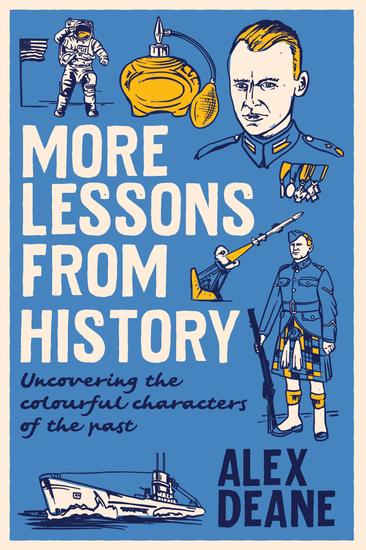
More Lessons from History - Uncovering the colourful characters of the past - cover

More Lessons from History - Uncovering the colourful characters of the past

Alex Deane

Casa editrice: Biteback Publishing

  • 0
  • 0
  • 0

Sinossi

"Fabulously entertaining, Alex Deane's wry, witty stories take hidden gems from our shared history and polish them until they shine. A must-read." – Iain Dale
"Ribald, riotous and sometimes surreal, Alex Deane's dispatches from the forgotten corners of history bring heroes and villains roaring vividly and often poignantly back to life." – Gavin Esler
"Alex Deane's tongue-in-cheek tales of eccentricity and endeavour not only shed light on the obscurest parts of history; they teach us things we never knew about the present." – Suella Braverman, Home Secretary
"More rollicking tales of fascinating figures who should not be lost to history – told with Alex Deane's warm empathy, shrewd insight and glistening wit." – Lord Parkinson, former special adviser to Prime Minister Theresa May
***
 
Welcome to another round of history's most absurd stories and the timeless lessons that come with them. In More Lessons from History, Alex Deane has unearthed yet more bizarre tales that you certainly haven't heard before. If you're wondering how large, flightless birds might organise themselves against a military regiment, how you should respond to the glare of an international rugby player whose glass eye you just knocked out, exactly why carrots are orange, or whether the world's worst-run battleship ever ceased firing upon her comrades-in-arms, then look no further.
 
In this second volume of his acclaimed series, Alex Deane reminds us that, throughout history, human nature has remained exactly the same, and the way that people responded to the most amusing, horrifying and convoluted of circumstances in the past can teach us everything we need to know about who we are today.
For even more lessons from history, check out Alex Deane's Hidden History Happy Hour podcast on Spotify, Google and Apple.
Disponibile da: 15/11/2022.
Lunghezza di stampa: 304 pagine.

Altri libri che potrebbero interessarti

  • Behind Academy Doors - Yuri Anime - cover

    Behind Academy Doors - Yuri Anime

    Rainbow Press

    • 0
    • 0
    • 0
    The things that go on behind closed doors… 
      
    Hanita and Oni — schoolmates, yes. But more?
    Mostra libro
  • Sulla and Caesar: The History of the Roman Republic’s Final Dictators - cover

    Sulla and Caesar: The History of...

    Editors Charles River

    • 0
    • 0
    • 0
    Julius Caesar is still remembered for winning a civil war and helping bring about the end of the Roman Republic, leaving a line of emperors in its place, but it’s quite possible that none of what Caesar did would’ve happened without the template for such actions being set 40 years earlier. At the time, when Caesar was in his teens, war was being waged both on the Italian peninsula and abroad, with domestic politics pitting the conservative, aristocratic optimates against the populist, reformist populares, and this tension ultimately escalated into an all-out war. One of the leading populares was Caesar’s uncle, Gaius Marius, a military visionary who had restructured the legions and extended the privileges of land ownership and citizenship to legionaries on condition of successful completion of a fixed term of service. In the late 2nd century B.C., Marius had waged a successful campaign against several Germanic tribes, and after earning eternal fame in the Eternal City, Marius was appointed a consul several times. In 88 B.C., he entered into conflict with his erstwhile protégé, the optimate Sulla, over command of the army to be dispatched against Mithridates VI of Pontus, a long-time enemy of Rome and its Greek allies.   
    	Ironically, Marius’s reforms had made the legions fiercely loyal to their individual generals rather than the state, which allowed Sulla to march his army against Rome and force Marius into exile. With that, Rome’s first civil war was officially underway, but Sulla’s triumph proved short-lived. Just as Sulla departed for a campaign, Marius returned at the head of a scratch army of veterans and mercenaries, taking over the city and purging it of Sulla’s optimate supporters, and though Marius died in 86 B.C., his party remained in power. After Sulla finished mopping up the last scraps of resistance, he intended to take back Rome for himself at the head of his legions. 
    Mostra libro
  • Jean-Paul Sartre - Existentialism and Human Freedom - cover

    Jean-Paul Sartre -...

    Hector Davidson

    • 0
    • 0
    • 0
    Jean-Paul Sartre, a towering figure in 20th-century philosophy, is perhaps best known for his development of existentialism, a school of thought that emphasizes individual freedom, choice, and the creation of meaning in an otherwise indifferent universe. Sartre’s philosophy arises from the existentialist tradition but distinguishes itself through its rigorous approach to human freedom and responsibility. At the heart of Sartre's thought is the idea that human beings are condemned to be free, burdened with the constant task of making choices without any external justification or predetermined essence. 
    Born in Paris in 1905, Sartre’s intellectual journey was shaped by early encounters with phenomenology and existential philosophy, especially through the works of Edmund Husserl and Martin Heidegger. However, it was his engagement with phenomenology, along with his studies in literature and politics, that laid the groundwork for his later ideas. Sartre’s major philosophical work, Being and Nothingness (1943), is considered one of the central texts of existentialist thought, where he explores the nature of existence, consciousness, and freedom in profound detail. 
    Sartre’s existentialism diverges from traditional metaphysical perspectives by rejecting the notion of an intrinsic human nature or essence. For Sartre, existence precedes essence, meaning that individuals are not born with any predefined purpose or identity; instead, they must create their essence through their actions and choices. This concept places the responsibility for defining oneself squarely on the individual, leading to Sartre’s famous assertion that "man is nothing else but what he makes of himself."
    Mostra libro
  • On Gaslighting - cover

    On Gaslighting

    Kate Abramson

    • 0
    • 0
    • 0
    "Gaslighting" is suddenly in everyone's vocabulary. It's written about, talked about, tweeted about, even sung about. It's become shorthand for being manipulated by someone who insists that up is down, hot is cold, dark is light—someone who isn't just lying about such things, but trying to drive you crazy. The term has its origins in a 1944 film in which a husband does exactly that to his wife, his crazy-making efforts symbolized by the rise and fall of the gaslights in their home. In this timely and provocative book, Kate Abramson examines gaslighting from a philosophical perspective, investigating it as a distinctive moral phenomenon. 


    Gaslighting, Abramson writes, is best understood as a form of interpersonal interaction, a particular way of fundamentally undermining someone. The gaslighter, Abramson argues, aims to make his target experience herself as incapable of reasoning, perceiving, or reacting in ways that would allow her to form appropriate beliefs, perceptions, or emotions in the first place. He seeks not only to induce in her this unmoored sense of herself but also to make it a reality. Using examples and analysis, Abramson gives an account of gaslighting and its immorality, and argues that such a discussion can help us understand other aspects of social life—from racism and sexism to the structure of interpersonal trust.
    Mostra libro
  • Swapped by a Bully - Gender Swap - cover

    Swapped by a Bully - Gender Swap

    Kinky Press

    • 0
    • 0
    • 0
    Bullies grow up – and not all of them change. 
      
    Peter has bulked up since his younger days. A chance meeting with a bully from his past leaves him with no doubt he now has the upper hand. They step outside for one last brawl, but his bully speaks, and Peter is enthralled. He finds himself unable to deny his bully any request, and he learns humiliation all over again. 
      
    Peter is transformed by a single word, molded into his bully's every desire and expected to please him in every way. 
      
    PSA: This story contains a man who does not get his way – and one who does. One is not eager to become a woman and give it all, but the other is fully expecting compliance. And he will get it. There will be mindless submission to men with complete mastery.
    Mostra libro
  • Communication Skills: Master the Art of Analyzing People Talk to Anyone with Confidence and Instantly Boost Your Social Intelligence - cover

    Communication Skills: Master the...

    Andy Gardner

    • 0
    • 0
    • 0
    Two: manuscripts in one audiobook:Communication Skills Training: How to Talk to Anyone about Anything and Immediately Improve Your Social Intelligence, Active Listening Skills, and Public SpeakingHow to Analyze People: Decoding Human Behavior and Body Language So You Can Read People like a Book Effortlessly 
    Communication Skills Training is a comprehensive guide showing readers how to get people to understand them and how they can understand others successfully. Learning how to get your point across and process the messages of others can allow you to maintain healthier relationships in life. 
    In the first part of this audiobook, you will:Find out the benefits of cultivating good communication skillsLearn how to be an active listenerExplore the roles of empathy, emotional awareness, and emotional intelligence in effective communicationUnderstand the effect that body language can have on the quality of your relationshipsDiscover how to master the art of storytelling 
    The second part will teach you how to read people like a book. It’s a wonderful blend between interesting information and practical knowledge that you can put to use. Use this as your go-to guide for social, professional, and romantic connections. 
    In the second part of this audiobook, you will learn to:Find out what a person’s behavior can tell youDecode a person’s tone and voice speed, attitude, and choice of wordsMaster the art of picking up non-verbal cuesUnderstand different personality typesDiscover why people lieIdentify when people are lying or being deceptiveAnd much, much more! 
    Click on the “add to cart” button now to unlock all the secrets about communication skills!
    Mostra libro