Join us on a literary world trip!
Add this book to bookshelf
Grey
Write a new comment Default profile 50px
Grey
Subscribe to read the full book or read the first pages for free!
All characters reduced
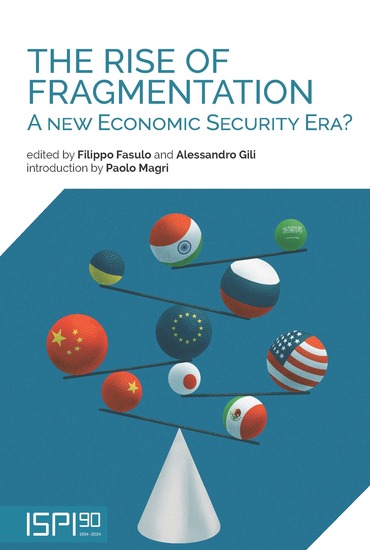
The Rise of Fragmentation - A New Economic Security Era? - cover

The Rise of Fragmentation - A New Economic Security Era?

Alessandro Gili, Filippo Fasulo

Publisher: Ledizioni

  • 0
  • 1
  • 0

Summary

Multiple crises have shaken the foundations of the global economy, and the resulting instability has yet to recover. Instead, it has led to increasing fragmentation along political and ideological lines. The current geoeconomic order is increasingly defined by the use of advanced trade defense and economic security tools, such as tariffs, trade barriers, sanctions, and export restrictions, which have become more sophisticated. Major economies are adapting to this new reality by shaping their own definitions of economic security, particularly to safeguard critical and high-tech sectors. The EU, the US, and China are each calibrating their economic security strategies, seeking a balance between openness and protection that maximizes their respective advantages. However, in this shifting international landscape, new actors are emerging with the potential to influence the global balance of power.
What type of "new globalization" is emerging? Could economic security tools become the new normal in the global economy? What are the key economic security strategies adopted by the world's leading economies?
Available since: 01/31/2025.
Print length: 138 pages.

Other books that might interest you

  • The Power of Privilege - cover

    The Power of Privilege

    June Sarpong

    • 0
    • 0
    • 0
    The death of George Floyd and subsequent Black Lives Matter protests have made clear to everyone the vicious reality of racism that persists today.  
    Many of those privileged enough to be distanced from racism are now having to come to terms with the fact that they continue to prosper at the detriment of others. Having spent the last four years researching, writing, and speaking about the benefits of diversity for society, June Sarpong is no stranger to educating and challenging those that have been enjoying the benefits of a system steeped in systemic racism without realising its true cost. 
    In The Power of Privilege, June will empower those fortunate enough not to be ‘otherised’ by mainstream Western society to become effective allies against racism, both by understanding the roots of their privilege and the systemic societal inequities that perpetuates it. The Power of Privilege offers practical steps and action-driven solutions so that those who have been afforded privilege can begin undoing the limiting beliefs held by society, and help build a fairer future for all. 
    In this top-rated self-help book, Sarpong delves into the science of social classes, economic disparity, and political relations, offering a global perspective on race and discrimination. The Power of Privilege is not just a motivational read, but an inspirational call to action for those who wish to challenge the status quo and contribute to a fairer society. 
    For fans of Matthew Desmond (Poverty, by America), Mary Ann Sieghart (The Authority Gap), Steve Silberman (Skeleton Key), Reni Eddo-Lodge (Why I’m No Longer Talking to White People About Race), and Laura Bates (Fix the System, Not the Women).
    Show book
  • Rare Earth Elements & Critical Minerals: Science Supply Chains & Statecraft - What They Do Why They Matter & What The Future Holds… - cover

    Rare Earth Elements & Critical...

    Dr. Nick Coman, I. A.I.

    • 0
    • 0
    • 0
    A 36‑lecture audio course on the materials that run the modern world—from ore bodies and brines to magnets, batteries, chips, and reactors. Each lecture focuses on one element or mineral, tracing its journey from deposit geology through beneficiation and refining to the devices it powers. 
    We make the flowsheet legible: comminution and flotation; roasting, high‑pressure acid leaching, solvent extraction, and ion exchange; separation to oxides and metals; alloying and specialty powders. See how neodymium‑iron‑boron magnets are born, why lithium hexafluorophosphate matters in electrolytes, where gallium nitride wins in power, how graphite anodes evolve with silicon, and how the uranium fuel cycle and vanadium flow batteries actually work. 
    Markets and politics are treated as engineering constraints. Learn to spot yield killers, read offtake agreements, and separate strategic scarcity from narrative. Test real substitutions—ferrites in small motors, sodium‑ion for short‑range storage, gallium nitride versus silicon carbide—and where performance cliffs block redesign. We map chokepoints beyond the mine: separation capacity, reagents, waste handling, water and energy intensity, and manufacturer qualification cycles. Then we follow the consequences—export controls and quotas, permitting and community consent, tariffs and friend‑shoring, standards and labeling rules. 
    Rigorous, narrative‑driven, and built for the intellectually ambitious, this course is an operator’s guide to the science, supply chains, and statecraft of a materials‑constrained century.
    Show book
  • Which Side of History? - How Technology Is Reshaping Our Democracy and Our Lives - cover

    Which Side of History? - How...

    James P. Steyer

    • 0
    • 0
    • 0
    "A valuable primer on this moment where humans are deciding how much power over their lives they give to monopolies and algorithms." -DAVE EGGERS, bestselling author of The CircleWhich Side of History? offers a collection of bold essays on how technology is affecting democracy, society, and our future.Featuring prominent national voices such as Sacha Baron Cohen, Marc Benioff, Ellen Pao, Ken Auletta, Chelsea Clinton, Tim Wu, Khaled Hosseini, Nicholas Kristof and Sheryl WuDunn, Jaron Lanier, Willow Bay, Sal Khan, Sherry Turkle, Shoshana Zuboff, Vivek Murthy, Geoffrey Canada, and many more.The essays focus on the extraordinary impact of technology on our privacy, kids and families, race and gender roles, democracy, climate change, and mental health.This groundbreaking audiobook challenges opinion leaders and the broader public to take action to improve technology's effects on our lives.With the rise of cyberbullying and hate speech online, issues around climate change and technology, and the "move fast and break things" mentality of tech culture, Which Side of History? will urge readers to draw the line. This book will help shape the conversations we have around technology in our society and our future for years to come.A smart gift for anyone who approaches tech and the future with a healthy skepticismEdited by James P. Steyer, the CEO and founder of Common Sense Media.Add it to the shelf with books like Ten Arguments for Deleting Your Social Media Accounts Right Now by Jaron Lanier, The Shallows: What the Internet Is Doing to Our Brains by Nicholas Carr, and The Age of Surveillance Capitalism: The Fight for a Human Future at the New Frontier of Power by Shoshana Zuboff.
    Show book
  • The China Freedom Trap - My Life on the Run - cover

    The China Freedom Trap - My Life...

    Dolkun Isa

    • 0
    • 0
    • 0
    From the president of The World Uyghur Congress, a nominee by Canadian and Finish parliamentarians for the Nobel Peace Prize, 2023
    		 
    Dolkun Isa was declared to be a terrorist by the Chinese Communist Party. His crime? Advocating for basic human, civil and religious freedoms for the people of East Turkestan. The country was taken over by the forces of the Chinese Communist Party in 1949. This was primarily achieved through persuasion as opposed to an armed invasion. What the leaders signed up for and were promised are why seventy years later, the Uygur people have been the subject of international headlines. Why have peaceful peoples been abused, terrorized and systematically used for slave labour and even murdered in camps by the Chinese Communist Party?
    		 
    In The China Freedom Trap, Dolkun Isa details his experiences working as an Uyghur political figure in the West and the barriers he has faced due to China's growing influence on liberal institutions. He describes his co-founding of the World Uyghur Congress and the ways in which China has attempted to disrupt and discredit Uyghur activism to further its agenda. Through its Transnational repression and significant influence in INTERPOL, China built a false narrative about Mr. Isa's work and life. Declaring him a separatist and terrorist, they convinced the agency to issue an INTERPOL Red Notice. That shadowed Isa for 21 years and almost cost him his life as he narrowly escaped extradition to China. During detention and deportation in democratic countries, Isa also finds himself uncovering corruption and peeling back the layers of the liberal institutions to see China at its rotting core.
    		 
    This book serves as a historical account of the political activities and behind-the-scenes diplomatic battles between China, the Uyghurs, and other interested or invested countries and institutions; a personal history of Isa’s struggle for the freedom of himself and his people; and ultimately, as a warning to other activists, policymakers, and interested parties: China's power and influence run more profound than most can fathom, they are growing, and they cannot be ignored.
    		 
    ABOUT THE AUTHOR
    		 
    Dolkun Isa is the President of the World Uyghur Congress.
    		 
    He was a student-leader in pro-democracy demonstrations at Xinjiang University in 1988. He founded the Students' Science and Culture Union at the university in 1987, working on programs to eliminate illiteracy, promote science and lead other students in East Turkistan. After enduring persecution from the Chinese government, he fled China in 1994, sought asylum in Europe, and became a German citizen in 2006. He has worked to mobilize the Uyghur diaspora community to collectively advocate for their rights. In 1997, an Interpol Red Notice was issued against him, deleted 21 years later, in 2018.
    		 
    Dolkun’s organization was nominated for the 2023 Noble Peace Prize, a testament to his dedication to enlightening the world about the plight of his fellow citizens from East Turkestan, better known as Xinjiang province.
    Show book
  • Locked Down Locked Out - Why Prison Doesn't Work and How We Can Do Better - cover

    Locked Down Locked Out - Why...

    Maya Schenwar

    • 0
    • 0
    • 0
    An analysis of the US prison system through real-life stories, and a look at the complex work of community-based social justice projects. 


    Through the stories of prisoners and their families, including her own family's experiences, Maya Schenwar shows how the institution that locks up 2.3 million Americans and decimates poor communities of color is shredding the ties that, if nurtured, could foster real collective safety. As she vividly depicts here, incarceration takes away the very things that might enable people to build better lives. But looking toward a future beyond imprisonment, Schenwar profiles community-based initiatives that successfully deal with problems—both individual harm and larger social wrongs—through connection rather than isolation, moving toward a safer, freer future for all of us. 


    "Maya Schenwar's stories about prisoners, their families (including her own), and the thoroughly broken punishment system are rescued from any pessimism such narratives might inspire by the author's brilliant juxtaposition of abolitionist imaginaries and radical political practices." —Angela Y. Davis, author of Are Prisons Obsolete?
    Show book
  • Saving Capitalism - For the Many Not the Few - cover

    Saving Capitalism - For the Many...

    Robert B. Reich

    • 0
    • 0
    • 0
    A Netflix Original Documentary 
     
    America was once celebrated for and defined by its large and prosperous middle class. Now, this middle class is shrinking, a new oligarchy is rising, and the country faces its greatest wealth disparity in eighty years. Why is the economic system that made America strong suddenly failing us, and how can it be fixed? 
     
    Leading political economist and bestselling author Robert B. Reich presents a paradigm-shifting, clear-eyed examination of a political and economic status quo that no longer serves the people, exposing one of the most pernicious obstructions to progress today: the enduring myth of the “free market” when, behind the curtain, it is the powerful alliances between Washington and Wall Street that control the invisible hand. Laying to rest the specious dichotomy between a free market and “big government,” Reich shows that the truly critical choice ahead is between a market organized for broad-based prosperity and one designed to deliver ever more gains to the top. Visionary and acute, Saving Capitalism illuminates the path toward restoring America’s fundamental promise of opportunity and advancement.
    Show book