Junte-se a nós em uma viagem ao mundo dos livros!
Adicionar este livro à prateleira
Grey
Deixe um novo comentário Default profile 50px
Grey
Assine para ler o livro completo ou leia as primeiras páginas de graça!
All characters reduced
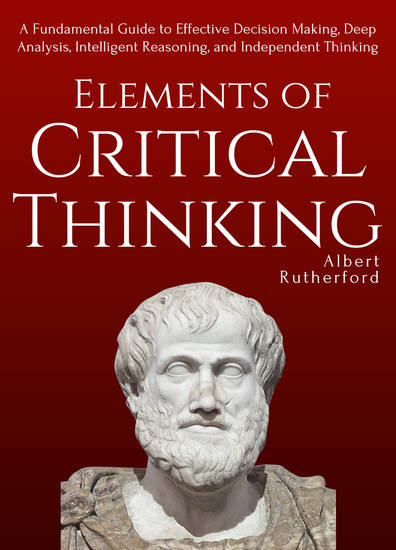
Elements of Critical Thinking - A Fundamental Guide to Effective Decision Making Deep Analysis Intelligent Reasoning and Independent Thinking - cover
LER

Elements of Critical Thinking - A Fundamental Guide to Effective Decision Making Deep Analysis Intelligent Reasoning and Independent Thinking

Albert Rutherford

Editora: Publishdrive

  • 0
  • 3
  • 0

Sinopse

Stay alert and avoid being tricked. Apply logic and analysis to your everyday life. Detect hidden assumptions, spot inconsistencies, and recognize dishonesty.The quality of our lives is determined by the quality of our thinking. And the quality of our thinking is often determined by the quality questions we ask from ourselves.Critical thinking is the art of asking relevant, necessary, and meaningful questions to discover the objective truth behind words, events, and opinions in general. Today we have more access to information than ever before. Information influences our world view and decisions often without us noticing it. Following wrong idols can lead us to bad decisions which lead to unhappiness and a dissatisfying life. When what’s “right, beautiful, successful, and cool” gets dictated around us we often forget to think for ourselves and make our own choices. Thus we make bad decisions based on the opinion of others – not even our own. Who should make your life choices for you? You’ve put your own thoughts, wishes, and opinions off for too long. It’s time for that to change.Elements of Critical Thinking provides you with unique insights into the nature of thinking and reasoning - why are we often so wrong, why we are so inclined to avoid the responsibility of thinking for ourselves, and how can we develop solid, objective patterns of thought. This book is a guide for the notoriously “trusting,” “overwhelmed,” and “gullible”. It is a deep psychological dive into what makes us stop thinking for ourselves, and how to systematically combat those compulsions. It’s a book that stands apart from others because of the plethora of real-life examples, studies, and solutions. If you wish to add to your critical thinking toolkit, you’ll find the step-by-step answer in here.
 
Elements of Critical Thinking lays out:
 
- The function of critical thinking and its main obstacles.- The varied elements of critical reasoning. - Important abilities and traits of critical thinkers. - The vocabulary of critical analysis, - The models essential to critical thinking.The most secure way of making good decisions is to have well-practiced and predictable strategies that you can use when you are faced with a problem that requires deeper analysis. This book will provide you with helpful exercises and tips to help you can find better solutions to your problems. - Learn the essential critical thinking skills when reading, writing, and speaking; - Be on your guard for hidden cognitive traps when shopping and interacting with advertisers. – Discover the tools and strategies can help you become a more disciplined thinker, developing your analytical, reasoning, and reflective thinking skills.
 
Be ready to learn. Be ready to argue intellectually.
 
- Learn to read between the lines and assess the validity of statements.- Identify and separate logical and illogical reasoning. - Learn how to construct a fair, well-reasoned argument with the help of formal and informal logic. As a physicist and computer scientist, I was always looking for logical, well-founded answers to questions. Yet, I needed to stay open to question my knowledge fairly often, revise my beliefs held, and unlearn some.
 
In this book I share the best of the best critical thinkers – intertwined with my own – to help you develop this essential skill that the contemporary job market so keenly demands. I will help you create thinking patterns that lead to a critical, and more objective understanding of the world.
Disponível desde: 06/03/2019.

Outros livros que poderiam interessá-lo

  • Political Economy - cover

    Political Economy

    John Ruskin

    • 0
    • 0
    • 0
    John Ruskin was a Victorian-era writer, art critic, and social thinker who wrote extensively on political economy. He was critical of the industrialization and capitalism that were taking hold in Britain during his time, and he believed that these developments were causing great harm to both the natural environment and human society. 
    Ruskin believed that the capitalist system was inherently flawed because it focused solely on maximizing profits and disregarded the well-being of workers, the environment, and society as a whole. He argued that the pursuit of wealth at all costs led to the exploitation of labor, the destruction of natural resources, and the degradation of art and culture. 
    In response to these problems, Ruskin advocated for a different economic system that was more in tune with the needs of people and the environment. He believed that the economy should be organized around the principles of social justice, sustainability, and community. 
    Ruskin's ideas were influential in the development of the Arts and Crafts movement, which sought to promote traditional crafts and design in opposition to the mass-produced goods of industrial capitalism. His critique of the capitalist system also influenced later socialist and environmental movements.
    Ver livro
  • Coming Clean - The Rise of Critical Theory and the Future of the Left - cover

    Coming Clean - The Rise of...

    Eric Heinze

    • 0
    • 0
    • 0
    What has gone wrong with the left—and what leftists must do if they want to change politics, ethics, and minds. 


    Leftists have long taught that people in the West must take responsibility for centuries of classism, racism, colonialism, patriarchy, and other gross injustices. Of course, right-wingers constantly ridicule this claim for its "wokeness." 


    In Coming Clean, Eric Heinzerejects the idea that we should be less woke. In fact, we need more wokeness, but of a new kind. Yes, we must teach about these bleak pasts, but we must also educate the public about the left's own support for regimes that damaged and destroyed millions of lives for over a century—Stalin in the Soviet Union, Mao Zedong in China, Pol Pot in Cambodia, or the Kim dynasty in North Korea. 


    Criticisms of Western wrongdoing are certainly important, yet Heinze explains that leftists have rarely engaged in the kinds of open and public self-scrutiny that they demand from others. Citing examples as different as the Ukraine war, LGBTQ+ people in Cuba, the concept of "hatred," and the problem of leftwing antisemitism, Heinze explains why and how the left must change its memory politics if it is to claim any ethical high ground.
    Ver livro
  • Economic Structures and Global Relations - Examining the Impact of Various Economic Systems on Global Stability (3 in 1) - cover

    Economic Structures and Global...

    Arlo Holders

    • 0
    • 0
    • 0
    This book bundle contains the following 3 titles: 
    - Mercantilism Explained: Mercantilism, a dominant economic theory from the 16th to the 18th century, played a pivotal role in shaping the economic and political landscape of early modern Europe. Rooted in the belief that a nation's wealth and power were measured by its stockpile of precious metals, particularly gold and silver, mercantilism emphasized the importance of maintaining a favorable balance of trade. Nations sought to maximize exports while minimizing imports, often employing protectionist policies to achieve this goal. This approach reflected the belief that global wealth was finite, creating fierce competition among nations to secure the largest share of resources and economic advantage. 
    - Communism vs. Capitalism: An economic system refers to the structure and methods a society uses to produce, distribute, and consume goods and services. It defines how resources are allocated, how wealth is distributed, and how economic decisions are made. Different societies have developed various economic systems over time, influenced by their unique historical, cultural, and political contexts. Among these systems, capitalism and communism are two of the most prominent and contrasting economic ideologies that have shaped the global landscape. 
    - Economic Impacts of Imperialism: Cultural and ideological factors also played a role in shaping imperialism. The belief in the superiority of certain civilizations over others justified the conquest and subjugation of indigenous peoples. Religion was another motivator, with missionary efforts often accompanying territorial expansion. Christianity, in particular, became a tool for legitimizing imperial control, as colonizing powers framed their endeavors as missions to civilize and convert native populations. 
    Ver livro
  • The Magic and Mayhem of Donald Trump - cover

    The Magic and Mayhem of Donald...

    Gretchen Wollert

    • 0
    • 0
    • 0
    In today’s deeply divisive political environment, the constant media storm pits Democrats against Republicans and liberals against conservatives, and drives narratives that describe Donald Trump as the worst president in American history who should be incarcerated forever for high crimes against society. But another segment of America believes Trump is the savior of the nation and worthy of sainthood. 
    What is the truth? Is there an acceptable reality somewhere within these two extremes? Can we know what actually guides Trump’s larger than life political persona? What really makes him tick? Is he worthy of the support of an American people desperately seeking the best for a nation in turmoil? 
    The Magic and Mayhem of Donald Trump lays out with uncommon clarity the reality of the Trump enigma. Known for his supreme self-confidence, inexhaustible ambition, braggadocio, arrogance, vanity, and knack for thriving amid conflict, Trump, who fights opponents with a fierce intensity that is often cruel and harsh, also possesses a firm but realistic sense of right and wrong influenced by a simple faith and bears a serious connection to everyday common people that springs from his past. 
    You will confidently discover, amidst the magic and the mayhem, the real man behind the myth. And in the process, you just might acquire a renewed or even novel appreciation for this American original.
    Ver livro
  • The Myth of Left and Right - How the Political Spectrum Misleads and Harms America - cover

    The Myth of Left and Right - How...

    Verlan Lewis, Hyrum Lewis

    • 0
    • 1
    • 0
    A groundbreaking argument that the political spectrum today is inadequate to twenty-first-century America and a major source of the confusion and hostility that characterize contemporary political discourse. 


    As American politics descends into a battle of anger and hostility between two groups called "left" and "right," people increasingly ask: What is the essential difference between these two ideological groups? In The Myth of Left and Right, Hyrum Lewis and Verlan Lewis provide the surprising answer: nothing. As the authors argue, there is no enduring philosophy, disposition, or essence uniting the various positions associated with the liberal and conservative ideologies of today. Far from being an eternal dividing line of American politics, the political spectrum came to the United States in the 1920s and, since then, left and right have evolved in so many unpredictable and even contradictory ways that there is currently nothing other than tribal loyalty holding together the many disparate positions that fly under the banners of "liberal" and "conservative." Cutting against the grain of most scholarship on polarization in America, this book shows why the idea that the political spectrum measures deeply held worldviews is the central political myth of our time and a major cause of the confusion and vitriol that characterize public discourse.
    Ver livro
  • The Shocking Truth about Social Movements - cover

    The Shocking Truth about Social...

    Zoey Fraisers

    • 0
    • 0
    • 0
    Social movements have shaped the course of history, challenging oppressive systems, advocating for change, and giving a voice to the marginalized. From civil rights struggles to labor movements, from feminist activism to climate change protests, these collective efforts have demonstrated the power of ordinary people to influence political, social, and economic landscapes. But what makes a social movement successful? Why do some fizzle out while others spark revolutions? This book explores the truth behind social movements—their origins, strategies, challenges, and impact on society.  
      
    Social movements arise from deep-seated grievances, often triggered by inequality, injustice, or political repression. When institutions fail to address these concerns, people come together to demand change. While some movements rely on peaceful protests, petitions, and advocacy, others take a more radical or even violent turn. The paths they take can determine their success or failure. Movements like the U.S. civil rights movement and India’s independence struggle succeeded through persistent, organized, and nonviolent resistance. In contrast, some movements collapse due to internal divisions, government crackdowns, or loss of public support.  
      
    In today’s digital age, technology has transformed activism. Social media has made it easier to mobilize large numbers of people, spread awareness, and hold those in power accountable. However, it has also given rise to misinformation, government surveillance, and fleeting activism that lacks long-term commitment. Movements that once took years to build can now emerge overnight, but sustaining them remains a challenge. 
    Ver livro